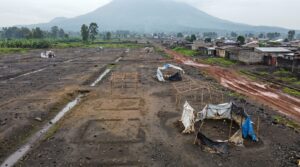

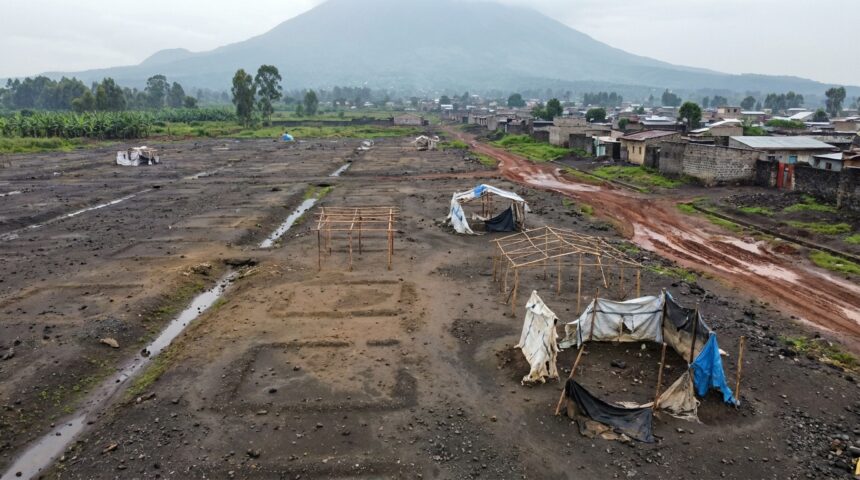
Where it stands: The camps that once ringed Goma are gone, emptied after the M23 and AFC capture of the city in January 2025 and a 72-hour evacuation order the following month.
Recorded displacement across the Democratic Republic of Congo has fallen from more than 7 million to 5.8 million, but Human Rights Watch and OCHA attribute much of that drop to forced returns rather than safety.
Access has narrowed again: MSF reported new restrictions on care for survivors of sexual violence in November 2026.
GOMA, Democratic Republic of Congo, November 23, 2026 — The Goma displacement camps that housed roughly 650,000 people before January 2025 no longer exist. The sites on the city’s outskirts were abandoned within weeks of the city changing hands, according to Human Rights Watch’s World Report 2026 and the International Organization for Migration.
IOM recorded more than 660,000 people re-displaced from sites in and around Goma and Nyiragongo between January and February 2025. The actor was the M23 armed group, operating within the Alliance Fleuve Congo (AFC) and supported by Rwandan Defence Forces, according to Human Rights Watch. What follows is the dated sequence, each entry attributed to the body that reported it.
January 27, 2025 — M23 and AFC forces take Goma
M23 and AFC forces captured Goma in late January 2025, and took Bukavu and Uvira in the weeks that followed, per Human Rights Watch’s DRC chapter. Camp administration passed to de facto authorities.
That transfer mattered more than it sounds. Supply routes into the city were severed and the registration framework humanitarian agencies had used to identify and supply displaced households stopped functioning, so agencies lost both the road and the list.
Before the offensive, IOM put the displaced population in makeshift sites around Goma at roughly 650,000 — the scale of what emptied over the following month.
February 2025 — the 72-hour order and the emptying of the camps
The camps emptied on an order. In February 2025, the de facto authorities instructed tens of thousands of displaced people in sites around Goma to leave within 72 hours and return to their places of origin. Human Rights Watch describes the order as unlawful; that is the organisation’s finding.
Virtually all the Goma displacement camps were abandoned. Hundreds of thousands moved north and west on foot, by motorbike and in shared minibuses, often walking for days without food or water, MSF reported through ReliefWeb.
“Given these massive movements, we deployed teams along the return routes… Everywhere, we found the same reality: health facilities that were already barely functional before the crisis were either abandoned or, at worst, destroyed or looted.”
— Anthony Kergosien, head of MSF’s mobile activities around Goma
Returnees, in other words, arrived in places with no clinic able to receive them.
February to April 2025 — water systems destroyed, warehouses looted
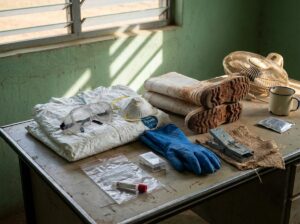
Fighters destroyed more than $700,000 worth of water and sanitation infrastructure — pipelines, latrines and storage tanks — according to Doctors Without Borders. Displaced people drank from contaminated streams instead, and cholera spread.
Humanitarian warehouses were looted in the same period, stripping agencies of pre-positioned food, medicine and medical supplies. Stock held inside a city can be moved in hours; stock that has to be re-imported travels along the same routes the fighting had already cut.
Aid stalling at the last mile rather than at the border is not unique to North Kivu — the same pattern appears in INQ Daily’s reporting on why aid is not reaching Mandalay.
Documented constraints on aid in North Kivu, 2025–2026
- Destruction of water and sanitation infrastructure worth more than $700,000, forcing use of contaminated streams (MSF)
- Looting of humanitarian warehouses, removing pre-positioned food, medicine and medical supplies (MSF)
- Severed supply routes into Goma, raising the cost and time of resupply (OCHA)
- Administrative rules imposed by the de facto authorities on medical care, including mandatory police reporting by patients (MSF, November 2026)
May 2025 — about 2,000 people moved from Sake to Goma
In May 2025, M23 forces rounded up approximately 2,000 people in the town of Sake and transferred them to Goma, according to Human Rights Watch, reportedly as part of an operation targeting suspected supporters of rival armed groups. That stated purpose is the reported claim, not a finding.
The episode changed the aid picture inside the city. Forced transfers create a displaced population in a place where no camp structure remains to receive it, so shelter, registration and food distribution fall to host families and unmapped informal sites.
Human Rights Watch documented summary executions and the arbitrary detention of activists in the same reporting period, which has shrunk the monitoring space that aid agencies rely on for independent verification.
Mid-2026 — recorded displacement falls to 5.8 million
A falling displacement figure is not evidence the crisis is easing. Internally displaced persons in the DRC peaked above 7 million in 2025 and stood at 5.8 million by mid-2026, per OCHA’s Global Humanitarian Overview 2026 and IOM reporting.
An estimated 1.9 million of that reduction came from returns to areas that remain insecure. Agencies treat the decline as a change in where people are counted.
The measurement consequence is straightforward: a family that leaves a registered site for a village with no working clinic, water point or market drops out of site-level data while its needs stay exactly where they were.
August 2026 — Ebola Bundibugyo reaches displaced populations
UNHCR reported in August 2026 that a spreading Ebola Bundibugyo outbreak had reached displaced populations, infecting at least 19 internally displaced people and killing five, according to UN News.
The mechanism links back to the destroyed water systems. People moving along return routes drink from untreated sources and pass through health facilities that were looted or abandoned, which is also how cholera, measles and mpox have spread among those on the move, per MSF and UNHCR. INQ Daily has tracked the DRC Ebola crisis spreading in North Kivu and the evacuation of an infected aid worker.
October 2026 — hunger figures and a €1.4 billion funding gap
Some 26.6 million people in the DRC face acute food insecurity in 2026, among the largest caseloads worldwide, driven by severed supply routes into Goma and by flooding that destroyed farmland in Kinshasa and Maniema, according to the World Food Programme and OCHA.
The 2026 response plan requires €1.4 billion for baseline needs and remains critically short, per the European Commission’s DRC humanitarian factsheet. Short-funded operations cut the geographic edges of their coverage first — and the edges are where returnees now live.
More than 4.18 million children aged 6 to 59 months are acutely malnourished, a pattern INQ Daily has also reported through UNICEF child hunger and displacement warnings elsewhere.
| Indicator | Figure | Source |
|---|---|---|
| People in need of humanitarian assistance | 14.9–18.5 million | OCHA, 2026 plan |
| People facing acute food insecurity | 26.6 million | WFP/OCHA |
| Children 6–59 months, acute malnutrition | 4.18 million | OCHA |
| Internally displaced persons, mid-2026 | 5.8 million | OCHA/IOM |
| Response plan funding requirement | €1.4 billion | European Commission (ECHO) |
November 17 to 23, 2026 — MSF reports new limits on care for survivors
MSF reported this month that the de facto authorities, now operating as the Front pour la Refondation de la Nation after the AFC/M23, have narrowed the definition of sexual violence, required survivors to undergo intrusive and medically unnecessary examinations, and mandated reporting to police before care is given.
A police-reporting requirement removes medical confidentiality. Survivors who fear exposure present late or not at all, and late presentation pushes cases past the 72-hour window in which post-exposure prophylaxis and emergency contraception work.
Aid workers told The World on November 17, 2026 that the DRC is among the hardest environments anywhere for responding to sexual violence. The same authorities control Goma as of this entry, a dispute that has drawn external pressure including Rwanda’s AGOA suspension and the DRC conflict.
What is expected next
The 2026 response plan is still short of its €1.4 billion requirement, and OCHA’s coordination cycle for the coming year will be set against a caseload the agency measures at 14.9 to 18.5 million people in need.
Operationally, the response has reorganised around roads rather than sites. MSF has restructured its mobile activities along return routes, and IOM continues tracking in areas where no registered site remains — the practical test of whether the people who left the Goma displacement camps can be reached at all.
Three indicators would mark a change, each held by a body that reports publicly: the restoration of medical confidentiality in North Kivu clinics, as monitored by MSF; unobstructed passage for resupply convoys into Goma, as reported by OCHA; and a decline in displacement that OCHA records as voluntary rather than forced return.