
Table of Contents
- What the Shahed-136 Is
- Shahed-136 Specifications at a Glance
- How the Shahed-136 Works, Step by Step
- The five-step Shahed-136 mission sequence
- Navigation and Anti-Jamming: Susanin, MOKh and the 32-Element Antenna
- Geran-2, Geran-4 and Geran-5: The Russian Upgrades
- Production Scale: 400–500 Airframes a Month
- Key figures: Shahed and Geran output, 2026
- The Cost-Exchange Problem
- How Air Defences Respond
- Counter-Shahed methods and their trade-offs
- The Chisinau Overflight: Minute by Minute
- Timeline: November 17, 2026, local time
- Diplomatic Fallout and What It Means for Moldova
- Frequently Asked Questions
- What is the Shahed-136 drone?
- How does the Shahed-136 actually work?
- Is the Geran-2 the same as the Shahed-136?
- Why did a Shahed drone fly over Chisinau?
- Why did Moldova close its entire airspace?
- How far can a Shahed-136 fly?
- How much does a Shahed-136 cost compared with a missile that shoots it down?
- Can electronic warfare or GPS jamming stop a Shahed drone?
- Why do Shahed drones sound like mopeds?
- What are the jet-powered Shahed variants?
- What Is Not Yet Confirmed
- Open questions as of November 18, 2026
- Conclusion
- References
Key takeaway: The Shahed-136 drone is a delta-wing, propeller-driven loitering munition built from foam and plywood that carries a 40–50 kg warhead up to 2,500 km at roughly 180 km/h. Russia builds it under licence as the Geran-2 at Yelabuga. One flew over Chisinau on November 17, 2026, forcing Moldova to close its entire airspace at 4:27 p.m.
CHISINAU, November 18, 2026 — A Shahed 136 drone operated by Russia crossed into Moldovan territory on the afternoon of November 17, 2026, and was filmed at low altitude over the capital’s Poșta Veche sector after visual sightings placed it moving north over Botanica. At 4:27 p.m. local time the Civil Aviation Authority (AAC) closed the entire national airspace on safety grounds; the central sector reopened at 5:03 p.m. Seven drones entered Moldovan airspace in total and five crashed inland. This explainer, part of INQ Daily world affairs coverage, sets out how the weapon works and why it reached a capital more than 200 km from the front line.
Reporting basis: All times are local. Event details are attributed to the Moldovan Ministry of Defence, the National Army Air Operations Center, the Civil Aviation Authority and Moldovan broadcaster TV8. Technical figures are open-source assessments, not manufacturer or state disclosures.
What the Shahed-136 Is
Definition: A Shahed 136 drone is a one-way attack aircraft — a loitering munition, commonly called a kamikaze drone — designed by Iran’s Shahed Aviation Industries and manufactured by HESA. It flies to pre-programmed coordinates and detonates its warhead on impact, which means the airframe is expendable by design.
Every other design choice follows from that disposability. Because the aircraft is consumed on each mission, it is assembled from foam, plywood and commercial-grade components rather than aerospace materials, which keeps unit cost low and allows output to scale into the hundreds per month. Russia operates the type under licence as the Geran-2. The combination of a delta-wing planform and a small piston engine produces a slow, low-altitude flight profile with an unmistakable acoustic signature — the reason residents of at least three Chisinau neighbourhoods identified the aircraft by sound on November 17 before any official statement was issued.
Shahed-136 Specifications at a Glance
The figures below describe the baseline Iranian-pattern airframe as assessed by the Missile Defense Advocacy Alliance system profile, drawn from open-source analysis rather than manufacturer data. Russian Geran variants deviate from this baseline, which the variant section addresses.
| Specification | Figure | Operational effect |
|---|---|---|
| Length | 3.5 m | Rail-launchable in stacks of five |
| Wingspan | 2.5 m | Delta wing, low radar cross-section |
| Warhead | 40–50 kg | Damages infrastructure, not hardened targets |
| Cruise speed | Approx. 180 km/h | Long warning time, trackable visually |
| Range | Up to 2,500 km | Reaches targets far behind the front line |
| Propulsion | Piston engine, pusher propeller | Moped-like acoustic signature |
| Primary materials | Foam and plywood | Low unit cost, mass production |
How the Shahed-136 Works, Step by Step
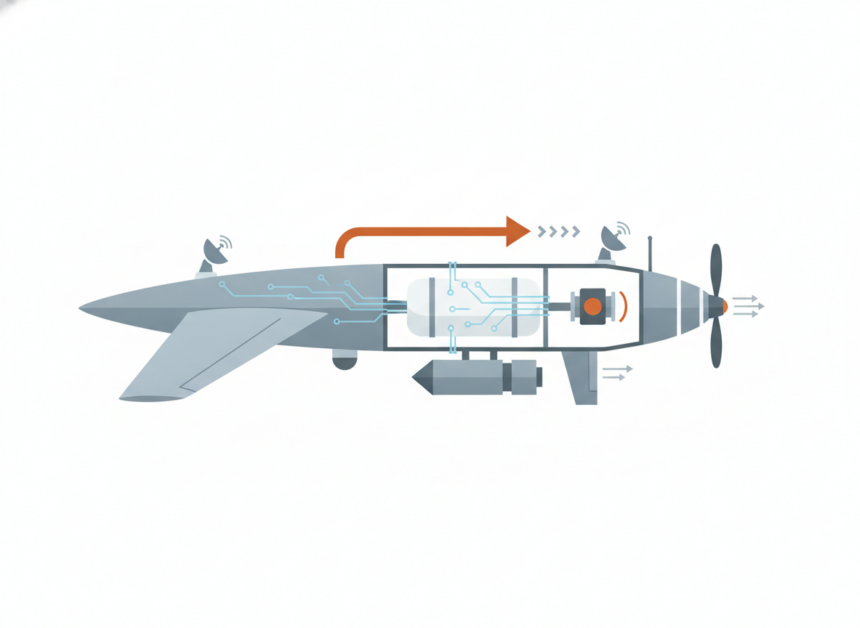
A Shahed 136 drone works by flying a pre-loaded route to fixed coordinates and detonating on arrival. It carries no sensor that selects a target in flight, which means the entire mission is decided before the airframe leaves the rail.
The five-step Shahed-136 mission sequence
- Programming: target coordinates and waypoints are loaded before launch, because there is no in-flight retargeting capability.
- Rail launch: a rocket booster accelerates the airframe off an inclined rail, after which the booster separates and falls away.
- Cruise: the piston engine drives a pusher propeller at roughly 180 km/h, normally at low altitude to stay beneath radar horizons.
- Navigation: satellite guidance backed by inertial measurement holds the route; newer variants add optical and magnetic correction.
- Terminal dive: the drone descends onto the programmed coordinates and the 40–50 kg warhead detonates on impact.
Because the route is fixed before launch, the weapon cannot react to a moving target or re-plan around a defended corridor. Its effectiveness therefore comes from volume and route-planning rather than precision — and that is why operators fly circuitous tracks that clip third-country airspace, the behaviour Moldova recorded on November 17.
Navigation and Anti-Jamming: Susanin, MOKh and the 32-Element Antenna
GPS jamming alone no longer reliably stops these drones, because the 2026 Geran variants carry redundant navigation that continues functioning when satellite signals are denied.
The Institute for Science and International Security reported in November 2026 that newer airframes carry the Susanin electro-optical correlation navigation system, which matches camera imagery against stored terrain references, alongside MOKh magnetic navigation support. The same assessment identified newly recovered 32-element anti-jamming antenna designs — controlled-reception-pattern arrays that null out interference arriving from known directions, which degrades spoofing and barrage jamming. The consequence is direct: as a result, defenders increasingly need a kinetic kill rather than a soft kill, and that raises the cost of every single intercept.
Geran-2, Geran-4 and Geran-5: The Russian Upgrades
The Geran-2 is the licence-built Russian Shahed-136, manufactured at the Yelabuga Special Economic Zone in Tatarstan. Russia has since replaced imported engines with locally produced turbojets on jet variants and, according to 2026 technical teardowns, redesigned airframes to carry heavier payloads. The effect is a shorter interception window: a jet-powered drone crosses a mobile gun team’s engagement envelope in a fraction of the time, therefore the gun-truck tactic that worked against propeller Shaheds degrades.
| Variant | Propulsion | Warhead | Interception window |
|---|---|---|---|
| Shahed-136 (Iranian baseline) | Piston, approx. 180 km/h | 40–50 kg | Wide |
| Geran-2 (Russian licence build) | Piston | 40–50 kg | Wide |
| Shahed-238 / Geran-4 | Turbojet | Reported up to 90 kg | Narrow |
| Geran-5 | Redesigned airframe | Reported up to 90 kg | Narrow |
Production Scale: 400–500 Airframes a Month
Key figures: Shahed and Geran output, 2026
- 400–500 airframes a month: estimated combined Iranian and Russian output in late 2026
- Approximately 3,500 drones: estimated Russian launches against Ukraine in September 2026 alone
- Yelabuga Special Economic Zone, Tatarstan: the licensed Geran-2 production site
These totals are external estimates compiled from Kyiv Independent reporting on Russian drone production and launch volumes, not disclosed production data. The consequence matters more than the precision of the figures: because monthly airframe output now exceeds the interceptor-missile production of most European air forces, saturation has become a routine tactic rather than an occasional surge. That volume is what pushes stray tracks across borders, which is how Moldovan and Romanian airspace ended up absorbing the November spillover.
The Cost-Exchange Problem
The Shahed-136 wins on arithmetic rather than performance, because intercepting a foam-and-plywood airframe with a modern surface-to-air missile destroys far more value than it saves.
| Engagement option | Relative unit cost | Limitation |
|---|---|---|
| Shahed-136 / Geran-2 airframe | Lowest | One-way, no retargeting |
| Surface-to-air missile intercept | Highest | Depletes scarce magazine depth |
| Interceptor drone | Low | Needs early detection and cueing |
| Mobile gun team | Lowest defensive | Short range, fails against jet variants |
A May 2026 analysis by the defence publication Quwa assessed that the Shahed programme has:
“imposed a cost-exchange ratio that no Western air defence architecture was designed to sustain.”
— Quwa, May 2026
Consequently, defenders are shifting spending toward cheap interceptors, guns and better early warning — the layering described next.
How Air Defences Respond
There is no single counter. Layered defence works because each method covers the failure mode of the one beside it.
Counter-Shahed methods and their trade-offs
- Interceptor drones — cheap per kill, but require accurate early cueing
- Mobile gun and MANPADS teams — lowest cost, but short range and largely ineffective against jet variants
- Surface-to-air missiles — highest reliability, but unsustainable cost per engagement
- GaN-based early-warning radar — detects low-flying, low-signature tracks, but detection alone does not stop a drone
- Electronic warfare and GPS denial — degrades older airframes, but is countered by optical and magnetic backup navigation
This layering logic, set out in CIMSEC analysis of counter-UAS economics, explains Moldova’s position. The National Army Air Operations Center detected and tracked the November 17 incursion from 3:49 p.m. onward, but the country fields no comparable kinetic layer. As a result, the available response was an airspace closure rather than an engagement — detection without interception.
The Chisinau Overflight: Minute by Minute
All times are local, drawn from Moldovan Ministry of Defence, National Army Air Operations Center and Civil Aviation Authority statements of November 17–18, 2026, as reported by Moldova 1.
Timeline: November 17, 2026, local time
- 3:49 p.m. — radar detects a Geran-2 entering Moldovan airspace from the direction of Grebenichi, Odesa region.
- The drone tracks toward Tiraspol in Transnistria, then exits back toward Ukraine.
- 4:02 p.m. — the same drone re-enters Moldova at Velîkoploske, heading for Mălăiești in Criuleni district.
- Visual sightings place a Shahed-type drone moving north over Chisinau’s Botanica sector.
- 4:27 p.m. — the Civil Aviation Authority closes the entire national airspace.
- 5:03 p.m. — the central airspace sector reopens.
- Seven drones in total entered Moldovan airspace; five crashed near Cheltuitori, Pohorniceni, Pohrebeni, Cuhureștii de Jos and Băxani.
The closure held a Sharm el-Sheikh–Chisinau passenger flight in a holding pattern above 3,000 metres near the Romanian border, while two further flights from Sharm el-Sheikh and Yerevan were diverted to land in Iași, Romania. TV8 journalists filmed the delta-winged drone at low altitude over the Poșta Veche sector, which supplied the visual confirmation behind the closure order.
Diplomatic Fallout and What It Means for Moldova
On November 18, 2026, the Moldovan Foreign Ministry summoned Russian Ambassador-designate Oleg Ozerov and handed him a formal protest note condemning the violation of Moldovan sovereignty, according to the ministry’s statement. President Maia Sandu said Moscow “cares neither about neutrality, nor sovereignty, nor human life.”
A constitutionally neutral state with radar coverage but no kinetic intercept layer has one practical lever when a drone appears over its capital, and that lever is the airspace itself. Closing it protects civil traffic but transfers the cost to passengers, airlines and Chisinau airport’s reliability — two diversions and one extended hold in a single afternoon. Repeated incursions therefore feed directly into Moldova’s air-defence procurement debate, because detection without engagement capability leaves closure as the default response. Readers can follow more INQ Daily reporting on security and conflict for further developments.
Frequently Asked Questions
What is the Shahed-136 drone?
A Shahed 136 drone is an Iranian-designed loitering munition that flies to fixed coordinates and detonates on impact. It measures 3.5 m long with a 2.5 m wingspan, carries a 40–50 kg warhead, and is built largely from foam and plywood to keep costs low. Russia produces it under licence as the Geran-2 at Yelabuga in Tatarstan.
How does the Shahed-136 actually work?
It flies a pre-programmed route to fixed coordinates and detonates on arrival. A rocket booster launches it from an inclined rail, then a piston engine drives a pusher propeller at roughly 180 km/h. Satellite guidance backed by inertial measurement holds the course. There is no in-flight retargeting, which means the mission is fixed before launch.
Is the Geran-2 the same as the Shahed-136?
Essentially yes — the Geran-2 is the Russian licence-built Shahed-136, produced at the Yelabuga Special Economic Zone in Tatarstan. Russian variants have since diverged through engine, antenna and payload changes, so later Geran-4 and Geran-5 models are no longer identical to the Iranian baseline design.
Why did a Shahed drone fly over Chisinau?
It crossed into Moldova during a large Russian bombardment of Ukraine on November 17, 2026. Radar detected it at 3:49 p.m. entering from the direction of Grebenichi, after which it tracked toward Tiraspol, exited, then re-entered at 4:02 p.m. from Velîkoploske before moving north over the Botanica and Poșta Veche sectors.
Why did Moldova close its entire airspace?
The Civil Aviation Authority closed all national airspace at 4:27 p.m. on safety grounds after a Shahed-type drone was visually confirmed over the capital. One inbound flight was held above 3,000 metres near the Romanian border and two were diverted to Iași, Romania. The central sector reopened at 5:03 p.m.
How far can a Shahed-136 fly?
Up to about 2,500 km, according to published open-source estimates. That radius places targets far behind the front line, and reaching them frequently involves flight paths that clip third-country airspace. This is why Moldova and Romania record repeated incursions during large-scale strike waves against Ukraine.
How much does a Shahed-136 cost compared with a missile that shoots it down?
Far less — the airframe costs a fraction of a modern surface-to-air missile. A May 2026 Quwa analysis assessed that the programme has “imposed a cost-exchange ratio that no Western air defence architecture was designed to sustain.” Consequently, defenders are shifting toward interceptor drones and gun teams to avoid spending missiles on plywood.
Can electronic warfare or GPS jamming stop a Shahed drone?
Not reliably against 2026 variants. The Institute for Science and International Security reported in November 2026 that newer Geran airframes carry the Susanin electro-optical correlation system, MOKh magnetic navigation support and 32-element anti-jamming antennas. As a result, a kinetic kill is now usually required instead of electronic disruption.
Why do Shahed drones sound like mopeds?
Because propulsion is a small piston engine turning a pusher propeller, producing a two-stroke buzz at low altitude. Residents of at least three Chisinau neighbourhoods identified the drone by that sound on November 17, 2026, before any official confirmation was issued — the acoustic signature arrives well ahead of the aircraft itself.
What are the jet-powered Shahed variants?
The Shahed-238 and the Russian Geran-4, which replace the piston engine with a turbojet. Higher speed narrows the interception window for mobile fire teams, which degrades gun-based defence. Reported Geran-4 and Geran-5 airframe redesigns carry warheads of up to 90 kg, roughly double the baseline figure.
What Is Not Yet Confirmed
The timeline, the airspace closure and the diplomatic protest are documented by Moldovan state bodies. Several technical and interpretive points are not.
Open questions as of November 18, 2026
- Variant identity: Moldovan statements describe a Geran-2, but no public teardown of the Chisinau airframe has established which navigation package it carried.
- Intent: Moldovan authorities have not determined whether the overflight was a routing choice, a navigation error or deliberate signalling.
- Specification spread: warhead, range and speed figures are open-source estimates that vary between production batches and between sources.
- Production and launch totals: the 400–500 per month and September 2026 figure of roughly 3,500 launches are external estimates, not disclosed data.
- Countermeasure effectiveness: published interception rates are claimed by combatants and are not independently verified.
Conclusion
The Chisinau overflight was not a technical surprise. It was the arithmetic working as designed: a weapon cheap enough to launch in the hundreds each month will, driven by sheer volume and circuitous routing, occasionally appear 200 km from the front over a neutral capital. The November 2026 navigation upgrades compound that, because an airframe that holds its route through jamming must now be shot down rather than talked down.
Two things deserve watching. The first is Moldova’s air-defence procurement debate, which the five crash sites of November 17 have made considerably harder to defer. The second is propulsion: every shift toward turbojet Geran-4 and Geran-5 airframes shortens warning times further, and the shahed 136 drone that passed over Poșta Veche at propeller speed represents the slowest version of this problem, not the fastest. Follow INQ Daily world affairs coverage for continued reporting.
References
- Moldovan Ministry of Defence and National Army Air Operations Center statements, November 17–18, 2026, as reported by Moldova 1 — https://moldova1.md
- Moldovan Civil Aviation Authority (AAC) airspace closure notice, November 17, 2026 — https://airlive.net
- Institute for Science and International Security, report on Geran navigation systems, November 2026 — https://isis-online.org
- Quwa, defence analysis on cost-exchange ratios, May 2026 — https://quwa.org
- Missile Defense Advocacy Alliance, Shahed-136 system profile — https://missiledefenseadvocacy.org
- Kyiv Independent, reporting on Russian drone production and launch volumes, 2026 — https://kyivindependent.com
- SeeNews / Moldovan Foreign Ministry statement, November 18, 2026 — https://seenews.com
- CIMSEC, analysis on counter-UAS and air defence economics — https://cimsec.org
- TV8 Moldova, footage of the drone over Poșta Veche, November 17, 2026 — https://tv8.md