
Table of Contents
- Key facts at a glance
- Milei confirms the 2027 bid
- The papal rebuke: Pope Leo XIV in Buenos Aires
- How the Casa Rosada and Victoria Villarruel responded
- The Falklands case: Argentina versus the Sea Lion project
- Where the race stands
- Why it matters for markets and for the region
- Timeline: from austerity to the 2027 bid
- Frequently asked questions
- What remains unverified
- The balance of the second act
- References
Key takeaway: Milei re-election 2027 is now official. Javier Milei confirmed on November 14, 2026, at the Museo de la Casa Rosada that he will seek a second term. Pope Leo XIV used the first papal visit to Argentina since 1987, from November 9 to 12, 2026, to criticise the human cost of the president’s austerity programme. Argentina filed for provisional measures at the International Tribunal for the Law of the Sea in October 2026 to halt the $2.2 billion Sea Lion oil project. Prediction-market odds on a Milei win fell from 56% in October to 44% by mid-November 2026.
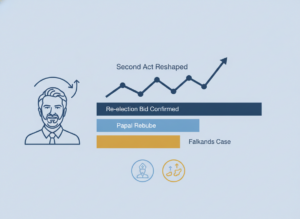
BUENOS AIRES, November 17, 2026 — President Javier Milei confirmed on November 14, 2026, at the Museo de la Casa Rosada in Buenos Aires, that he will contest next year’s presidential election. Milei re-election 2027 is therefore settled as a question of intent, and a Javier Milei second term is now the explicit organising goal of his government.
“For all those who doubt that I will run for re-election: yes, I will run for re-election,” the president said at the museum, where he was inaugurating the Belgrano, la revolución de las ideas exhibition during the capital’s “Museum Night”, according to the Buenos Aires Times.
Two forces are reshaping that campaign before it formally opens. Pope Leo XIV’s November 9-12 rebuke of austerity threatens Milei’s standing among Catholic and low-income voters, while the October filing against the Sea Lion oil project is a nationalist pivot that hardens Argentina UK relations at a delicate moment.
About this report: Dateline-led news analysis from the INQ Daily world affairs desk. Published November 17, 2026 by INQ Daily. All figures carry the date on which they were reported.
Transparency: This is a developing story. Trade and deregulation figures attributed to President Milei are his own claims, presented without published methodology. Prediction-market probabilities are traded prices, not opinion polling.
Key facts at a glance
These dated figures define the state of the Argentina 2027 general election as of November 17, 2026.
The 2027 race in six facts
- November 14, 2026 — Milei confirms his re-election bid at the Museo de la Casa Rosada, Buenos Aires
- November 9-12, 2026 — Pope Leo XIV visits Argentina, the first papal visit since 1987, and criticises the human cost of austerity
- October 2026 — Argentina files for provisional measures at the International Tribunal for the Law of the Sea in Hamburg (the Argentina ITLOS case)
- $2.2 billion — value of the Sea Lion oil project north of the Falkland Islands that Argentina wants halted
- 56% to 44% — fall in Polymarket Milei odds of a 2027 win between October and mid-November 2026
- $500 billion — the sum Milei claims deregulation will return to Argentine citizens in the coming years
Milei confirms the 2027 bid
The confirmation came in an unusual setting: a museum opening, not a party rally, with an audience gathered for a Belgrano exhibition rather than a campaign launch. Milei addressed the speculation head-on and removed it in a single sentence. Milei re-election 2027 therefore becomes the organising question of Argentine politics for the next eleven months, because every fiscal, monetary and diplomatic decision the Casa Rosada takes from here will be read through it.
“For all those who doubt that I will run for re-election: yes, I will run for re-election.”
— Javier Milei, Museo de la Casa Rosada, Buenos Aires, November 14, 2026
The timing is an investor-facing signal rather than an electoral one. Bond holders and foreign creditors needed assurance that Milei economic reforms and the fiscal adjustment are permanent rather than a single-term experiment, and ambiguity about the president’s future was itself a risk premium. Consequently Milei moved to close the question before the campaign season opened, which converts his austerity programme from a four-year episode into a stated eight-year project — the argument most likely to hold foreign capital in place through 2027.
He attached a concrete agenda to the bid. Milei said Argentina’s global trade reach has expanded from 10% to 30% of the world’s countries since he took office and set a target of 90% by 2031, and he projected that his deregulation drive could return $500 billion to Argentine citizens over the coming years, as reported in coverage of the announcement. These are the president’s own figures, issued without a published methodology, which means they should be treated as campaign claims rather than audited data.
The papal rebuke: Pope Leo XIV in Buenos Aires
The Pope Leo XIV Argentina visit ran from November 9 to 12, 2026, and was the first papal visit to the country since 1987, according to Associated Press coverage. That 39-year gap matters because Pope Francis, an Argentine, never returned home during his pontificate; therefore Leo XIV’s trip carried domestic weight no ordinary pastoral visit would have held.
“The economy must be at the service of the people, rather than people being at the service of the economy.”
— Pope Leo XIV, Palacio Libertad, Buenos Aires, November 2026
The papal rebuke of Milei austerity was delivered at the Palacio Libertad with the president seated nearby, as The Guardian reported. Beyond the line on the economy, the Pontiff named pensioners and people affected by disability specifically and observed that many Argentines, “despite hard work, nonetheless struggle to meet their household’s needs”. Because those two groups are precisely the constituencies hit by cuts to disability assistance and state welfare, the remarks functioned as an itemised critique of the adjustment rather than generalised social teaching.
The third strand was political conduct. Leo XIV urged the president and other leaders to “safeguard democracy” and to exercise a “careful use of words” — a passage read in Buenos Aires against Milei’s confrontational rhetoric. The electoral consequence is direct: in a majority-Catholic country, a papal critique of Milei austerity measures supplies the opposition with moral framing it could not generate on its own.
The three strands of the papal critique
- Economic shock therapy: the economy must serve people, not the reverse
- The vulnerable: pensioners and those affected by disability named directly
- Political conduct: a call to safeguard democracy and use words carefully
How the Casa Rosada and Victoria Villarruel responded
The Casa Rosada gave the visit a “positive assessment” and avoided direct confrontation, while Vice-President Victoria Villarruel reframed the Pope’s remarks as a broader call for “national unity”. The reasoning is straightforward: attacking a pope days after a historic visit would have cost the government more support than absorbing the criticism, therefore the administration chose reinterpretation over rebuttal.
The Falklands case: Argentina versus the Sea Lion project
In October 2026 Argentina filed a request for provisional measures with the International Tribunal for the Law of the Sea in Hamburg, seeking to halt development of the $2.2 billion Sea Lion oil project north of the islands on the stated grounds of preserving the country’s sovereign rights, according to Associated Press reporting. The Falkland Islands oil dispute has therefore moved from rhetorical assertion of the Malvinas sovereignty claim to active international litigation.
London rejected the filing within days. On October 13, 2026, Foreign Office Minister Uma Kumaran told the House of Commons that Argentina was attempting to use “measures beyond its jurisdiction” as a form of “economic coercion” against the Falkland Islanders, and restated that the Sea Lion field lies on the Falklands’ continental shelf and that the licensed activity is entirely lawful, per The Independent.
Argentina and the United Kingdom: the competing legal positions
| Dimension | Argentina’s position | United Kingdom’s position |
|---|---|---|
| Forum | ITLOS provisional measures, October 2026 | Measures “beyond its jurisdiction” |
| Sovereignty basis | Malvinas sovereignty claim | Falkland Islanders’ self-determination |
| Sea Lion licences | Exploitation of Argentine resources | Lawful continental-shelf activity |
| View of the other side | Resource grab in disputed waters | “Economic coercion” against islanders |
| Remedy sought | Halt development | No change; project proceeds |
The domestic function of the escalation is hard to miss. Milei has ruled out military action and is instead using prime-time national addresses to argue that the “winds of change” favour Argentina. Because large-scale oil production raises the economic stakes, the dispute hands the president a nationalist cause capable of uniting a fragmented electorate and deflecting attention from household economic pain — which is why the legal offensive and the re-election announcement arrived within weeks of each other rather than by coincidence.
Where the race stands
Milei re-election 2027 is not priced as a certainty. The probability of a Milei win fell from 56% in October 2026 to 44% by mid-November 2026, according to a November 16, 2026 report citing Polymarket. That twelve-point slide was driven by market turbulence and public backlash over welfare and disability cuts. These Polymarket Milei odds are traded prices set by a self-selected pool of participants, which means they are not equivalent to a Milei approval rating measured by survey and should not be read as one.
The opposition landscape remains unsettled. Buenos Aires province governor Axel Kicillof is the most prominent Peronist contender for 2027, operating within a fragmented field, and questions persist over whether Victoria Villarruel’s base aligns fully with the president’s. No primaries have been held, therefore the field is provisional.
The field as of November 2026
- Javier Milei (La Libertad Avanza) — incumbent, bid confirmed November 14, 2026
- Axel Kicillof — Buenos Aires province governor and leading Peronist contender for 2027
- A fragmented Peronist and centrist field — no declared primary calendar
- Victoria Villarruel — vice-president, positioned as a conciliatory voice rather than a declared rival
For the odds to recover, Milei needs visible improvement in real wages and inflation before the campaign formally opens, because the papal critique landed precisely on the constituency most exposed to the adjustment.
Why it matters for markets and for the region
Morgan Stanley analysts and bond investors have flagged the risk that a successor government abandons strict fiscal austerity, as CNN reported, which means Argentine debt pricing now tracks the election rather than the current fiscal accounts. The mechanism is simple: because the adjustment rests on executive discipline rather than entrenched legislation, a change of president removes the policy quickly, resulting in a repricing of sovereign risk that investors are attempting to anticipate eleven months early.
The bilateral cost runs the other way. The Falklands escalation hardens Argentina UK relations at the precise moment Buenos Aires needs external capital and open trade channels, therefore the nationalist pivot carries a measurable diplomatic price alongside its domestic political return. What is genuinely unresolved is how the tribunal in Hamburg handles the provisional-measures request and on what timetable, since no procedural schedule had been published as of November 17, 2026.
Timeline: from austerity to the 2027 bid
Six events between October and November 2026 defined the opening of the campaign.
Key dates, October to November 2026
| Date | Event | Why it matters |
|---|---|---|
| October 2026 | Argentina files ITLOS provisional measures over Sea Lion | Dispute moves into litigation |
| October 13, 2026 | UK minister Uma Kumaran rejects the filing in the Commons | London alleges “economic coercion” |
| October 2026 | Polymarket prices a Milei 2027 win at 56% | Baseline for the later slide |
| November 9-12, 2026 | Pope Leo XIV visits Argentina and criticises austerity | First papal visit since 1987 |
| November 14, 2026 | Milei confirms his re-election bid at the Casa Rosada museum | Signals policy continuity to creditors |
| November 16, 2026 | Reported prediction-market odds down to 44% | Twelve-point fall in six weeks |
Frequently asked questions
Has Javier Milei confirmed he will run for re-election in 2027?
Yes. On November 14, 2026, at the Museo de la Casa Rosada in Buenos Aires, Milei said: “For all those who doubt that I will run for re-election: yes, I will run for re-election.” He tied the bid to continued austerity, deregulation and trade expansion, confirming he will seek a Javier Milei second term.
When is Argentina’s next presidential election?
Argentina’s next presidential election falls in 2027, at the end of Milei’s four-year term that began in December 2023. Argentine presidential elections are held in October, with a run-off if no candidate meets the first-round threshold. No official date or primary calendar for the Argentina 2027 general election had been published as of November 17, 2026.
What did Pope Leo XIV criticise during his Argentina visit?
He criticised the human cost of Milei’s economic programme. Speaking at the Palacio Libertad with Milei present, Pope Leo XIV said “the economy must be at the service of the people, rather than people being at the service of the economy”, highlighted pensioners and people affected by disability, and urged leaders to safeguard democracy and use words carefully.
Why was Pope Leo XIV’s trip historic for Argentina?
It was the first papal visit to Argentina since 1987. Pope Francis, who was Argentine, never returned to the country during his pontificate, so Leo XIV’s November 9-12, 2026 trip ended a 39-year gap. That rarity amplified the political weight of his remarks on austerity in a majority-Catholic country.
What is the Sea Lion oil project and why does Argentina oppose it?
Sea Lion is a $2.2 billion Israeli-British offshore oil development north of the Falkland Islands. Argentina opposes it because it considers the waters part of its sovereign territory under the Malvinas sovereignty claim, which means it treats licensed drilling as unlawful exploitation of Argentine resources. The United Kingdom says the field sits on the Falklands’ continental shelf and the licences are lawful.
What legal action has Argentina taken over the Falkland Islands?
In October 2026 Argentina filed a request for provisional measures with the International Tribunal for the Law of the Sea in Hamburg. The filing asks the tribunal to halt development of the Sea Lion project to preserve Argentina’s claimed sovereign rights. The Argentina ITLOS case is a legal and diplomatic route; Milei has ruled out military action.
How has the United Kingdom responded to Argentina’s tribunal filing?
The UK rejected it outright. On October 13, 2026, Foreign Office Minister Uma Kumaran told the House of Commons that Argentina was attempting to use “measures beyond its jurisdiction” as a form of “economic coercion” against the Falkland Islanders, and restated that the Sea Lion field lies on the Falklands’ continental shelf and the project is entirely lawful.
What are Milei’s chances of winning in 2027?
Prediction markets priced a Milei win at 44% in mid-November 2026, down from 56% in October, according to a November 16, 2026 report citing Polymarket. The fall was driven by market turbulence and backlash over welfare and disability cuts. These are market prices rather than survey results, and with eleven months to the campaign they carry limited predictive weight.
Who are Milei’s main rivals for 2027?
Buenos Aires province governor Axel Kicillof is the most prominent challenger, leading the Peronist opposition to Milei’s programme. The wider field remained fragmented as of November 2026, with no primaries held and no formal candidacies declared beyond the president’s. Any list of rivals is therefore provisional until Argentina’s primary calendar is set.
What would happen to Argentina’s austerity programme if Milei lost?
Morgan Stanley analysts and bond investors have warned a successor government could abandon strict fiscal austerity. Because the adjustment rests largely on executive decisions rather than entrenched legislation, a change of president removes the policy quickly, which is why Argentine debt pricing now tracks the election. The scale of any repricing depends on who wins and on fiscal conditions in 2027.
What remains unverified
This is a developing story, and several of its central numbers are political claims or traded market prices rather than audited data.
Caveats on the figures in this report
- Milei’s trade figures (10% to 30% of the world’s countries, 90% by 2031) and the $500 billion deregulation claim are the president’s own statements and have no published methodology.
- Polymarket pricing reflects traded probability among a self-selected pool of participants, not a representative poll of Argentine voters.
- No ruling, hearing date or procedural timetable had been published for Argentina’s ITLOS provisional-measures request as of November 17, 2026.
- Quotations from Pope Leo XIV are drawn from reported coverage of the November 9-12 visit; full official transcripts were not available at publication.
- Argentina’s primary calendar and candidate registrations for 2027 are not yet set, so the opposition field is provisional.
- Figures and odds in this article are dated; readers should check for movement after November 17, 2026.
The balance of the second act
Milei confirmed the bid early to make austerity look permanent to creditors, but the same austerity is what Pope Leo XIV attacked at the Palacio Libertad and what pushed the president’s market-implied odds down twelve points in six weeks. Consequently the Milei re-election 2027 campaign rests less on rhetoric than on whether household conditions improve measurably before Argentines vote.
The Falklands dimension is the counterweight. Nationalist mobilisation over Sea Lion lifts domestic support at the cost of straining Argentina UK relations while Buenos Aires needs external capital — a trade-off the government has chosen deliberately. Follow developments through INQ Daily world affairs coverage.
References
- Buenos Aires Times — Milei’s November 14, 2026 confirmation of his re-election bid at the Museo de la Casa Rosada
- The Guardian — Pope Leo XIV’s remarks on the economy, pensioners and people affected by disability, November 2026
- Associated Press — First papal visit to Argentina since 1987 and the Casa Rosada’s assessment of the trip
- Associated Press — Argentina’s October 2026 ITLOS filing against the $2.2 billion Sea Lion project
- The Independent — UK Foreign Office Minister Uma Kumaran’s October 13, 2026 House of Commons response
- Thursday Times — November 16, 2026 report citing Polymarket on the fall from 56% to 44%
- CNN — Investor and analyst concern over fiscal continuity after 2027
- News Argentina — Milei’s trade expansion claims and the $500 billion deregulation projection