
Table of Contents
- What the James Webb hidden planet story actually is
- Why planets vanish inside telescope images
- How FLIP works: a digital twin of Webb
- Step one: model the optics, not the picture
- Step two: fit millions of parameters
- Step three: subtract the glare and see what is left
- No, the image was not generated by AI
- The numbers: 2x to 15x more sensitive, zero new hardware
- What this rewrites for archival data
- The next target: Earth-like worlds and the Habitable Worlds Observatory
- Frequently asked questions
- Limits of the result, and what would disprove it
- Sources and method
- References
- Related Reading
Key takeaway
>
The James Webb hidden planet story is a recovery, not a first discovery: 51 Eridani b was already known from ground-based imaging in 2014. What is new is FLIP (Physics-based Learning for Imaging Planets), software published in Nature on 4 November 2026 by a Northwestern University/CIERA team, which builds a digital twin of JWST’s NIRCam optics and subtracts residual starlight. The result: 2x to 15x better sensitivity to faint planets, with zero hardware changes.
EVANSTON, Illinois, November 16, 2026 — Astronomers at Northwestern University’s Center for Interdisciplinary Exploration and Research in Astrophysics (CIERA) pulled the James Webb hidden planet 51 Eridani b out of two-year-old archival JWST NIRCam observations using new software called FLIP, in a study published in Nature on 4 November 2026. According to the Northwestern University announcement, the method improved sensitivity to faint planets by 2 to 15 times with no change to the telescope itself, which means the gain is computational and applies retroactively to data already collected. 51 Eridani b is not a new world — it was first directly imaged from the ground in 2014 — so the news is that Webb’s own observations contained the planet and standard processing could not see it. Because the improvement comes from modelling the optics rather than buying scarce observing time, the technique is already feeding into the design case for NASA’s proposed Habitable Worlds Observatory.
Reported by the INQ Daily news desk. Corrections and source queries: via the INQ Daily homepage.
What the James Webb hidden planet story actually is
No new planet was discovered — a known planet was recovered from data that had already been taken. Headlines described a “hidden planet” because the object was hidden inside JWST’s own dataset, not hidden from astronomy as a whole.
The history matters here. 51 Eridani b was first directly imaged in 2014 by a ground-based instrument, according to NASA’s exoplanet catalog, which means its existence, orbital position and approximate mass were established well before Webb looked at the system.
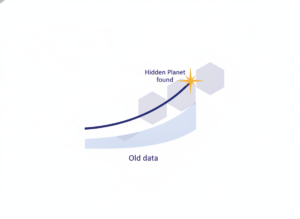
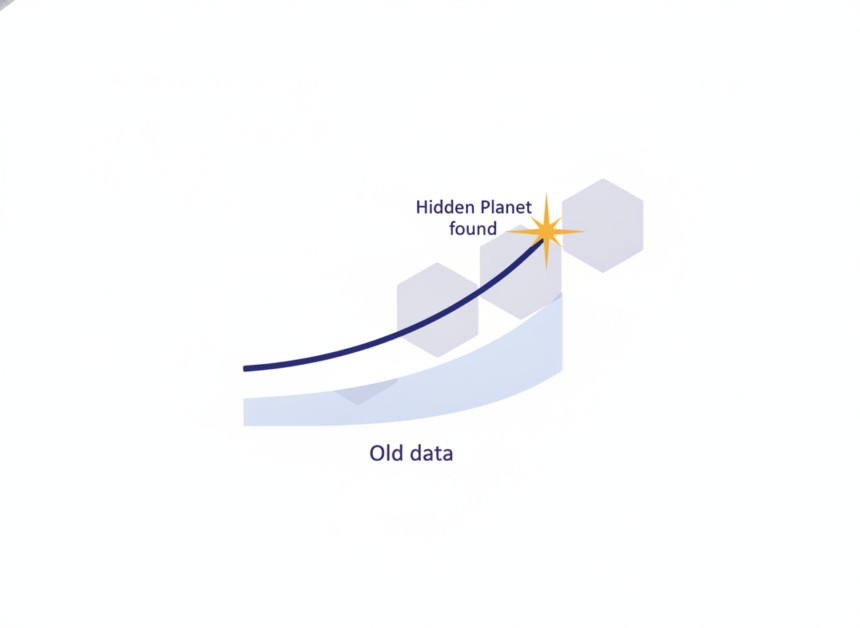
What failed was the processing, not the telescope. When JWST observed 51 Eridani roughly two years ago, conventional post-processing could not separate the planet from residual coronagraph glare; therefore the detection sat unrecognised in the archive until the Northwestern team re-ran the exposures through FLIP.
This matters more than a single detection. If a known, relatively bright young gas giant could be lost inside Webb data, the archive plausibly contains signals of planets nobody has a prior reason to look for — and until now there was no reason to go back and check.
| Attribute | Value |
|---|---|
| Planet | 51 Eridani b |
| Host star | 51 Eridani |
| Constellation | Eridanus |
| Distance from Earth | ~97 light-years |
| Planet type | Young gas giant |
| First direct image | 2014, ground-based |
| JWST instrument used | NIRCam (coronagraphic imaging) |
| Age of the recovered data | ~2 years |
| Study publication | Nature, 4 November 2026 |
Why planets vanish inside telescope images
Exoplanets are difficult to photograph because they are up to a million times fainter than the stars they orbit. For an object like 51 Eridani b, that contrast ratio means any light leaking past the starlight-blocking optics swamps the planet’s signal entirely.
A coronagraph is a mask inside an instrument such as NIRCam that blocks the host star’s direct light. Crucially, it suppresses the glare rather than removing it, so a residual halo of scattered starlight always remains in the frame.
That residual halo refuses to sit still. Webb’s mirror segments shift and tilt by nanometres as temperature and pointing change, which alters the leaked light pattern between exposures and defeats subtraction methods that assume a fixed pattern.
The consequence is a limit set by modelling rather than by optics: because the residual pattern moves, sensitivity was capped by how well astronomers could predict the glare, not by the size of Webb’s 6.5-metre mirror. That is the specific limit FLIP attacks.
“Planets are a million times fainter than their stars… slight shifts or tilts — even on the scale of just a few nanometers — can change the pattern of light. Our method models how light travels through the telescope and accounts for those tiny changes, allowing us to remove the glare much more precisely.”
— Rodrigo Ferrer-Chavez, PhD student in astronomy, Northwestern University, lead author, via Northwestern University
How FLIP works: a digital twin of Webb
FLIP stands for Physics-based Learning for Imaging Planets. Rather than filtering the final image, it reconstructs what the telescope should have recorded and subtracts that prediction, which means the planet is whatever survives the subtraction.
The pipeline runs in a fixed order, and the order is the method: build a physical replica of the instrument, fit it to the actual exposure, subtract, then examine the residuals.
How FLIP recovers a planet from existing JWST data
- Build the digital twin: construct a physics-based replica of NIRCam that simulates how light travels through Webb’s mirrors and coronagraph.
- Fit the optics to the real data: use the optimisation machinery developed for training machine-learning models to tune millions of parameters until the twin reproduces the observed starlight pattern, including nanometre-scale mirror tilts.
- Subtract the predicted glare: remove the simulated starlight from the real exposure frame by frame, so residuals shrink toward the noise floor.
- Inspect what remains: any coherent, point-like signal left after subtraction is a candidate planet, then verify it against the independently measured position and brightness of 51 Eridani b.
Step one: model the optics, not the picture
Conventional reference-differential imaging compares frames statistically, which works only when the glare pattern repeats closely enough between exposures. FLIP instead encodes the actual optical path, therefore it can account for an optical state that occurred once and never recurred. That distinction is why the gain shows up in data where statistical subtraction had already been applied and had already failed.
Step two: fit millions of parameters
Fitting millions of optical parameters is a scale problem, not a physics problem, and the machine-learning community had already solved scale. Co-author Jason Wang, assistant professor of physics and astronomy at Northwestern, has clarified that the team used AI training tools to handle the parameter tuning while the physics model constrained every solution to real, physically possible optics — reporting on the study has made the same distinction.
Step three: subtract the glare and see what is left
The team tested FLIP on archival observations of three stars, and 51 Eridani b emerged clearly from the noise in the 51 Eridani dataset. Because an independent ground-based image from 2014 had already fixed the planet’s position and brightness, the recovery functions as a validation rather than a claim: the residual signal landed where an external measurement said a planet should be.
No, the image was not generated by AI
The image was not AI-generated. The researchers used machine-learning optimisation tools to fit a physics model; the planet’s light is real measured photons. The team has stated plainly that it did not use AI to generate or invent the image — the AI component is the optimiser, not the output.
The distinction is mechanical. A generative model invents pixels consistent with its training data, whereas FLIP subtracts a physically derived prediction from measured data, which means the surviving signal cannot have been synthesised by the software; it was either in the exposure or it was not.
That distinction carries editorial consequences. Because “AI found a planet” headlines conflate optimisation with image synthesis, readers reasonably suspect a hallucinated detection — and the independent 2014 ground-based image is the check that rules that reading out.
For working scientists the verification logic is tighter still: a false positive produced by over-fitting the optical model would not be expected to land at the planet’s independently measured position and at its independently measured brightness.
The numbers: 2x to 15x more sensitive, zero new hardware
FLIP improves JWST’s sensitivity to faint planets by 2 to 15 times, depending on the observation, without any hardware modification. The range exists because the gain scales with how badly residual glare dominated a given dataset — the worse the starting contamination, the more there is to model away.
The cost consequence is the part that reshapes the field. JWST observing time is the scarcest resource in exoplanet imaging, therefore a sensitivity gain delivered in software lowers the cost per detection far more than an equivalent gain purchased with new exposures, as secondary coverage of the study has also emphasised.
There is a second-order effect that is easy to miss: because the improvement applies to data already taken, the effective sensitivity of every past Webb coronagraphic observation rose on 4 November 2026, without a single additional photon being collected.
| Metric | Reported figure |
|---|---|
| Sensitivity improvement to faint planets | 2x to 15x |
| Planet-to-star brightness contrast addressed | ~1 million times fainter |
| Scale of optical shifts modelled | A few nanometres |
| Age of archival data used | ~2 years |
| Number of star systems tested | 3 |
| Hardware changes required | None |
| Publication date | 4 November 2026 |
What this rewrites for archival data
Yes — because FLIP works on data already collected, thousands of hours of archived JWST coronagraphic observations can be reprocessed for planets missed the first time. The archive becomes a search space rather than a record, and reprocessing costs computing time rather than telescope time, which means the barrier to a systematic re-analysis campaign is unusually low.
One caution keeps this honest: recovering a known planet demonstrates that the method reproduces a true signal. It does not yet establish a detection rate for unknown planets sitting in the archive.
Three consequences of a computational sensitivity gain
- Reprocessing becomes cheaper than observing: archived JWST NIRCam datasets can be re-run through FLIP without competing for new telescope time.
- Detection limits shift retroactively: observations once logged as non-detections need re-examination, because the glare floor that produced the null result has moved.
- Survey design changes: because post-processing now absorbs part of the stability problem, future observing proposals can target fainter and colder planets than the raw instrument specification implies.
The next target: Earth-like worlds and the Habitable Worlds Observatory
FLIP’s stability modelling at picometre scales is expected, according to the study authors, to inform the software and hardware design of NASA’s proposed Habitable Worlds Observatory, a mission being designed to image Earth-like exoplanets directly. The scale problem is severe: an Earth analogue orbiting a Sun-like star is orders of magnitude fainter relative to its host than a young, self-luminous gas giant like 51 Eridani b, therefore the stability requirement moves from nanometres down to picometres.
The design consequence follows directly. Because FLIP demonstrates that modelling can recover performance that mechanical stability alone did not deliver, mission planners gain the option to trade part of the stability budget against computational correction — a trade that lands on the cheaper side of the engineering ledger.
That trade has a hard floor. Software cannot recover photons the telescope never collected, which means aperture size and raw coronagraph performance remain the binding constraints for Earth-like targets, however good the model becomes.
The practical near-term test is narrower and more checkable: whether FLIP-style processing yields a genuinely new detection, rather than a recovery, in JWST archival data over the coming observing cycles.
Frequently asked questions
What is the James Webb hidden planet found in old data?
It is 51 Eridani b, a young gas giant about 97 light-years away in the constellation Eridanus. The planet was already known from 2014 ground-based imaging, but it went unseen in JWST NIRCam observations taken roughly two years ago. New software called FLIP removed the residual starlight, and the planet emerged from the archived data.
Did James Webb actually discover a brand-new planet?
No. 51 Eridani b was first directly imaged in 2014, so its existence was established before Webb observed the system. What is new is that the planet was recovered from JWST data where standard processing could not see it, which demonstrates the archive holds detectable signals that were previously missed.
What does FLIP stand for and how does it work?
FLIP stands for Physics-based Learning for Imaging Planets. It builds a digital twin of JWST’s NIRCam, simulating how light travels through the telescope’s mirrors and coronagraph, including nanometre-scale tilts. The model is fitted to the real exposure, the predicted starlight glare is subtracted, and any point-like signal remaining is a planet candidate.
How much more sensitive does FLIP make the James Webb telescope?
Between 2 and 15 times more sensitive to faint planets, according to the Nature study published on 4 November 2026. The range depends on how strongly residual starlight dominated a given observation. No hardware changes were involved, which means the gain applies retroactively to data JWST has already collected.
Was AI used to create the image of the hidden planet?
No. The researchers state they did not use AI to generate the image. They used optimisation tools developed for training machine-learning models to fit millions of parameters in a physics-based telescope model. The planet’s light is measured photons from the original exposure; the software subtracted predicted glare rather than inventing pixels.
Who led the study and where was it published?
Rodrigo Ferrer-Chavez, a PhD student in astronomy at Northwestern University, led the work, with assistant professor Jason Wang as co-author. Both are affiliated with CIERA, Northwestern’s Center for Interdisciplinary Exploration and Research in Astrophysics. The study was published in Nature on 4 November 2026.
Why are exoplanets so hard to photograph directly?
Because planets are up to a million times fainter than the stars they orbit. Coronagraphs suppress the star’s direct light but leak a residual glare pattern, and because mirror segments shift by nanometres between exposures, that pattern changes. Subtraction methods assuming a fixed pattern therefore leave the planet buried in the residuals.
How far away is 51 Eridani b?
About 97 light-years from Earth. It orbits the young star 51 Eridani in the southern constellation Eridanus. The planet is a young, self-luminous gas giant, which is why it is bright enough in the infrared for direct imaging at all, despite the extreme contrast with its host star.
Could more hidden planets be found in existing telescope archives?
Probably, though none has been confirmed this way yet. Because FLIP reprocesses data already collected, archived JWST coronagraphic observations can be re-run at the new sensitivity floor. Datasets once recorded as non-detections therefore need re-examination. The 51 Eridani b result validates the method; it does not establish how many unknown planets the archive contains.
What does this mean for the Habitable Worlds Observatory?
It strengthens the case for building the mission around computational glare removal. FLIP’s stability modelling is expected to inform both software and hardware design for NASA’s proposed Habitable Worlds Observatory, which targets direct images of Earth-like planets. Because modelling recovers performance mechanical stability alone did not deliver, designers gain margin in the stability budget.
Limits of the result, and what would disprove it
The central limitation is the nature of the test case. FLIP recovered a planet that was already catalogued, therefore the result demonstrates that the method reproduces a true signal — it does not yet demonstrate that it finds signals nobody knew were there.
The sample is also small, and should be read that way. The technique was tested on archival observations of three stars, which means performance across the wider JWST archive is projected from three datasets rather than measured across many.
Established methods have not been displaced. Conventional reference-differential and angular-differential imaging remain the field standard, and ground-based extreme adaptive optics systems continue to deliver detections Webb cannot, because they observe at different wavelengths and reach different contrast regimes. 51 Eridani b itself was found that way in 2014.
There is a clear falsification test readers can watch for: independent teams applying FLIP to other archival datasets, and either confirming candidate signals or failing to.
What the study does not establish
- No new planet has been discovered with FLIP to date; 51 Eridani b was a recovery of a known object.
- The 2x to 15x sensitivity range comes from three test systems, not a full archive survey.
- Software cannot recover signal from photons the telescope never collected, so aperture and coronagraph limits still bind.
- Results have not yet been independently replicated by a separate team on separate data.
Sources and method
The James Webb hidden planet episode matters because the limiting factor on direct imaging turned out to be a modelling problem rather than a mirror problem, and modelling problems get solved faster and far more cheaply than hardware ones. That is the substantive shift behind the 4 November 2026 Nature paper: Webb did not get better, but what Webb has already recorded did. The near-term thing to watch is narrow and binary — a first genuinely new planet pulled from the archive, rather than a second recovery of something already catalogued.
For more INQ Daily science and technology coverage, see the INQ Daily homepage.
Attribution
- Study: published in Nature, 4 November 2026.
- Lead author: Rodrigo Ferrer-Chavez, PhD student in astronomy, Northwestern University.
- Co-author: Jason Wang, assistant professor of physics and astronomy, Northwestern University.
- Institution: CIERA, Center for Interdisciplinary Exploration and Research in Astrophysics, Northwestern University.
- Instrument: NIRCam coronagraphic imaging, James Webb Space Telescope (NASA/ESA/CSA).
- Reporting basis: the published study, Northwestern University press materials, and NASA instrument and mission documentation.
References
- Nature — peer-reviewed publication of the FLIP method, 4 November 2026.
- Northwestern University news — institutional release on the FLIP study, sensitivity figures and the Ferrer-Chavez quotation.
- NASA, James Webb Space Telescope mission and NIRCam documentation — coronagraphic imaging capability.
- NASA Exoplanet Catalog — 51 Eridani b, 2014 direct imaging and distance.
- NASA, Habitable Worlds Observatory — mission design goal of directly imaging Earth-like exoplanets.
- ScienceDaily — coverage including the clarification on machine-learning optimisation versus generative AI.
- SciTechDaily — general-audience summary of the digital-twin approach and sensitivity gain, November 2026.