
THE HAGUE — The Dutch cabinet presented its updated Programme for Agriculture, Nature and Nitrogen to Parliament in early November 2026, with Agriculture Minister Jaimi van Essen fronting the package. The law is built on two legs: state-funded voluntary farm buyouts on one side, and strict exclusion zones around vulnerable Natura 2000 nature areas on the other. It obliges the agricultural sector to cut nitrogen emissions by 42% to 46% by 2035 against 2019 levels, backed by a €9 billion transition fund. Builders are watching closely, because Dutch courts have blocked thousands of permits since a 2019 ruling tied construction consents to nitrogen emissions.
What the law requires
The binding obligations fall unevenly across the economy. Agriculture carries the 42–46% reduction by 2035, while industry and transport are expected to cut emissions by 50%, according to the cabinet plan reported by exereco.com.
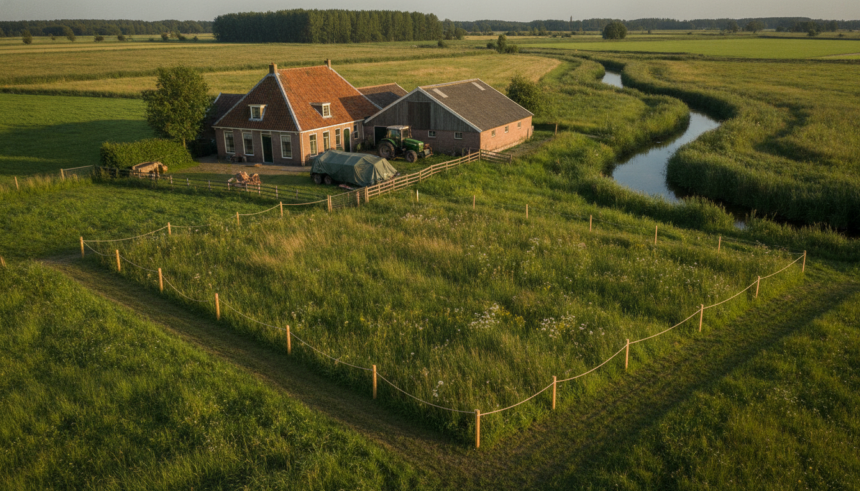
Zoning is the enforcement instrument. Provinces have until September 2028 to draw strict exclusion zones around vulnerable habitats — the government’s zones run from 500 to 1,000 metres — and farms inside them face a ceiling of 1.5 cows per hectare. The zoning follows from Natura 2000 conservation obligations; the density cap is what makes a zone enforceable at farm level rather than aspirational.
The third element is cash. The European Commission cleared a €715 million voluntary buyout programme in mid-2026, sitting inside the wider transition fund. It follows the €1.82 billion Lbv-plus scheme for peak-load emitters, which closed to applications in December 2024, as documented by the Netherlands Enterprise Agency (RVO).
| Measure | Figure | Deadline / date | Source |
|---|---|---|---|
| Agricultural nitrogen cut (vs 2019) | 42%–46% | 2035 | exereco.com |
| Industry and transport cut | 50% | 2035 | exereco.com |
| Livestock density in strict zones | 1.5 cows per hectare | Phased from 2028 | exereco.com |
| Provincial deadline to draw strict zones | Not stated (zones 500–1,000 m) | September 2028 | exereco.com |
| Voluntary buyout scheme budget | €715 million | Opens 18 January 2027 | European Commission approval |
| Total transition fund | €9 billion | Not stated | exereco.com |
| Previous Lbv-plus scheme budget | €1.82 billion | Closed December 2024 | RVO |
What farmers must give up to take the money
Participation in the Dutch nitrogen policy farm buyout scheme is voluntary but effectively one-way, because acceptance requires surrendering production rights and signing a non-compete clause. The conditions set out in the European Commission’s mid-2026 approval, reported by Wodne Sprawy, are explicit:
- Remove the herd from the holding
- Surrender livestock production rights
- Demolish specified livestock buildings
- Sign a non-compete clause barring any restart of livestock activity elsewhere
Exposure is not evenly spread. Petra Berkhout, project leader at Wageningen Social and Economic Research, identified mid-sized family farms as the most at risk, because they lack the capital for low-emission barn conversions that larger operations finance through economies of scale, per Brussels Signal.
How it came to this
The crisis dates to the 2019 court ruling that invalidated the Dutch permitting framework for nitrogen-emitting activities. That decision froze building consents and bound housing and road projects to farm emissions, a linkage detailed in policy analysis of the Netherlands nitrogen buyouts.
What followed was a sequence of partial fixes: the Lbv-plus peak-load buyout closing in December 2024, a plan tabled in June 2026, the Commission’s state-aid clearance of the €715 million programme in mid-2026, and the updated law in November 2026. Litigation has run in parallel — in September 2026 courts were asked to shut 130 farms for breaching nitrogen limits, as DutchNews.nl reported — so the timetable is now driven by enforcement as much as by legislation. The pattern is familiar across the bloc, where the EU methane rules delay showed affected sectors contesting compliance deadlines.
Tourist Tax 2026 and the Fee Era: How Governments Turned Charges Into Policy Weapons
One alternative was rejected. In October 2026 the Landbouw Alliantie proposed German-style 250-metre exclusion zones in place of the government’s wider bands; Van Essen dismissed the proposal on the stated grounds that it would invite further legal challenge and leave vulnerable habitats unprotected.
What the people involved say
Farmer sentiment is measurable. An October 2026 survey of nearly 600 livestock farmers by RTL and the trade magazine Boerderij found 87% had lost confidence in their farms’ future, six in ten dairy farmers said they could not meet the stricter standards, and trust in Van Essen stood at 7%, according to NL Times. LTO chairman Ger Koopmans called the package “less bad on important points” than earlier versions while maintaining “fundamental objections” over the absence of clarity on individual farm cuts.
Builders read the same law differently. Bouwend Nederland said it finally creates room to build homes and roads again, because a defensible nitrogen framework is what releases permits held up by emissions from construction equipment — the same consent bottleneck that constrains Europe’s green hydrogen build-out.
Environmental assessors are unpersuaded in the opposite direction. The PBL think tank cautioned that more than half of vulnerable habitats will still exceed nitrogen thresholds in 2035 even under full implementation, and Greenpeace accused the cabinet of disregarding court rulings demanding faster action.
What happens next
Applications under the Dutch nitrogen policy farm buyout scheme open on 18 January 2027, giving farmers a decision window before provinces begin mapping strict zones ahead of the September 2028 deadline.
The projected scale of exit is substantial. A Wageningen Social and Economic Research study published on 4 November 2026, commissioned by the agriculture ministry, estimated that 10% to 30% of roughly 27,000 livestock farmers — up to about 8,100 holdings — could quit. The same assessment found national food security unaffected, because the Netherlands produces far more animal product than it consumes, while agri-food gross value added falls by up to 4% and sector employment by up to 5%. Set against wider public spending commitments such as the climate finance benchmarks set at Belém, the €9 billion fund is the largest single instrument in the package. The law must still clear Parliament, and provincial implementation decisions follow from it.
What is still unconfirmed
The per-farm reduction obligations LTO says are undefined have not been published. No province has yet released final strict-zone boundaries. Parliamentary passage and any amendments remain open, as does take-up under the €715 million programme, which is unknowable until applications open — a dependency comparable to markets stalled when subsidy rules are rewritten mid-cycle. Whether pending litigation, including the September 2026 case against 130 farms, alters the timetable has not been determined.
References
- exereco.com — Netherlands Sets Nitrogen Cuts for Farmers as Builders Wait for Room to Build
- RVO — Lbv-plus: current information
- Wodne Sprawy — The Netherlands will pay for farm closures
- DutchNews.nl — Courts asked to shut 130 farms for breaching nitrogen limits
- DutchNews.nl — Van Essen dismisses farmers’ alternative nitrogen emissions plan
- NL Times — 87% of Dutch livestock farmers lose faith in future under nitrogen rules
- Brussels Signal — Dutch nitrogen plans could shutter up to 30 per cent of livestock farms