
Table of Contents
- What the 7.7-magnitude Mandalay earthquake destroyed
- Four reasons Myanmar earthquake recovery stalled
- 1. Funding cuts forced agencies back to short-term relief
- 2. Armed clashes close the roads aid must use
- 3. Fuel and fertiliser costs made every delivery dearer
- 4. Debris physically blocks the rebuild
- The funding gap in the words of the agencies
- Myanmar earthquake recovery by the numbers
- Sagaing: conflict stacked on collapse
- What the recovery phase actually funds now
- Where donations still reach survivors
- Frequently asked questions
- What this reporting cannot confirm
- The bottom line
- References
- Related Reading
BANGKOK — 24 October 2026. Myanmar earthquake recovery has stalled nineteen months after the 7.7-magnitude Mandalay quake: 16 million people now need humanitarian assistance, 450,000 metric tonnes of debris remain uncleared, and 12.4 million face acute food insecurity.
Recovery has stalled because funding fell while the cost of access rose, therefore relief has substituted for reconstruction. This article sets out the four documented causes, the current figures agencies publish, and where Myanmar earthquake aid still lands.
Key facts at a glance
>
- Myanmar earthquake recovery moved from emergency response into an 18-month recovery phase in 2026, but housing and infrastructure rebuilding remains largely unstarted (UNDP Myanmar, 2026).
- The 7.7-magnitude quake struck at 1:10 PM local time on 28 March 2025, with its epicentre 17 km from Mandalay (USGS event reporting, 2025).
- Myanmar earthquake death toll: more than 1,700 killed in Myanmar and 17 in Thailand.
- 16 million people — close to one in three nationwide — are projected to need humanitarian assistance in 2026 (UN OCHA Humanitarian Needs and Response Plan, 2026).
- 12.4 million people face acute food insecurity and 8.5 million depend entirely on food assistance (ReliefWeb/HNRP reporting, 2026).
- More than 450,000 metric tonnes of debris still require organised clearance; 1.2 million people need debris and waste support (Early Recovery Cluster, 2026).
- Welthungerhilfe reached about 1.7 million people in the first year; the ICRC and partners assisted more than 300,000 (agency reporting, March 2026).
About this report: Compiled by the INQ Daily world affairs desk from agency reporting, UN humanitarian planning documents and seismological analysis published between March 2025 and October 2026. Reporting is desk-based; see “What this reporting cannot confirm” below.
Transparency: INQ Daily receives no funding from any organisation named in this article and does not endorse any appeal. Figures are quoted as published by the named source, with the reporting period stated.
What the 7.7-magnitude Mandalay earthquake destroyed
A 7.7-magnitude earthquake struck central Myanmar at 1:10 PM local time on 28 March 2025 with an epicentre roughly 17 km from Mandalay, killing more than 1,700 people in Myanmar and 17 in Thailand, and a 6.4-magnitude aftershock followed the same afternoon.
Seismological analysis of the event, published after the rupture and summarised on the USGS event page, indicates the rupture propagated along the Sagaing fault at supershear speeds estimated at up to roughly 6 km/s before decelerating. That mechanism produced unusually violent ground motion along a narrow corridor. As a result, Mandalay earthquake damage was concentrated in dense urban blocks and in Sagaing town rather than spread evenly across the two regions, and unreinforced masonry and brick-infill buildings failed first. Entire buildings collapsed, critical infrastructure was destroyed and communications were severed within minutes.
The quake hit a population already displaced by armed conflict and squeezed by a collapsing kyat economy, therefore the disaster compounded existing vulnerability rather than creating it. Sagaing fault earthquake risk remains a standing hazard for any rebuild, because reconstruction on the same fault trace without enforced seismic standards reproduces the exposure that made March 2025 so lethal.
| Parameter | Detail | Source |
|---|---|---|
| Date and local time | 28 March 2025, 1:10 PM | USGS event reporting |
| Magnitude | 7.7 | USGS event reporting |
| Epicentre distance from Mandalay | About 17 km | USGS event reporting |
| Largest aftershock | Magnitude 6.4 | USGS event reporting |
| Fault involved | Sagaing fault | Seismological analysis, 2025 |
| Rupture speed | Up to about 6 km/s (study estimate) | Seismological analysis, 2025 |
| Deaths in Myanmar | More than 1,700 | Agency and official reporting |
| Deaths in Thailand | 17 | Agency and official reporting |
Four reasons Myanmar earthquake recovery stalled
Myanmar reconstruction stalled because four pressures hit at once: international funding cuts, conflict-driven access restrictions, a fuel and fertiliser price shock, and more than 450,000 tonnes of uncleared debris.
1. Funding cuts forced agencies back to short-term relief
Because international contributions to Myanmar were cut sharply across 2025 and 2026, agencies including the World Food Programme and Welthungerhilfe warned they would be forced to scale back recovery programming. The effect is a substitution rather than a reduction: money that would have funded shelter repair and livelihoods now funds food rations. Consequently households stay aid-dependent instead of rebuilding — 8.5 million people in Myanmar now depend entirely on food assistance, according to humanitarian response plan reporting for 2026.
2. Armed clashes close the roads aid must use
Because fighting continued across Sagaing and parts of Mandalay region through 2026, humanitarian access Myanmar-wide depends on route-by-route negotiation and travel authorisations. As a result, assessment teams cannot reach parts of the damage zone, and unassessed areas do not appear in funded response plans — the access problem therefore becomes a funding problem. Agencies report displacement caused by renewed clashes in Sagaing; the scale of need in those districts is not independently verifiable.
3. Fuel and fertiliser costs made every delivery dearer
Driven by the escalation of war in the Middle East involving Iran, global fuel and fertiliser prices rose through 2025 and 2026, and Myanmar prices followed. Consequently the same budget moves fewer tonnes of cement, water and food into central Myanmar, and farmers cut fertiliser use, which depresses the next harvest and widens food insecurity. Welthungerhilfe’s country director flagged the fuel increase explicitly in March 2026, quoted in full below.
4. Debris physically blocks the rebuild
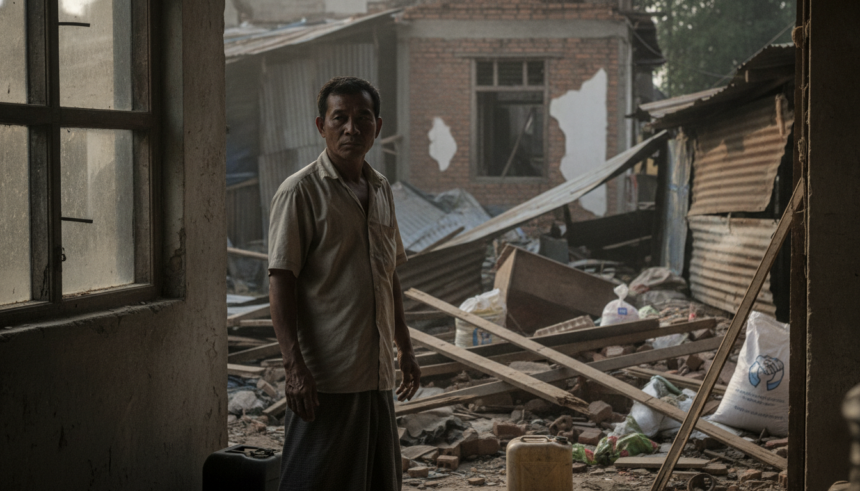
Because more than 450,000 metric tonnes of debris remain uncleared and municipal waste systems are overwhelmed, Myanmar debris clearance is the binding constraint on reconstruction. Rubble blocks the transport routes that construction materials need, occupies the plots that require rebuilding, and creates public health risk in makeshift camps. The Early Recovery Cluster, coordinated through UNDP Myanmar, reports that 1.2 million people need debris removal, recycling and safe waste management support to restore basic living conditions.
The funding gap in the words of the agencies
“Funding gaps, restricted access for aid organizations, and the ongoing crisis in the country are significantly slowing the progress. The escalation of the war in the Middle East is making the situation even worse. Fuel prices have also risen significantly in Myanmar.”
— Henry Braun, Country Director, Welthungerhilfe Myanmar, March 2026
Around the Myanmar earthquake anniversary in March 2026, UN Assistant Secretary-General Kanni Wignaraja and UNDP Myanmar Resident Representative Titon Mitra pressed for sustained international attention, arguing that the quake compounded pre-existing conflict and economic vulnerability rather than acting alone. The consequence of that advocacy falling short is structural: because appeals for a conflict-affected country compete with better-covered emergencies, pledges arrive late and in small tranches. That forces short programme cycles, which means agencies cannot sign the multi-year contracts that permanent reconstruction requires. Welthungerhilfe’s one-year reporting describes the result as families left dependent on short-term aid.
Myanmar earthquake recovery by the numbers
The Myanmar humanitarian crisis 2026 baseline is 16 million people in need, which means need has widened since the quake rather than narrowed. The table below consolidates the figures published by operating agencies and UN planning documents between March 2025 and 2026.
| Indicator | Figure | Period | Source |
|---|---|---|---|
| People needing humanitarian assistance | 16 million | 2026 projection | UN OCHA HNRP |
| Acute food insecurity | 12.4 million | 2026 | HNRP / ReliefWeb |
| Fully dependent on food assistance | 8.5 million | 2026 | HNRP / WFP reporting |
| Debris still requiring clearance | 450,000+ metric tonnes | 2026 | Early Recovery Cluster |
| People needing debris support | 1.2 million | 2026 | Early Recovery Cluster |
| Welthungerhilfe people reached | About 1.7 million | First year, to March 2026 | Welthungerhilfe |
| ICRC and partners people assisted | More than 300,000 | 2025–2026 | ICRC |
| DEC cash transfer per household | 360,000 MMK (about $86) | Late 2025 | DEC-funded project |
| Households receiving DEC cash | 5,552 | Late 2025 | DEC-funded project |
The gap between agency reach figures and the needs baseline indicates coverage of roughly a tenth of the affected population, therefore Myanmar food insecurity and shelter needs persist into a second year.
Sagaing: conflict stacked on collapse
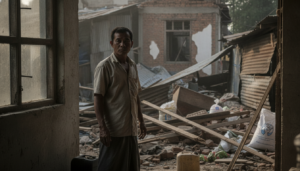
The Sagaing earthquake zone is the least served part of the response, because the same districts hit hardest in March 2025 have seen continued armed clashes and further displacement, therefore aid movement there requires security clearance that agencies report is frequently delayed or denied.
“After the earthquake took my husband and destroyed my home, I felt completely hopeless. I would sit in front of the ruins, not knowing how to start again. When the debris was cleared, it felt like the first light after a long darkness.”
— Kyu Kyu Myint, 67, survivor, Sagaing
That account points to the structural cause. Debris clearance is the precondition for every later step, and because clearance crews need secure road access and fuel they can afford, insecurity in Sagaing delays shelter, water and livelihood programmes in sequence rather than in parallel. One blocked route therefore postpones four programmes. The access claims in this section are reported by operating agencies, including the ICRC and Welthungerhilfe; INQ Daily has not verified them independently on the ground.
What the recovery phase actually funds now
The response left the Category III National Response emergency framework and entered an 18-month recovery phase, which means funding now targets restoring basic services rather than distributing emergency supplies. Early recovery restores water, sanitation, shelter and income within months. Reconstruction rebuilds permanent housing and infrastructure to seismic standards over years, and in central Myanmar it has barely begun.
What the 18-month recovery phase funds
- WASH interventions in makeshift camps to prevent waterborne disease outbreaks (World Vision, UNDP, Red Cross Movement)
- Debris removal, recycling and safe waste management through the Early Recovery Cluster
- Multi-purpose Myanmar cash assistance to restart micro-businesses such as street food vending
- Transitional shelter repair and materials rather than permanent housing construction
- Agricultural inputs to offset fertiliser price rises before the next planting season
Because the UNDP Myanmar earthquake response and partner budgets are sized for early recovery and not for reconstruction, the current phase stabilises households without rebuilding the city. The next funding cycle therefore determines whether permanent rebuilding starts at all.
Where donations still reach survivors
Readers searching how to donate Myanmar earthquake funds should prioritise organisations that publish reach figures and operate inside Mandalay and Sagaing, because published programme data is the only check available on whether money lands. The table lists organisations with figures already in the public record.
| Organisation | Programme focus | Published reach | Reporting period |
|---|---|---|---|
| Welthungerhilfe | Food, livelihoods, early recovery | About 1.7 million people | First year, to March 2026 |
| ICRC / IFRC and Myanmar Red Cross | Health, water, shelter, relief | More than 300,000 people | 2025–2026 |
| UNDP (Early Recovery Cluster) | Debris clearance, waste, services | 1.2 million people identified as needing support | 2026 |
| World Vision | WASH in camps, cash assistance | Not stated | 2025–2026 |
| Disasters Emergency Committee member appeal | Multi-purpose cash | 5,552 households, 360,000 MMK each | Late 2025 |
Confirm that an appeal is Myanmar-specific and currently open before donating. The IFRC Myanmar earthquake emergency appeal publishes its own status and funding coverage, and INQ Daily neither endorses nor receives funding from any organisation listed here.
Frequently asked questions
What happened in the March 2025 Mandalay earthquake?
A 7.7-magnitude earthquake struck central Myanmar at 1:10 PM local time on 28 March 2025, with its epicentre about 17 km from Mandalay. A 6.4-magnitude aftershock followed. More than 1,700 people were killed in Myanmar and 17 in Thailand, because collapse concentrated in dense urban blocks of unreinforced masonry.
Why is earthquake aid stalling in central Myanmar?
Four causes: international funding cuts, conflict-driven access restrictions, higher fuel and fertiliser costs, and more than 450,000 tonnes of uncleared debris. Myanmar earthquake recovery therefore reverted to short-term relief, because shrinking budgets had to cover food rations before shelter and livelihoods could be funded.
How many people in Myanmar need humanitarian assistance in 2026?
An estimated 16 million people — close to one in three nationwide — are projected to need humanitarian assistance in 2026, according to the UN’s 2026 humanitarian needs baseline. Conflict and economic collapse drive that figure alongside the earthquake, which means the total exceeds quake-affected caseloads alone.
How much debris is still uncleared in Mandalay and Sagaing?
More than 450,000 metric tonnes require organised clearance, and 1.2 million people need debris and waste support, per Early Recovery Cluster reporting in 2026. Rubble blocks the transport routes materials need and occupies the plots that require rebuilding, which delays every later phase.
Is the Myanmar junta blocking earthquake aid?
Operating agencies report that access requires travel authorisations that are frequently delayed or denied, and that active fighting also closes routes. Those access restrictions are documented. INQ Daily cannot independently verify intent, therefore this article distinguishes reported restrictions from any attribution of motive to a party.
How many people are facing hunger in Myanmar?
Around 12.4 million people face acute food insecurity and 8.5 million depend entirely on food assistance, according to 2026 humanitarian response plan reporting. Because food programming is the first line protected when budgets fall, funding cuts translate directly into ration reductions for those 8.5 million.
Which organisations are still working on Myanmar earthquake recovery?
Welthungerhilfe (about 1.7 million people reached), the ICRC and IFRC with the Myanmar Red Cross (more than 300,000 assisted), UNDP through the Early Recovery Cluster, World Vision, and WFP for food assistance. Each publishes Myanmar-specific programme data, which allows reach to be checked against need.
How can I donate to Myanmar earthquake relief and be sure it lands?
Choose organisations that publish Myanmar-specific programme reach and operate inside Mandalay and Sagaing. Unrestricted donations to an open Myanmar appeal typically reach programmes faster than earmarked gifts, because agencies can allocate against current gaps. Check the appeal is still active before giving.
What is the difference between emergency relief and early recovery?
Emergency relief keeps people alive with food, water and shelter in the first weeks; early recovery restores services, income and debris-free land over months. Reconstruction — rebuilding permanent housing and infrastructure to seismic standards — is a third and later phase that central Myanmar has barely entered.
Will Mandalay be rebuilt, and on what timeline?
No funded timeline for full reconstruction exists as of October 2026. The current 18-month recovery phase covers early recovery only, therefore permanent rebuilding depends on a further funding cycle and on enforcing seismic standards along the Sagaing fault, where the 2025 rupture occurred.
What this reporting cannot confirm
Casualty, displacement and needs figures for Myanmar are agency-reported and derived from partial assessments, because conflict, travel authorisation requirements and communications restrictions prevent full enumeration. These totals should therefore be read as floors rather than precise counts.
Areas that cannot be assessed are not counted, which means the true scale of unmet need in parts of Sagaing is unknown and likely understated.
This article documents access restrictions reported by operating agencies; it does not attribute intent to any party, and INQ Daily had no reporter on the ground in Mandalay or Sagaing. Some analysts also argue that local and diaspora-funded mutual aid networks deliver more than the formal cluster system records, which means published reach figures could undercount total assistance.
The bottom line
Myanmar earthquake recovery has not stalled for lack of a plan but for lack of money and access, because an 18-month early recovery phase cannot deliver reconstruction that was never funded.
The decisive numbers stand at 16 million people in need, 12.4 million facing acute food insecurity, and more than 450,000 metric tonnes of debris awaiting clearance. These are the metrics that will show whether the next funding cycle changes anything.
The measurable test in 2027 is tonnes of debris cleared and permanent housing units completed in Mandalay and Sagaing — not pledges announced. Follow INQ Daily world affairs coverage for those figures as agencies publish them.
References
- UN OCHA, Humanitarian Needs and Response Plan — Myanmar 2026 — https://humanitarianaction.info/plan/1298
- ReliefWeb, Myanmar country page (food insecurity and response plan reporting) — https://reliefweb.int/country/mmr
- UNDP Myanmar, Early Recovery Cluster reporting, 2026 — https://www.undp.org/myanmar
- Welthungerhilfe, Myanmar one-year earthquake reporting and Henry Braun statement, March 2026 — https://www.welthungerhilfe.org/news
- International Committee of the Red Cross, Myanmar operations — https://www.icrc.org/en/where-we-work/asia-pacific/myanmar
- IFRC, Myanmar earthquake emergency appeal — https://www.ifrc.org/emergency/myanmar-earthquake
- World Vision International, Myanmar earthquake response — https://www.wvi.org/emergencies/myanmar-earthquake
- USGS, M 7.7 central Myanmar earthquake event page, 28 March 2025 — https://earthquake.usgs.gov/earthquakes/eventpage/us7000pn9s/executive