

Table of Contents
- What happened in Riyadh on November 8, 2026
- Which cities received Civil Defense alerts
- Houthi claims versus coalition confirmation
- Why the Yemen war reignited in 2026
- The Houthi advance on Yemen's Red Sea coast
- Why Saudi air defenses are being penetrated
- Economic fallout: oil, markets and Vision 2030
- The humanitarian cost inside Yemen
- Travel advisories and the international response
- What to watch next
- Frequently asked questions
- What we know, what we don't, and how to read competing claims
- Conclusion
- References
Key Takeaway
RIYADH, November 9, 2026 — A Houthi missile attack on Riyadh damaged a Saudi Aramco building in the King Abdullah Financial District on November 8. Coalition spokesman Maj. Gen. Turki al-Maliki said air defenses intercepted three ballistic and two cruise missiles. The Saudi Energy Ministry reported no injuries or fatalities.
RIYADH, November 9, 2026 — A Houthi missile attack Riyadh had not seen at this depth since the war’s first phase damaged a Saudi Aramco corporate building in the King Abdullah Financial District on Sunday, November 8, 2026. The barrage combined ballistic missiles, cruise missiles and drones against the capital and the oil-producing Eastern Province, and the Saudi Civil Defense broadcast warnings across six named locations. Coalition spokesman Maj. Gen. Turki al-Maliki said air defenses intercepted three ballistic and two cruise missiles.
The impact point matters more than the damage. Because the debris fell inside the Kingdom’s financial core rather than on a border installation, the escalation now touches the physical geography of Vision 2030 rather than Najran’s frontier districts. This report sets out the verified sequence, separates Houthi claims from coalition confirmations — the two diverge materially — explains why the April 2022 truce collapsed in July 2026, why interception is failing, and what the renewed war costs in economic and humanitarian terms.
About this report
Compiled by the INQ Daily world affairs desk from statements by the Saudi Energy Ministry, the Saudi-led coalition, Houthi military spokesman Yahya Saree, the US Department of State, United Nations reporting, and published expert analysis by Bernard Haykel, Professor of Near Eastern Studies at Princeton University. Dateline: Riyadh, November 9, 2026.
Transparency note
This is a developing conflict. No independent monitor has access to impact sites in Riyadh or to launch sites in Sanaa and Saada. Figures attributed to either belligerent are reported as the positions of their sources, not as audited fact. See the limitations section below.
What happened in Riyadh on November 8, 2026
The Houthi missile attack on Riyadh began on the morning of Sunday, November 8, 2026, and combined ballistic missiles, cruise missiles and drones against the capital and the Eastern Province. Saudi air defenses engaged the incoming projectiles over Riyadh, and falling debris and shrapnel from the engagement struck a Saudi Aramco corporate building in the King Abdullah Financial District. The Saudi Energy Ministry reported no injuries and no fatalities.
Witnesses described windows blown out across several floors of the tower and damage to the facade. That account comes from witness reporting rather than from an official damage assessment, and Saudi statements attribute the damage to debris from an interception rather than to a direct strike. The distinction is not cosmetic, but neither reading changes the strategic point: because the impact occurred inside the King Abdullah Financial District rather than at a border installation or a remote pumping station, the attack demonstrated reach into the Kingdom’s administrative and financial core.
The geographic spread extended well beyond the capital. Alerts and claimed targets covered Al-Kharj, home to Prince Sultan Air Base, the border province of Najran, and the Eastern Province cities of Dhahran, Dammam and Abqaiq. Abqaiq hosts the world’s largest crude stabilisation facility, which is why alerts there carry weight with crude traders independently of whether anything was hit.
Several things remain unestablished as of November 9. Neither side has stated the total number of projectiles launched, no repair timeline has been issued for the damaged tower, and there is no confirmation that any oil storage at Abqaiq was affected.
November 8, 2026: the sequence as reported
- Houthi forces launch a combined ballistic missile, cruise missile and drone barrage at Riyadh and the Eastern Province.
- Saudi Civil Defense activates the National Early Warning Platform; alerts broadcast across Riyadh, Al-Kharj, Najran, Dhahran, Dammam and Abqaiq.
- Saudi air defenses engage incoming projectiles over Riyadh; debris falls on the King Abdullah Financial District.
- Witnesses report blown-out windows and facade damage at a Saudi Aramco corporate building.
- Houthi military spokesman Yahya Saree claims direct hits on King Khalid International Airport, the financial district and Aramco storage tanks at Abqaiq.
- Coalition spokesman Maj. Gen. Turki al-Maliki confirms interception of three ballistic and two cruise missiles.
- Saudi Energy Ministry confirms no injuries or fatalities.
- Coalition announces airstrikes destroying Houthi missile launchers in Sanaa and Saada.
Which cities received Civil Defense alerts
The Saudi Civil Defense activated the National Early Warning Platform repeatedly in late October and early November 2026, and the November 8 activation covered six named locations across three regions.
| Location | Region | Nearby strategic asset | Alert type |
|---|---|---|---|
| Riyadh | Riyadh Province | King Abdullah Financial District; King Khalid International Airport | National Early Warning Platform alert |
| Al-Kharj | Riyadh Province | Prince Sultan Air Base | National Early Warning Platform alert |
| Najran | Najran Province | Yemeni border province | National Early Warning Platform alert |
| Dhahran | Eastern Province | Eastern Province administrative centre | National Early Warning Platform alert |
| Dammam | Eastern Province | Port and urban centre | National Early Warning Platform alert |
| Abqaiq | Eastern Province | Crude stabilisation facility | National Early Warning Platform alert |
The alert map tracks military and energy infrastructure rather than population density, which means the targeting set reads as strategic rather than indiscriminate. Najran’s inclusion reflects its position on the Yemeni border and its exposure to shorter-range systems, while the Eastern Province alerts cluster on oil infrastructure — Abqaiq above all — because that is where the Kingdom’s export capacity is physically concentrated.
Houthi claims versus coalition confirmation
The two accounts of November 8 do not match, and the gap is substantive. Yahya Saree claimed direct hits on three separate target sets; Maj. Gen. Turki al-Maliki confirmed interceptions and did not confirm any hit. The divergence matters commercially as well as militarily, because damage claims shape oil market reaction. An unverified Houthi assertion of hits on Abqaiq storage tanks carries price consequences independent of whether it is accurate.
| Target or outcome | Houthi claim (Yahya Saree) | Coalition statement (Maj. Gen. Turki al-Maliki) | Independently corroborated? |
|---|---|---|---|
| King Khalid International Airport | Direct hit claimed | Not confirmed | No |
| King Abdullah Financial District | Direct hit claimed | Damage attributed to intercept debris | Damage reported by witnesses |
| Aramco storage tanks, Abqaiq | Direct hit claimed | Not confirmed | No |
| Projectiles intercepted | Not stated | Three ballistic, two cruise missiles | No |
| Casualties | Not stated | None, per Saudi Energy Ministry | No |
| Strikes in Sanaa and Saada | Not stated | Launchers destroyed | No |
As of November 9, the only physically corroborated damage is the Aramco corporate building in the financial district, and the Saudi account attributes that to falling debris rather than to a direct strike. No independent verification of damage at King Khalid International Airport or at Abqaiq has emerged. Therefore the Houthi claim of direct hits remains unsubstantiated, while the coalition’s intercept count remains unaudited by any third party. Readers tracking this conflict through INQ Daily’s world affairs reporting should expect both figures to be revised.
Why the Yemen war reignited in 2026
The war reignited on July 13, 2026, when Saudi Arabia and the Saudi-backed Yemeni government bombed Sanaa International Airport in an operation reported to be aimed at preventing an Iranian aircraft carrying Islamic Revolutionary Guard Corps officers and military equipment from landing. That single strike ended a truce that had broadly held since April 2022 — a truce that reduced cross-border fire without ever producing a peace agreement.
The collapse did not occur in isolation. It followed the regional spillover of the US-Israeli confrontation with Iran, which raised the value to Tehran of resupplying its Yemeni ally and simultaneously raised the perceived cost to Riyadh of permitting that resupply to continue. As a result, an airport interdiction that would have been contained and absorbed in 2023 instead triggered full re-escalation in 2026, because both sides were operating with narrower tolerance for the other’s gains.
The Houthi response followed a declared doctrine. Because the Houthis framed Saudi restrictions on territory under their control as a blockade, they adopted a “blockade for a blockade” policy: a naval blockade against Saudi shipping in the Red Sea, enforced alongside a renewed air campaign against Saudi cities. This two-front approach converted what had been a Yemeni internal conflict into a direct Saudi homeland security problem, because the pressure now applies to Saudi exports and Saudi urban airspace rather than to Yemeni front lines.
| Date | Event | Consequence |
|---|---|---|
| April 2022 | UN-brokered truce takes effect | Cross-border fire largely stops |
| 2022–2025 | Truce holds without a peace agreement | No settlement framework built |
| July 13, 2026 | Sanaa International Airport struck | Truce collapses |
| July–August 2026 | Houthi air campaign on Saudi cities resumes | Saudi homeland exposed again |
| September 2026 | Houthi Red Sea coast offensive | Yemeni shore of Bab al-Mandeb taken |
| October 2026 | UAE rejoins, funds anti-Houthi ground forces | Coalition pressure restored on land |
| October 23, 2026 | US orders departure of non-emergency personnel | Aviation risk formally recognised |
| November 8, 2026 | Riyadh financial district struck | Conflict reaches Vision 2030 geography |
Consequently, by November 2026 Saudi Arabia was fighting a conflict it had spent four years trying to exit, with no functioning negotiating channel and with the 2022 truce architecture effectively defunct.
The Houthi advance on Yemen’s Red Sea coast
In September 2026 the Houthis launched a ground offensive that took Yemen’s entire Red Sea coastline, including the historic port city of Al-Makha, Perim Island and the Hanish Islands. As a result they hold the Yemeni shore of the Bab al-Mandeb Strait — the chokepoint through which Red Sea traffic reaches the Suez Canal — and the Saudi-backed government lost its last western maritime outlet.
September 2026 gains and what each one controls
- Al-Makha — Red Sea port city, controls coastal access south of Taiz
- Perim Island (Mayyun) — sits inside the Bab al-Mandeb shipping lane
- Hanish Islands — southern Red Sea archipelago astride northbound traffic
- Yemen’s full Red Sea coastline — removes the government’s last western outlet
- Combined effect — the Yemeni shore of Bab al-Mandeb under single-actor control
Holding the eastern shore and the islands is not the same as closing the strait, and the distinction should be stated precisely. The western shore lies in Djibouti and Eritrea, and international naval forces continue to operate in the corridor. However, shore control combined with anti-ship missiles and long-endurance drones is sufficient to impose risk on every northbound hull, which drives up war-risk insurance premiums and reroutes commercial traffic around the Cape. The effect is therefore economic attrition rather than physical closure — a cheaper and more durable form of leverage.
Why Saudi air defenses are being penetrated
The Houthi missile attack Riyadh absorbed on November 8 reached the capital’s financial district because the attacking mix has changed. Rather than single ballistic missiles on predictable trajectories, the Houthis now launch swarms of drones alongside cruise missiles that fly low and slow, saturating interceptor capacity. That capability assessment comes from Bernard Haykel, Professor of Near Eastern Studies at Princeton University, who notes the systems are increasingly capable of penetrating Saudi air defenses.
Haykel’s assessment of the supply side explains the pace of improvement: the systems are supplied with Iranian assistance and incorporate Chinese parts, which means the Houthi arsenal advances faster than a sanctioned non-state actor’s arsenal otherwise would. The cost asymmetry compounds the problem. An interceptor is substantially more expensive than the drone it destroys, therefore saturation attacks drain Saudi magazines by design — the attacker wins on economics even when every projectile is shot down.
“the graveyard of empires”
— Bernard Haykel, Professor of Near Eastern Studies, Princeton University, on Yemen
Geography is the second constraint. Saudi Arabia’s airspace is vast and its high-value targets are dispersed across Riyadh, the Eastern Province oil complex and the Red Sea export terminals at Yanbu, consequently point defence cannot cover the full target set simultaneously. That dispersion is precisely why foreign deployments have concentrated on specific named assets rather than attempting national coverage.
Because Riyadh will not re-enter Yemen on the ground — Haykel’s characterisation of the country as “the graveyard of empires” captures the calculation driving that refusal — the Kingdom is pursuing external security guarantees instead, including defence arrangements with Pakistan and Turkey. As a result, Saudi Arabia’s answer to a drone-and-cruise-missile problem is diplomatic and industrial rather than expeditionary.
Economic fallout: oil, markets and Vision 2030
The Houthi missile attack Riyadh sustained on November 8 carries economic weight disproportionate to its physical damage, because the impact point was the King Abdullah Financial District — the built symbol of Vision 2030’s financial-services pillar. Daily drone and missile attacks through October and early November have pushed the Saudi benchmark index down and reduced tourism against the 123 million annual tourist arrivals the Kingdom reported for 2025. Zero casualties, considerable consequence.
The oil channel runs through the Eastern Province. Alerts over Abqaiq and Dhahran matter to crude markets because Abqaiq hosts the world’s largest crude stabilisation capacity, therefore even an unverified Houthi claim of a hit on storage tanks there moves prices before any assessment is possible. The Yanbu dimension reinforces the point: France deployed troops and air defence equipment specifically to protect the Yanbu export terminal, which indicates that allied planners now assess export infrastructure, not only upstream production, as being at risk.
Key figures: the economic exposure
- 123 million annual tourist arrivals reported by Saudi Arabia in 2025 — the baseline now under pressure
- Benchmark Saudi index decline attributed to daily drone and missile attacks (October–November 2026)
- Abqaiq — crude stabilisation facility named in Houthi target claims on November 8, 2026
- Yanbu — Red Sea oil export terminal receiving French troops and air defence equipment
- King Abdullah Financial District — Vision 2030 financial-services hub, site of the damaged Aramco building
The Vision 2030 risk mechanism is specific rather than abstract. The programme depends on foreign direct investment, international events and inbound tourism, and all three price in security risk. Consequently the cost of this conflict surfaces first as higher insurance, delayed project timelines and deferred corporate relocations rather than as destroyed assets. A strike that kills nobody still constitutes a Vision 2030 problem, because the asset being damaged is confidence rather than concrete.
What to watch is duration. The variable that reprices the diversification programme is whether war-risk premiums on Red Sea shipping and Gulf aviation persist beyond November, because sustained premiums — not single strikes — are what force investors and insurers to rebuild their models.
The humanitarian cost inside Yemen
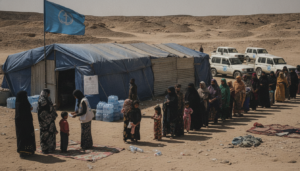
The United Nations reported that renewed fighting displaced more than 308,000 people across 10 Yemeni provinces between August 1 and November 4, 2026. That figure covers only the period since the August escalation, which means it excludes everyone displaced during earlier phases of a war that began in 2014 and it understates cumulative displacement considerably.
The pattern follows the fighting. Displacement clustered where the September ground offensive moved, therefore the Red Sea coastal corridor and the front lines around Taiz and Marib account for the largest movements. Because the Houthis enforced a naval blockade on Saudi shipping while the coalition struck launch sites in Sanaa and Saada, commercial and humanitarian logistics degraded at the same time, resulting in reduced access precisely where displacement was heaviest.
One verification limit should be stated openly. Casualty totals for 2026 remain disputed and no party to the conflict publishes auditable figures, so this report cites displacement — which UN agencies track systematically — rather than death tolls, which they do not.
Travel advisories and the international response
The US Department of State ordered the departure of non-emergency US government employees and their family members from Saudi Arabia effective October 23, 2026, and US personnel now require special authorisation to use any Saudi airport. That measure was driven by aviation risk rather than by ground insecurity, because missile and drone activity over Riyadh and the Eastern Province transits civil airspace and affects commercial approach paths, not only military installations.
The foreign deployment pattern is consistent and revealing. Britain deployed Typhoon fighters to help guard Saudi cities; France sent troops and air defence equipment to protect the Yanbu export terminal; the United Arab Emirates, which had stepped back from the war, rejoined in October 2026 by funding Yemeni government ground forces. Partners are protecting energy infrastructure and airspace while declining to commit their own ground troops, which means Saudi Arabia’s manpower problem inside Yemen remains unaddressed.
| Country | Action taken | Asset or focus | Effective date |
|---|---|---|---|
| United States | Ordered departure of non-emergency personnel and families | Diplomatic staff; Saudi airports restricted | October 23, 2026 |
| United Kingdom | Typhoon fighter deployment | Air defence of Saudi cities | Not stated |
| France | Troops and air defence equipment | Yanbu oil export terminal | Not stated |
| United Arab Emirates | Funding for Yemeni government ground forces | Ground campaign against the Houthis | October 2026 |
| Saudi-led coalition | Airstrikes on launch sites | Sanaa and Saada | November 8, 2026 |
Practical guidance for travellers is straightforward. Check your own government’s current advisory immediately before booking, because advisories in this conflict have been revised on a timescale of days rather than weeks, and airspace closures affect connections through Riyadh, Dammam and Jeddah with little notice.
What to watch next
The November 8 strike did not change the military balance, but it changed the political arithmetic, because an attack landing inside the King Abdullah Financial District raises the domestic cost to Riyadh of continuing the war without a settlement. Therefore the next phase will be decided by three measurable variables rather than by battlefield movement.
Three indicators that will determine the next phase
- Whether any de-escalation channel reopens — the 2022 truce framework is defunct, so a new mediation format would have to be constructed from scratch.
- Whether Saudi defence arrangements with Pakistan and Turkey produce concrete commitments — formalised pacts would signal Riyadh has ruled out a ground return to Yemen.
- Whether attacks shift from symbolic targets to producing-and-exporting energy assets — a confirmed hit on Abqaiq or Yanbu would move crude prices rather than only the Saudi index.
The base case is continuity. Absent a negotiated de-escalation, the pattern of saturation attacks met by partial interception continues, which means the Kingdom’s exposure is measured in insurance premiums and deferred investment rather than in lost territory.
Frequently asked questions
What happened in Riyadh on November 8, 2026?
A Houthi missile attack on Riyadh damaged a Saudi Aramco corporate building in the King Abdullah Financial District. Houthi forces used ballistic missiles, cruise missiles and drones against the capital and the Eastern Province. Coalition spokesman Maj. Gen. Turki al-Maliki said three ballistic and two cruise missiles were intercepted, and the Saudi Energy Ministry reported no injuries or fatalities.
Why did the Yemen war reignite in 2026?
The war reignited on July 13, 2026, when Saudi Arabia and the Saudi-backed Yemeni government struck Sanaa International Airport, reportedly to stop an Iranian aircraft carrying IRGC officers and military equipment from landing. The truce had held since April 2022 without any peace agreement, and regional spillover from the US-Israeli confrontation with Iran raised the stakes for both sides, which turned a single interdiction into full re-escalation.
Was Saudi Aramco’s headquarters damaged?
A Saudi Aramco corporate building in Riyadh’s King Abdullah Financial District was damaged — not the company’s Dhahran headquarters. Witnesses reported blown-out windows across several floors and facade damage. Saudi accounts attribute the damage to falling debris from an interception rather than a direct hit. The Energy Ministry confirmed no injuries or fatalities.
How many missiles did Saudi Arabia intercept?
Coalition spokesman Maj. Gen. Turki al-Maliki said Saudi air defenses intercepted three ballistic missiles and two cruise missiles on November 8, 2026 — five projectiles in total. The total number launched, including drones, has not been officially confirmed by either side, and no third party has audited the intercept count.
Is it safe to travel to Saudi Arabia right now?
Several governments have raised their risk assessments, and the US Department of State ordered the departure of non-emergency government personnel and their families effective October 23, 2026. US personnel now need special authorisation to use any Saudi airport. Missile and drone activity affects civil airspace over Riyadh and the Eastern Province, so travellers should check their own government’s current advisory before booking.
How do Houthi missiles reach Riyadh from Yemen?
Riyadh sits within reach of medium-range ballistic missiles and long-endurance drones launched from Houthi-held northern Yemen. According to Bernard Haykel of Princeton University, the Houthis deploy swarms of drones and cruise missiles supplied with Iranian assistance and incorporating Chinese parts. These fly low and saturate defences, which means interceptor capacity rather than detection is the limiting factor for Saudi air defense.
How many people have been displaced by the renewed fighting?
The United Nations reported more than 308,000 people displaced across 10 Yemeni provinces between August 1 and November 4, 2026. The figure covers only the post-August escalation and excludes earlier displacement. Casualty totals for 2026 remain disputed, because no party to the conflict publishes auditable figures.
Which countries are helping defend Saudi Arabia?
Britain deployed Typhoon fighters to help guard Saudi cities, France sent troops and air defence equipment to protect the Yanbu oil export terminal, and the UAE rejoined in October 2026 by funding Yemeni government ground forces. Saudi Arabia is also pursuing defence arrangements with Pakistan and Turkey rather than redeploying its own ground troops into Yemen.
What does the escalation mean for oil prices and Vision 2030?
The immediate effect is risk pricing rather than lost supply. Alerts over Abqaiq and Dhahran move crude markets because Abqaiq hosts the world’s largest crude stabilisation capacity. For Vision 2030 the damage is to confidence: daily alerts pushed the Saudi benchmark index down and reduced tourism against the 123 million arrivals reported in 2025, which delays investment decisions and project timelines.
Do the Houthis now control the Bab al-Mandeb Strait?
They control the Yemeni shore and nearby islands, not the strait itself. The September 2026 offensive took Yemen’s Red Sea coastline, Al-Makha, Perim Island and the Hanish Islands. The western shore lies in Djibouti and Eritrea and international naval forces still operate in the corridor, so the practical effect is higher war-risk premiums and rerouting rather than closure.
What we know, what we don’t, and how to read competing claims
Every reported figure in this account of the Houthi missile attack on Riyadh originates with a party to the conflict or with a UN agency, because no independent monitor has access to impact sites in Riyadh or to launch sites in Sanaa and Saada. Satellite-based damage assessment of the Eastern Province target set has not been published. Therefore readers should treat intercept counts and damage claims as the stated positions of their sources rather than as audited fact, and weigh them accordingly.
Known limitations in this report
- The total number of projectiles launched on November 8, 2026 has not been officially stated by either side
- Houthi claims of direct hits on King Khalid International Airport and Abqaiq storage tanks are uncorroborated
- The coalition’s intercept figure of three ballistic and two cruise missiles has not been independently verified
- 2026 casualty totals inside Yemen are disputed; this report cites UN displacement data instead
- The market and tourism impact is directional; the Kingdom has not published attributed loss figures
- Travel advisories in this conflict have been revised within days, so any status quoted here carries its effective date
INQ Daily will update this report as official statements, satellite-verified damage assessments or UN figures are revised, and will date each revision. Where a figure is later corrected, the correction will be stated explicitly rather than silently substituted into the text.
Conclusion
The Houthi missile attack on Riyadh of November 8, 2026 caused limited physical damage and no casualties, yet the debris landed inside the King Abdullah Financial District. That location is the point: the conflict has reached the geography of Saudi Arabia’s economic programme rather than its border provinces, which changes what the war costs the Kingdom.
The causal chain is short and traceable. The July 13 strike on Sanaa International Airport ended the April 2022 truce; the September offensive along Yemen’s Red Sea coast handed the Houthis maritime leverage over Bab al-Mandeb; and improved drone-and-cruise-missile saturation gave them reach to the capital. As a result Saudi Arabia faces a two-front pressure campaign it cannot answer with point defence alone, which is why it is buying guarantees abroad instead.
Three measurable variables will decide what follows: whether a mediation channel reopens, whether the Pakistan and Turkey defence arrangements formalise, and whether attacks move to producing energy assets. Follow INQ Daily world affairs coverage for dated, attributed updates on the Yemen conflict and Saudi security.
References
- Houthi claims of strikes on Riyadh’s business district and damage to an Aramco tower, November 8, 2026 — defence-blog.com
- Saudi Civil Defense National Early Warning Platform alerts across Riyadh, Al-Kharj, Najran and the Eastern Province — saudigazette.com.sa
- US Department of State ordered departure of non-emergency personnel from Saudi Arabia, effective October 23, 2026 — usembassy.gov
- Timeline of the 2022 truce, the July 13, 2026 Sanaa airport strike and renewed hostilities — wikipedia.org
- Analysis by Bernard Haykel, Professor of Near Eastern Studies, Princeton University, on Houthi drone and cruise missile capability and Saudi defence pacts — forbes.com
- Reporting on the September 2026 Houthi Red Sea coast offensive and Bab al-Mandeb positions — sanaacenter.org
- UN reporting on displacement of more than 308,000 people across 10 Yemeni provinces, August 1 – November 4, 2026 — eurasiareview.com
- Coalition statements and regional reaction to the November 8 barrage — arabnews.com
- International military deployments to Saudi Arabia and UAE re-entry into the conflict — aa.com.tr
- Market and tourism impact of sustained missile and drone alerts on the Kingdom — thehindu.com