
Table of Contents
- How Deep Is the Interceptor Missile Shortage?
- Why Ukraine Ran Out First
- Saudi Arabia and the Cost of Rationing
- Underground Production: How Iran Kept Firing
- The Cost Asymmetry Driving the Attrition
- Industry Response: Scaling Up Against the Clock
- What Comes Next
- Frequently Asked Questions
- Limitations of This Analysis
- Conclusion
- References
- Related Reading
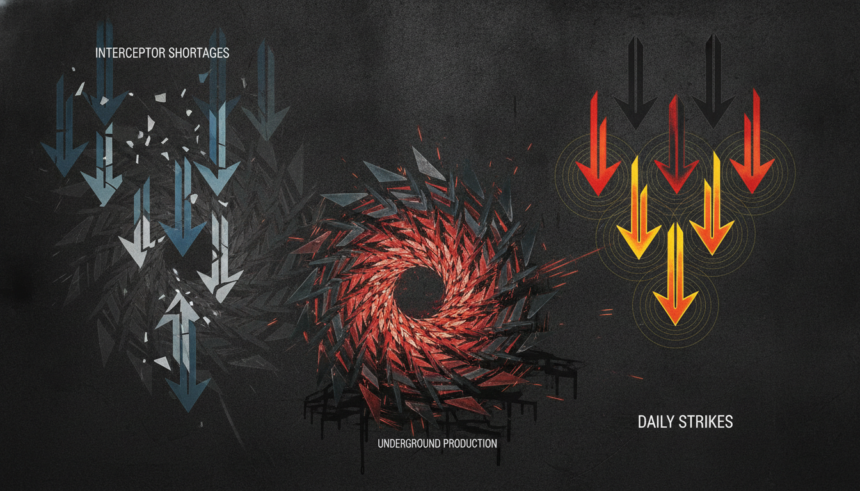
Key Takeaway: The global interceptor missile shortage has become the defining constraint on Western air defense, because consumption rates in Ukraine and the Middle East have outrun factories that need up to 36 months to build a single round. A Congressional Budget Office assessment found the U.S. military expended between one-half and two-thirds of its missile defense interceptor inventory since June 2025, and former Army Chief of Staff Gen. Randy George warned stockpiles might not return to pre-war levels until 2030. Meanwhile Iran has resumed ballistic missile assembly in underground facilities, and Russia and the Houthis are exploiting the gap with daily strikes designed to drain magazines rather than destroy defenses.
Air defense was supposed to be the West’s asymmetric advantage. Instead, by October 2026 it has become its most exposed flank. The reason is arithmetic rather than engineering: a Patriot PAC-3 round takes years to build and costs millions, while the drones and ballistic missiles it shoots down are produced in weeks at a fraction of the price. When that exchange runs daily for eighteen months, the defender loses the ledger even when it wins every engagement.
The consequences are already visible on three continents. Ukraine has reportedly exhausted its U.S.-made Patriot interceptors. Saudi Arabia has been forced to redeploy batteries away from civilian areas to shield oil infrastructure. Washington is rationing scarce rounds across multiple theatres simultaneously. And Tehran, having absorbed heavy U.S. and Israeli strikes on its missile bases, has pushed production underground and restarted the lines.
About this report: Compiled by the INQ Daily international news desk, which covers armed conflict, security and defence procurement with dateline-led, attributed reporting. All figures below are traceable to the named sources in the References section.
Transparency note: This analysis draws on publicly reported assessments from the Congressional Budget Office, the Center for Strategic and International Studies, CBS News, The Wall Street Journal and regional reporting current to October 19, 2026. Stockpile numbers for classified munitions are estimates produced by outside analysts, not official inventories, and they should be read as approximations.
How Deep Is the Interceptor Missile Shortage?
The interceptor missile shortage is now measured in years of recovery, not months of resupply. According to a Congressional Budget Office report, the U.S. military expended between one-half and two-thirds of its total inventory of missile defense interceptors from June 2025 onward as a direct result of the conflict with Iran. By August 2026, sources indicated that nearly 80% of interceptors for key missile defense systems had been drawn down.
The Center for Strategic and International Studies estimated the United States entered 2026 with roughly 2,300 Patriot interceptors and expended up to 1,430 of them during the Middle East conflict, alongside up to 290 of its 355 pre-war THAAD rounds. That is not attrition at the margins; it is the consumption of a strategic reserve built over two decades.
Recovery is slow because production physics will not bend to political urgency. Manufacturing a single missile can take up to 36 months, and new THAAD contracts take over four years to fulfil. Consequently, a CBS News report revealed that ousted U.S. Army Chief of Staff Gen. Randy George warned American THAAD and Patriot stockpiles were critically low and might not recover to pre-war levels until 2030. The effect of that timeline is a four-year window in which the United States cannot simultaneously defend Israel, supply Ukraine, backstop Gulf partners and hold a reserve for the Indo-Pacific.
| Metric | Reported figure | Source |
|---|---|---|
| U.S. interceptor inventory expended since June 2025 | One-half to two-thirds | CBO |
| Key-system interceptors depleted by August 2026 | Nearly 80% | Reported sources |
| Patriot interceptors held entering 2026 | About 2,300 | CSIS |
| Patriot rounds expended in Middle East conflict | Up to 1,430 | CSIS |
| THAAD rounds expended of 355 pre-war | Up to 290 | CSIS |
| Build time for a single missile | Up to 36 months | CBO/industry |
| Projected stockpile recovery | 2030 | Gen. Randy George, via CBS News |
Why Ukraine Ran Out First
Ukraine ran out first because it was last in the allocation queue and first in the firing line. As of mid-October 2026 Ukraine has reportedly exhausted its supply of U.S.-made Patriot interceptor missiles. On October 16, 2026, reporting indicated Kyiv held only about 10 Patriot rounds as of October 7, and those were consumed during subsequent Russian attacks.
The supply side explains why the deficit never closed. President Volodymyr Zelensky stated on October 18, 2026, that the United States is supplying just 12 Patriot interceptors per month and is delaying delivery of missiles already paid for under the NATO-coordinated PURL initiative. Twelve rounds a month cannot cover a single serious ballistic salvo, which means Ukraine’s air defense has shifted from denial to triage.
Russia has read the ledger correctly. During a major attack on August 5, 2026, Ukrainian forces intercepted none of the 24 ballistic missiles launched. Russian planners now pair drone reconnaissance with simultaneous ballistic launches from multiple axes, a method that works precisely because depleted Patriot batteries cannot cover every vector at once. Strikes on October 14 and October 18–19, 2026, concentrated on energy infrastructure in Kyiv and Kharkiv, capitalising on the absence of interceptors ahead of winter.
Saudi Arabia and the Cost of Rationing
Saudi Arabia is rationing air defense because daily Houthi missile and drone attacks have outpaced its own interceptor resupply. The kingdom has redeployed batteries to prioritise critical energy facilities and national leadership, and as a result other regions and civilian infrastructure are more exposed than they were a year ago.
The human cost of that trade-off surfaced on October 10, 2026, when an attack killed 12 people and wounded more than 300. The lesson defence planners drew was uncomfortable: systems as capable as PAC-3 and THAAD are overwhelmed by volume and evolving attack geometry once magazine depth falls below a certain threshold. Capability without quantity is a brittle defence.
Underground Production: How Iran Kept Firing
Iran kept firing because it moved its factories where bombs could not reach them. Despite heavy U.S. and Israeli airstrikes on Iranian missile bases early in the war, Tehran has resumed ballistic missile production. A September 2026 Wall Street Journal report found Iran is drawing on stockpiled components to assemble both liquid- and solid-fuelled missiles in underground facilities, including the Kozir missile complex.
Tehran has also turned survival into messaging. In August 2026 Iranian Armed Forces Chief of Staff Major General Ali Abdollahi visited an underground production facility and released video to state media, a deliberate signal that the manufacturing base outlived the strike campaign and that output has increased. Whether the claimed increase is accurate matters less strategically than the perception it creates among regional partners weighing whether Western deterrence still holds.
Underground production is not unique to Iran proper. In September 2024 Israeli special forces from the Shaldag Unit executed “Operation Many Ways,” a raid that destroyed an underground Iranian missile manufacturing plant at a Syrian Scientific Studies and Research Center site near Masyaf. The raid succeeded tactically, yet the broader shift to subterranean manufacturing continues to frustrate Western intelligence collection and strike planning, because hardened and dispersed sites force repeated, expensive sorties for uncertain effect.
The Cost Asymmetry Driving the Attrition
The economics of interception are the core problem, and no amount of engineering excellence resolves them. The Congressional Budget Office estimates direct operational costs for the U.S. Department of Defense in the war with Iran reached approximately $38 billion by August 2026. Defenders fire multi-million-dollar interceptors at comparatively cheap offensive munitions, and adversaries are deliberately exploiting that mathematics by sustaining volume rather than seeking precision.
This asymmetry reshapes doctrine in three ways:
- Allocation becomes the main decision. With finite rounds, commanders defend assets rather than territory, which concedes civilian exposure by design.
- Deterrence erodes before defences fail. An adversary that knows the magazine is shallow has an incentive to escalate, not pause.
- Cheaper interceptors become a strategic requirement. Matching cost-per-shot matters as much as hit probability.
Industry Response: Scaling Up Against the Clock
Industry is responding, though every initiative on the table matures after the current window of vulnerability closes. In October 2026 the first Tamir interceptor for the Iron Dome system built entirely outside Israel was delivered from the new Raytheon–Rafael facility in Camden, Arkansas, a step that adds a second geographic source and reduces single-point production risk.
New entrants are attacking the cost problem directly. Anduril Industries has unveiled the “Steelfin” interceptor as a cheaper complement to Patriot and is exploring manufacturing in Europe, specifically Poland, ahead of flight testing in 2027. Lockheed Martin is in advanced talks to expand Patriot PAC-3 production outside the United States and is developing the lower-cost “PAC-3 ACE” variant.
| Initiative | Company | Status as of October 2026 |
|---|---|---|
| Tamir interceptor, Camden, Arkansas | Raytheon–Rafael | First non-Israeli-built round delivered |
| Steelfin interceptor | Anduril Industries | Unveiled; flight testing planned 2027 |
| European production site | Anduril Industries | Poland under consideration |
| PAC-3 production expansion abroad | Lockheed Martin | Advanced talks |
| PAC-3 ACE lower-cost variant | Lockheed Martin | In development |
The common thread is that capacity expansion is a 2027–2030 story, while the strikes are happening nightly. Therefore the next two years will be governed by allocation discipline rather than by new supply — a point our ongoing coverage of world affairs and security at INQ Daily returns to repeatedly.
What Comes Next
Three dynamics will determine whether the interceptor missile shortage stabilises or deepens. First, whether U.S. deliveries to Ukraine rise above the 12 rounds a month Zelensky described, because anything less leaves Ukrainian cities structurally undefended against ballistic salvos. Second, whether low-cost interceptors such as Steelfin and PAC-3 ACE reach fielding quickly enough to change cost-per-shot before 2030. Third, whether strike campaigns against hardened underground production prove capable of suppressing output, which the Iranian case so far suggests is difficult.
“Technological superiority is negated by a lack of magazine depth.”
— Analytical summary of the 2025–2026 interceptor depletion record
Frequently Asked Questions
What is causing the interceptor missile shortage?
Sustained high-tempo conflict combined with slow production. The CBO found U.S. forces expended one-half to two-thirds of their missile defense interceptor inventory since June 2025, while a single missile takes up to 36 months to build and THAAD contracts take over four years to fulfil. Demand therefore outran supply.
How many Patriot interceptors does Ukraine have left?
Effectively none of its U.S.-made stock. Reporting on October 16, 2026, indicated Ukraine held roughly 10 Patriot rounds as of October 7, which were used during subsequent Russian attacks. Zelensky said on October 18, 2026, that U.S. supply runs at about 12 interceptors per month.
When will U.S. stockpiles recover?
Not before 2030, according to a CBS News report on warnings from former Army Chief of Staff Gen. Randy George. Recovery depends on production line throughput rather than funding alone, because missile assembly timelines cannot be compressed quickly even with additional contracts.
Why does underground production matter so much?
It protects supply from airstrikes. A September 2026 Wall Street Journal report found Iran assembling liquid- and solid-fuelled missiles underground using stockpiled parts, including at the Kozir facility. Consequently offensive output survived the strike campaign while Western defensive stockpiles fell.
Are cheaper interceptors a realistic fix?
Partly. Anduril’s Steelfin enters flight testing in 2027 and Lockheed Martin is developing the PAC-3 ACE lower-cost variant. Both target the cost asymmetry directly, but neither changes magazine depth during the 2026–2027 period when the shortage is most acute.
Limitations of This Analysis
Research limitations. Interceptor inventories are classified, so the figures here rest on outside estimates — notably CSIS modelling of roughly 2,300 Patriot rounds entering 2026 — and on official statements that may be partial. Expenditure ranges such as “one-half to two-thirds” reflect genuine uncertainty rather than reporting imprecision. Iranian production claims come from state media and should be treated as self-interested.
Alternative readings. Some analysts argue depletion figures overstate risk because they count rounds expended in a single intense campaign rather than steady-state consumption, and because allied inventories in Europe, Israel and East Asia are not fully captured in U.S.-centric estimates. Others contend layered defences using guns, electronic warfare and short-range effectors can absorb drone volume and preserve high-end interceptors for ballistic threats.
Where to seek further detail. Readers requiring procurement-grade data should consult primary CBO publications, CSIS reports and official defence budget documentation rather than secondary summaries, including this one.
Conclusion
The 2025–2026 record exposes a structural flaw in Western defence planning: magazine depth was treated as a budgeting detail rather than a strategic variable. Because interceptor production runs on multi-year timelines while conflict consumption runs daily, the United States and its partners entered a window of vulnerability that closes around 2030 at the earliest.
Adversaries have adapted faster than industry. Iran protected its assembly lines underground and restarted output; Russia and the Houthis switched to volume tactics that trade cheap munitions for expensive interceptors. The result is a war of attrition that favours the side with the shorter production cycle, which is not the side with the better technology.
The immediate consequence is allocation under scarcity: Ukraine running on near-zero Patriot stocks, Saudi Arabia shielding oil facilities at the expense of civilian areas, and Washington balancing three theatres with a depleted reserve. For readers tracking how defence industrial capacity shapes geopolitics, this is the pressure point to watch through 2027.
References
- Congressional Budget Office and allied assessments of interceptor expenditure (reported October 2026)
- Reporting on U.S. missile defense stockpile depletion and recovery timelines
- Coverage of Saudi air-defence redeployment and Houthi strike tempo
- Ukrainian reporting on remaining Patriot interceptor stocks, October 2026
- Kyiv Independent coverage of Russian strike campaigns and interceptor supply
- Kyiv Independent reporting on PURL deliveries and monthly interceptor rates
- Reporting on Iran’s underground missile assembly and the Kozir facility
- Analysis of Iranian production resilience after the 2025–2026 strike campaign
- Record of Operation Many Ways and the Masyaf underground facility
- Tamir interceptor production in Camden, Arkansas
- Anduril Steelfin interceptor and European manufacturing plans
- Lockheed Martin PAC-3 expansion and PAC-3 ACE development
- Middle East Eye reporting on regional strike impacts