
Table of Contents
- The state of play one month out
- How the gang war became an air war
- The October 18 ambush that triggered the surge
- What explosive drones do in a dense slum
- The dead and the hunted: gang leadership losses
- Mathias Saintil, Nan Boston, killed November 5-6
- Wilson Joseph's compound destroyed November 8
- Why El Salvador is fighting in Haiti
- The human cost in numbers
- Can the December 13 vote actually happen?
- What the referendum would change
- Accountability questions the strikes have opened
- What to watch before December 13
- Frequently Asked Questions
- When is Haiti's 2026 election and what is being voted on?
- Can Haiti's December 13 election actually happen?
- Which Haitian gang leaders have been killed in the recent airstrikes?
- Why did El Salvador deploy troops to Haiti?
- What is Viv Ansanm?
- What is the Gang Suppression Force and how large is it?
- How many people have been killed in Haiti this year?
- Are the drone strikes in Haiti killing civilians?
- Who governs Haiti right now if there are no elected officials?
- What happens if the Haiti election is delayed again?
- What this reporting cannot confirm
- Conclusion
- References
- Related Reading
Key Takeaway: Haiti election 2026 is scheduled for December 13. On that day voters would choose a president and legislature and decide a constitutional referendum, in the first general election since 2016. A Salvadoran-backed air campaign has killed Nan Boston leader Mathias Saintil and destroyed Wilson Joseph’s 400 Mawozo compound, but the UN logged more than 1,000 killings between July and September. Security, not politics, will decide whether the vote happens.
PORT-AU-PRINCE, Nov. 13, 2026 — The Haiti election 2026 first round is set for December 13, one month from today, and would be the country’s first general election since 2016. Since late October, more than 2,000 Salvadoran troops, attack helicopters and explosive drones have changed the fight against the Viv Ansanm gang coalition. Two gang leadership targets were struck within four days. The vote’s feasibility is still in doubt. The UN counted more than 1,000 people killed from July to September, and hundreds of thousands of Haitians are displaced. Jacques Desrosiers, president of the Provisional Electoral Council, has said the vote cannot proceed unless security improves dramatically. Decapitation strikes are being tried because ground clearance proved impossible. The election’s fate therefore depends on whether air power can substitute for territorial control within 30 days.
About this report: Prepared by the INQ Daily world affairs desk. It draws on the UN human rights report of Nov. 12, 2026, statements from Amnesty International and RNDDH, and regional reporting from Caribbean and specialist military outlets. Every figure is attributed to a named source and dated.
Transparency note: INQ Daily did not verify these events independently on the ground. Mathias Saintil’s death was announced by the Haitian government. Casualty figures linked to the November strikes are provisional. All information is current as of Nov. 13, 2026.
The state of play one month out
The Haiti election 2026 ballot is unusually broad because Haiti currently has no elected officials in office. As a result, the December 13 vote covers the presidency, the legislature and a constitutional referendum at the same time. According to Caribbean Today’s reporting on the electoral timetable (2026), the Provisional Electoral Council (CEP) set the date.
The CEP extended candidate registration through late October to ease frustrations. Consequently, the candidate field was settled only weeks before voters are due at the polls, in the middle of the worst phase of the Port-au-Prince security situation.
Where Haiti stands on Nov. 13, 2026
- Dec. 13, 2026: First round of presidential and legislative elections plus a constitutional referendum, set by the Provisional Electoral Council (CEP)
- 2016: Last general election; Haiti currently has no elected officials in office
- Late October 2026: Nayib Bukele deploys more than 2,000 Salvadoran soldiers, attack helicopters and armoured vehicles to Port-au-Prince
- Nov. 5-6, 2026: Nan Boston leader Mathias Saintil dies of injuries from an explosive drone strike on his vehicle
- Nov. 12, 2026: UN human rights report records more than 1,000 people killed in Haiti between July and September
How the gang war became an air war
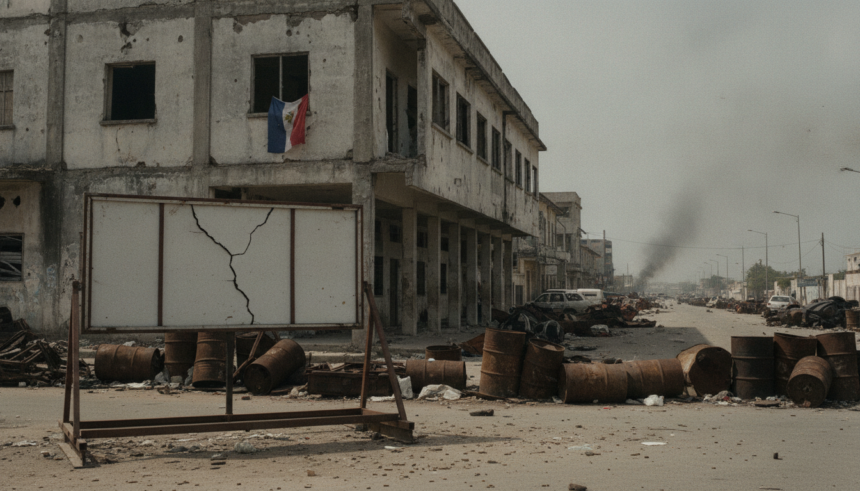
Air power replaced infantry because there was no infantry to clear the ground. The UN-backed Gang Suppression Force (GSF) had been operating at less than 30% of its intended capacity. That shortfall made house-by-house clearance of Viv Ansanm territory impossible. Salvadoran and Haitian forces therefore turned to attack helicopters and explosive “kamikaze” drones to hit gang strongholds from above, according to Militarnyi’s reporting on the Port-au-Prince deployment (2026). Haiti’s conflict had been fought at street level until this autumn. The airstrikes mark a clear break with that pattern.
From street fighting to airstrikes: the escalation timeline
- Oct. 18, 2026: Four Salvadoran aviation technicians attached to the GSF are ambushed and disappear.
- Late October 2026: Bukele orders a surge of more than 2,000 troops, attack helicopters and armoured vehicles into Port-au-Prince.
- Nov. 3, 2026: Salvadoran attack helicopters fly close air support for Chadian GSF troops pinned down under heavy fire.
- Nov. 5-6, 2026: An explosive drone strike hits Mathias Saintil’s vehicle in the Nan Boston area of Cité Soleil.
- Nov. 8, 2026: A joint Haitian-Salvadoran airstrike destroys Wilson Joseph’s 400 Mawozo compound.
- Nov. 12, 2026: The UN human rights report is published, documenting both gang atrocities and security-force killings.
The trade-off is structural. Airstrikes remove commanders and buildings, but they do not take or hold ground. Consequently, none of the sources reviewed for this article report that gang control of neighbourhoods and roads has loosened in any measurable way.
The October 18 ambush that triggered the surge
The surge followed the loss of El Salvador’s own personnel. On October 18, four Salvadoran aviation technicians attached to the GSF were ambushed and disappeared, as reported by Caribbean National Weekly (2026). The loss of its nationals turned El Salvador’s technical contribution into a combat deployment. This explains why helicopters, armoured vehicles and drones reached Port-au-Prince within days of the ambush rather than months.
What explosive drones do in a dense slum
Explosive drones were used against vehicles and compounds in Cité Soleil, one of the most densely populated districts in Port-au-Prince. They detonate on impact, and in tightly packed housing the blast reaches whoever is nearby, not only the intended target. According to the UN human rights report of Nov. 12, 2026, at least 16% of people killed in security-force operations were not associated with gangs. Amnesty International has warned Prime Minister Alix Didier Fils-Aimé and President Bukele that Salvadoran operations must comply with international human rights law. Amnesty cited the indiscriminate effect of explosive drones in densely populated slums.
The dead and the hunted: gang leadership losses
Two Viv Ansanm-linked leadership targets were hit within four days. Mathias Saintil of Nan Boston was killed. Wilson Joseph of 400 Mawozo lost his compound but survived, because he was not there when it was struck.
High-value targets struck, November 2026
| Target | Gang / affiliation | Date | Method | Outcome |
|---|---|---|---|---|
| Mathias Saintil | Nan Boston (Viv Ansanm), Cité Soleil | Nov. 5-6, 2026 | Explosive drone strike on vehicle | Died of injuries (government-announced) |
| Wilson Joseph, alias Lanmò San Jou | 400 Mawozo | Nov. 8, 2026 | Joint Haitian-Salvadoran airstrike | Compound destroyed; Joseph at large |
| Gang positions engaged alongside Chadian GSF troops | Viv Ansanm-held area | Nov. 3, 2026 | Attack helicopter close air support | Not stated |
Prime Minister Fils-Aimé marked Saintil’s death on social media, as reported by Caribbean National Weekly (2026):
“One less gang leader. The fight to free the country from the grip of bandits continues with determination. The gangs won’t get a moment’s peace.”
— Alix Didier Fils-Aimé, Prime Minister of Haiti, on social media
The statement shows how the government is presenting its campaign. It is counting dead commanders because it has no recaptured territory to point to.
The strategy also has a ceiling. Viv Ansanm is a coalition, so removing one faction boss redistributes authority inside the structure rather than dissolving it.
Mathias Saintil, Nan Boston, killed November 5-6
Saintil died after a coordinated explosive drone strike on his vehicle. He suffered fatal injuries and died shortly afterwards. The Haitian government announced the death, and Prime Minister Fils-Aimé celebrated it publicly. No independent verification was available at the time of publication. Saintil led Nan Boston, the Viv Ansanm faction operating in Cité Soleil, which made him the highest-profile casualty of the air campaign so far.
Wilson Joseph’s compound destroyed November 8
A joint Haitian-Salvadoran airstrike destroyed the headquarters of Wilson Joseph, alias Lanmò San Jou, leader of 400 Mawozo. Joseph was absent and remains at large. The operational gain was therefore the loss of gang infrastructure and a message to gang leaders, not the removal of a leader. The strike was a symbolic victory. It did not cut 400 Mawozo’s chain of command.
Why El Salvador is fighting in Haiti
Bukele’s deployment exports El Salvador’s “iron fist” security model. As a result, the political stakes of the operation reach well beyond Haiti’s ballot. Political analysts describe Haiti as a testing ground for that approach.
The mechanism is simple. With the GSF below 30% of intended strength, El Salvador’s troops, helicopters and drones did not just reinforce an existing mission. They redefined it, according to Militarnyi (2026).
The Gang Suppression Force before and after the Salvadoran surge
| Dimension | Before late October 2026 | After the Salvadoran surge |
|---|---|---|
| Manning against authorised strength | Less than 30% | More than 2,000 Salvadoran troops added |
| Air assets in use | Not stated | Attack helicopters, explosive drones |
| Primary tactic | Ground-level urban fighting | Drone and helicopter strikes on strongholds |
| Named troop contributors in action | Salvadoran aviation technicians | Salvadoran, Chadian and Haitian forces |
Reactions have split along predictable lines. Thousands marched in Port-au-Prince in early November in support of the Salvadoran troops, driven by exhaustion with gang rule. Amnesty International warned Fils-Aimé and Bukele that operations must comply with international human rights law.
A December vote held under foreign air cover would strengthen the case for the Bukele model across the region. This is why the operation is being watched outside the Caribbean.
The human cost in numbers
The UN human rights report published Nov. 12, 2026 covers July to September. It therefore predates the air campaign and does not capture strike-related casualties. Those have since been documented by RNDDH, Haiti’s leading domestic human rights monitoring network.
Haiti’s violence in figures, 2026
| Figure | What it measures | Period | Source |
|---|---|---|---|
| More than 1,000 | People killed in Haiti | July–September 2026 | UN human rights report, Nov. 12, 2026 |
| 19 | People beheaded in Cité Soleil, including 12 elderly women | August 2026 | UN human rights report |
| 36 | Victims shot dead in a church courtyard | Not stated | UN human rights report |
| 44 | Extrajudicial executions involving the Haitian National Police | Q3 2026 | UN human rights report |
| At least 16% | Security-force operation victims not linked to gangs | Not stated | UN |
| Under 30% | GSF manning before the Salvadoran surge | Before late October 2026 | Not stated |
The pattern shows violence against civilians coming from both gangs and state forces. Consequently, accountability questions attach to both.
Can the December 13 vote actually happen?
On the evidence available on Nov. 13, the Haiti election 2026 first round is not deliverable as a full nationwide vote on December 13. The realistic outcomes are a partial or phased vote, or a further postponement.
The strongest evidence comes from the electoral authority itself. CEP president Jacques Desrosiers has warned that the vote cannot proceed unless security improves dramatically, according to Caribbean Today (2026). That improvement has not happened, because gang territorial control remains intact.
The practical obstacles compound one another:
- Polling centres. There is no verified count of safe polling centres, which means ballot distribution cannot be planned.
- Displacement. Hundreds of thousands of people have been displaced, as documented in ReliefWeb’s Haiti situation reporting. As a result, voter rolls no longer match where people live.
- Poll workers. Gangs have murdered civilians who denounced their interference in the electoral process. Recruiting poll workers is therefore dangerous in itself.
Five conditions a December 13 vote requires
- Security: Gang control of Port-au-Prince neighbourhoods reduced enough for unarmed poll workers to operate
- Polling centres: A published, verified list of sites that can open and be defended on the day
- Voter registration: Rolls reconciled with a displaced population that has moved since the last update
- Displacement: Arrangements for hundreds of thousands of internally displaced Haitians to vote away from their home districts
- Candidates and campaigning: A final candidate list and the physical ability to campaign, after registration ran into late October
One development would change this verdict: the CEP publishing a verified list of secured polling centres before early December.
What the referendum would change
The constitutional referendum is being held on the same day as the first round. Voters are therefore being asked to approve a new constitutional framework and, at the same time, to elect the officials who would operate under it.
Holding both votes together creates a specific risk. A low or regionally uneven turnout would leave both the referendum result and the new legislature open to legitimacy challenges. That risk is the strongest argument for holding the two votes separately.
The legislative elections would also restore a parliament that has been absent since 2016. A newly elected parliament would give Haiti’s institutions an elected mandate for the first time in a decade.
Accountability questions the strikes have opened
Amnesty International has set out the objection directly. It warned Prime Minister Fils-Aimé and President Bukele that all operations by Salvadoran forces must comply with international human rights law, citing the indiscriminate effect of explosive drones in densely populated slums.
The documentation supports that concern. RNDDH reported that the recent drone strikes, while killing gang leaders, also caused civilian casualties. The UN human rights report of Nov. 12, 2026 recorded 44 cases of extrajudicial execution involving the Haitian National Police in the third quarter alone.
The government and its supporters have a case of their own. The strikes removed a gang leader whose death the government has announced. Thousands also marched in support of the Salvadoran deployment, because gang rule had made ordinary movement across the capital impossible.
The mechanism that would settle these disputes does not yet exist. No independent body has been named to investigate casualties from the strikes, so the disputed figures will stay disputed.
What to watch before December 13
Five concrete indicators will show by early December whether the vote is being prepared or quietly abandoned.
Five indicators to track
- Polling centres: Whether the CEP publishes a verified list of secured polling centres by early December. Publication would show the vote is logistically real.
- Gang succession: Whether Viv Ansanm names successors to Mathias Saintil. That would show the coalition is absorbing its leadership losses.
- Air operations: Whether Salvadoran air operations continue after the case of the four missing aviation technicians is resolved. Continued strikes would show a commitment to Haiti that goes beyond retaliation.
- GSF manning: Whether GSF manning rises further toward authorised strength. This matters because air power alone does not hold polling sites.
- Civilian deaths inquiry: Whether any independent mechanism is announced to investigate civilian deaths from the airstrikes. An announcement would show accountability is being built into the campaign.
Frequently Asked Questions
When is Haiti’s 2026 election and what is being voted on?
The Haiti election 2026 first round is set for December 13, 2026. On the same day, voters would elect a president and a legislature and decide a constitutional referendum. It would be Haiti’s first general election since 2016. The Provisional Electoral Council set the date and extended candidate registration through late October to ease frustrations among candidates.
Can Haiti’s December 13 election actually happen?
A full nationwide vote on December 13 is not deliverable on current evidence. CEP president Jacques Desrosiers has warned that the vote cannot proceed without a dramatic improvement in security. Gang territorial control in Port-au-Prince remains intact, hundreds of thousands of voters are displaced, and there is no verified list of safe polling centres. A partial or phased vote, or another postponement, are the realistic outcomes.
Which Haitian gang leaders have been killed in the recent airstrikes?
Mathias Saintil, leader of the Nan Boston gang in Cité Soleil, died after an explosive drone strike on his vehicle on November 5-6, 2026. The Haitian government announced his death. An airstrike on November 8 destroyed the compound of Wilson Joseph, leader of 400 Mawozo. Joseph was not present and remains at large, so that strike removed infrastructure rather than leadership.
Why did El Salvador deploy troops to Haiti?
President Nayib Bukele sent more than 2,000 soldiers, attack helicopters and armoured vehicles in late October 2026. The deployment followed the October 18 ambush and disappearance of four Salvadoran aviation technicians serving with the Gang Suppression Force. Analysts also see the deployment as an export of Bukele’s “iron fist” security model, which raises its stakes well beyond Haiti.
What is Viv Ansanm?
Viv Ansanm is the powerful coalition of Haitian gangs that Salvadoran and Haitian forces are now targeting from the air. Its member factions include Nan Boston in Cité Soleil, the group led by Mathias Saintil. Because Viv Ansanm is a coalition, killing one faction leader redistributes authority among the remaining factions rather than dismantling the overall structure.
What is the Gang Suppression Force and how large is it?
The Gang Suppression Force (GSF) is the UN-backed mission deployed against Haiti’s gangs. It was operating at less than 30% of its intended capacity until more than 2,000 Salvadoran troops arrived in late October 2026. Salvadoran and Chadian personnel are among the contributors now in action. The Salvadoran surge changed the mission’s main tactic to drone and helicopter strikes.
How many people have been killed in Haiti this year?
A UN human rights report published November 12, 2026 recorded more than 1,000 people killed between July and September 2026 alone. The same report documented 19 beheadings in Cité Soleil in August, including 12 elderly women, and 36 people shot dead in a church courtyard. Full-year figures have not been published, and the report predates the November air campaign.
Are the drone strikes in Haiti killing civilians?
Yes, according to human rights monitors. RNDDH reported civilian casualties from the recent drone strikes. The UN found that at least 16% of people killed in security-force operations had no gang association. Amnesty International warned Fils-Aimé and Bukele over the use of explosive drones in densely populated areas. No independent body has been named to investigate the strike casualties.
Who governs Haiti right now if there are no elected officials?
Haiti is run by a transitional government led by Prime Minister Alix Didier Fils-Aimé, because the country currently has no elected officials in office. The Provisional Electoral Council organises the vote. This lack of electoral legitimacy is why the December 13 ballot carries such weight: it would restore elected leadership for the first time since 2016.
What happens if the Haiti election is delayed again?
A further delay would extend unelected transitional rule and leave the constitutional referendum unresolved. That would deepen the legitimacy deficit that has persisted since 2016. It would also increase Haiti’s reliance on foreign military deployments for basic order, because no elected mandate exists to authorise, oversee or constrain operations such as the Salvadoran air campaign.
What this reporting cannot confirm
Coverage of the Haiti election 2026 countdown depends on sources that cannot be independently checked on the ground. The Haitian government announced Mathias Saintil’s death, and Prime Minister Alix Didier Fils-Aimé celebrated it publicly. No independent forensic verification had been published at the time of writing.
The UN casualty counts for July to September predate the air campaign. As a result, civilian deaths from the current strikes are documented only by RNDDH, and those figures remain provisional. OHCHR’s Haiti country reporting explains how verification standards affect the timing and completeness of such counts.
No verified national count of safe polling centres exists. Any projection of turnout or coverage on December 13 is therefore an estimate, not a measurement.
There are two competing readings of the strikes. Supporters of the deployment argue that decapitation strikes are the only instrument available. Amnesty International argues that the method is unlawful in dense urban areas. Both positions rest on the same incomplete casualty record.
Conclusion
The transitional government turned to airstrikes because the GSF lacked the manpower to clear territory. Consequently, the election’s viability now depends on whether removing commanders changes who controls the streets. So far, the evidence shows dead and displaced leaders but no change in gang control of territory. That points to a partial or phased first round, or another postponement, on December 13 rather than a full nationwide vote. The Haiti election 2026 question will be answered by one checkable indicator before the date arrives: whether the CEP publishes a verified list of secured polling centres.
References
- United Nations. Human rights report on Haiti, covering July–September 2026, published Nov. 12, 2026. https://www.un.org/
- UN Office of the High Commissioner for Human Rights. Haiti country page and human rights reporting. https://www.ohchr.org/en/countries/haiti
- Amnesty International. Warning to Prime Minister Fils-Aimé and President Bukele on Salvadoran force operations, 2026. https://www.amnesty.org/en/location/americas/central-america-and-the-caribbean/haiti/
- Réseau National de Défense des Droits Humains (RNDDH). Documentation of civilian casualties from November 2026 drone strikes. https://web.rnddh.org/
- ReliefWeb. Haiti humanitarian and displacement situation reporting. https://reliefweb.int/country/hti
- Militarnyi. Reporting on the Salvadoran deployment, attack helicopters and drone operations in Port-au-Prince, 2026. Link
- Caribbean National Weekly. Reporting on the Oct. 18 ambush, the death of Mathias Saintil and the Wilson Joseph compound strike, 2026. Link
- Caribbean Today. Reporting on the Provisional Electoral Council timetable, candidate registration extension and CEP security warning, 2026. Link