
Table of Contents
- Iron Dome 2026 at a glance
- How Iron Dome works, in four steps
- What one battery actually contains
- The drone gap that forced the laser upgrade
- The laser layer: Iron Beam joins Iron Dome
- 28 December 2025: first system delivered
- 1 July 2026: integration into the battle management centre
- The limits: 14 batteries, 10 kilometres, weather
- Arkansas-built interceptors: the Camden production line
- R2S: the Raytheon-Rafael joint venture
- 7-8 October 2026: the first fully US-made Tamir
- SkyHunter, the US Marine Corps and the road to 1,000 a year
- First deployment abroad: the UAE battery, then Romania
- Iron Dome compared: Patriot, David's Sling, Arrow 3 and Golden Dome
- What the Iron Dome 2026 changes mean next
- Frequently asked questions
- Limitations of the 2026 upgrades, and what they do not fix
- Conclusion
- References
Iron Dome 2026 marks the system’s biggest change since 2011. The 100kW-class Iron Beam laser was folded into the Iron Dome battle management centre on 1 July 2026, cutting the cost per engagement from roughly $50,000 per Tamir to a few dollars of electricity. The first fully US-made Tamir interceptors were handed to the Israel Missile Defense Organization by Raytheon-Rafael Protection Systems in East Camden, Arkansas on 7-8 October 2026. And Israel deployed an Iron Dome battery to the United Arab Emirates in April 2026 — its first operational deployment on foreign soil — followed by Romania in September 2026.
On 7-8 October 2026, Raytheon-Rafael Protection Systems handed the Israel Missile Defense Organization the first Tamir interceptors built end-to-end in East Camden, Arkansas. That handover is the clearest marker that iron dome 2026 is no longer a purely Israeli system. The driver was arithmetic: Iran and its partners shifted to cheap one-way attack drones, and because a $50,000 Tamir interceptor fired at a drone worth a fraction of that is a losing exchange, the defender was paying more per engagement than the attacker. Consequently Israel pursued two answers at once — a directed-energy layer and a second production source. This article covers the mechanics, the laser integration, the Arkansas line, the UAE and Romania deployments, and how the Israel air defense system compares with Patriot, David’s Sling, Arrow 3 and the US Golden Dome programme. All figures are current as of 8 November 2026.
About this report. INQ Daily is an international news desk covering armed conflict, security and defence procurement with concise, attributed, dateline-led reporting. This explainer is built from published reporting and named official statements, not from unattributed briefings.
Transparency note. Every date, price and production figure below is attributed to its source in the text and listed in the References section. Interception counts and success rates cited here originate with Israeli officials or the manufacturer; INQ Daily has not independently verified them.
Iron Dome 2026 at a glance
The 2026 position of iron dome 2026 can be stated in three clauses. Kinetic interceptors now come from two countries rather than one, because the Camden, Arkansas line reached full production and delivered complete Tamir rounds in October. A directed-energy layer now sits inside the same battle management centre, following the Israeli Ministry of Defense announcement of 1 July 2026 that it had completed a test series integrating Iron Beam. And the system has fired in anger outside Israeli territory for the first time, in the United Arab Emirates during the April 2026 war with Iran. Taken together, these shifts changed the system’s cost structure, its supply security and its diplomatic function.
| Date | Development | Why it matters |
|---|---|---|
| 28 Dec 2025 | First 100kW-class Iron Beam delivered to the IDF | Moved high-energy lasers from trials to fielded service |
| April 2026 | Iron Dome battery deployed to the UAE during the Iran war | First operational use outside Israeli territory |
| 26 April 2026 | Axios first reports the UAE deployment | Brought a secret deployment into public record |
| 12 May 2026 | US Ambassador Mike Huckabee confirms the deployment | Framed it as an Abraham Accords outcome |
| 1 July 2026 | Israeli MoD completes Iron Beam integration into the battle management centre | Made the laser a layer, not a parallel system |
| 20 July 2026 | Rafael’s Shlomo Toaff confirms serial Iron Beam production at Farnborough | Signalled production, not prototype status |
| September 2026 | Romania reported relying on Iron Dome | First overseas presence in Europe |
| 7-8 Oct 2026 | First fully US-made Tamir interceptors handed to the IMDO in Arkansas | Created a genuine second source of supply |
How Iron Dome works, in four steps
Iron Dome is a short-range, all-weather air defence system built by Rafael Advanced Defense Systems with Raytheon, operational since 2011 and designed to intercept rockets, artillery, mortars and — since the 2026 upgrades — drones.
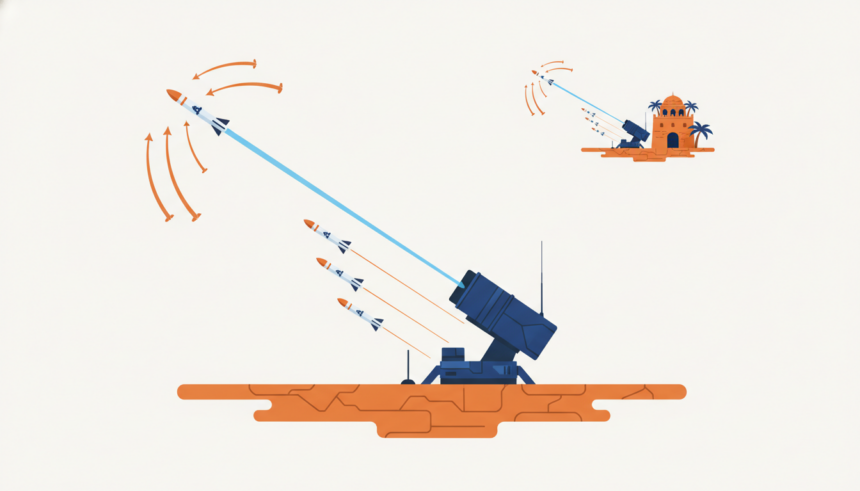
The Iron Dome engagement sequence
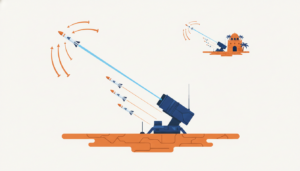
- Detection: the radar acquires the projectile at launch and tracks it to build a trajectory.
- Prediction: the battle management and weapon control centre calculates the impact point within seconds.
- Decision: the system engages only if the projectile threatens a populated area or protected asset, and since 1 July 2026 commanders choose between a Tamir missile and an Iron Beam laser pulse.
- Interception: the Tamir manoeuvres to the target and detonates by proximity fuse, or the laser burns through the target in 4-5 seconds at ranges up to about 10 kilometres.
Step three carries most of the system’s value, because selective engagement is an economic decision as much as a tactical one. The battle management centre declines to fire at projectiles tracked to open ground, since each Tamir costs roughly $50,000 and magazine depth is finite. Israel and Rafael have cited interception rates above 90% against the rockets the system chooses to engage. Those figures come from the operator and the manufacturer rather than from independent verification, and readers should weigh them accordingly.
What one battery actually contains
A standard Iron Dome battery pairs a detection and tracking radar with a battle management and weapon control centre and multiple launchers, each holding a magazine of Tamir interceptors. The battery is the relevant unit of account throughout this article because batteries are what get moved, maintained and funded. That mobility is precisely what made the April 2026 deployment to the United Arab Emirates possible within the span of a short war.
The drone gap that forced the laser upgrade
Israel added a laser to Iron Dome because the cost exchange against cheap drones was unsustainable: roughly $50,000 per Tamir against targets worth a small fraction of that. The one-way attack drones fired from Yemen, Iraq and Iran are low-cost, mass-produced and expendable by design. Therefore every successful kinetic interception was a financial loss for the defender, and a saturation attack imposed costs on Israel faster than on the attacker — the exact inversion that air defence is supposed to avoid.
The second-order effect was magazine depletion. Production capacity, not radar coverage, set the ceiling on how long a battery could keep firing, which means the cost-exchange problem was simultaneously a supply problem. This is why 2026 produced two answers rather than one: a cheap-per-shot laser layer for the lowest tier of threats, and a second manufacturing source to deepen the kinetic magazine. Addressing only one would have left the other constraint binding.
Directed energy does not close the gap on its own. Beam performance is degraded by cloud, dust and rain, which means the kinetic layer remains mandatory rather than legacy. The laser subtracts Tamir expenditures at the bottom of the threat spectrum; it does not retire the missile.
The laser layer: Iron Beam joins Iron Dome
Iron Beam is operational. The first system was delivered to the Israel Defense Forces on 28 December 2025, and on 1 July 2026 the Israeli Ministry of Defense announced it had completed a comprehensive test series integrating the laser into the Iron Dome battle management centre. That integration is the single change that defines iron dome 2026 as a hybrid kinetic and directed-energy architecture rather than a missile system with a laser parked beside it.
At the Farnborough Airshow on 20 July 2026, Shlomo Toaff, head of air and missile defence systems at Rafael, described the programme as past the prototype stage:
“We already gave the first system to the IDF, and now we’re in production of the next systems, and they’re going in as we speak.”
— Shlomo Toaff, head of air and missile defence systems, Rafael Advanced Defense Systems, Farnborough Airshow, 20 July 2026
The significance of that statement is serial production. A single fielded unit proves the physics; a production line is what converts the cost advantage into coverage.
- Power class: 100kW-class high-energy laser, designated Or Eitan
- Effective range: approximately 10 kilometres
- Time to kill: 4-5 seconds per target
- Cost per engagement: a few dollars of electricity, against roughly $50,000 for a Tamir interceptor
- Coverage requirement: an estimated 14 batteries for a nationwide shield
- Known limitation: performance degraded by cloud, dust and heavy precipitation
28 December 2025: first system delivered
The first operational 100kW-class Iron Beam, known in Hebrew as Or Eitan, was delivered to the IDF on 28 December 2025. The delivery made Israel the first state to field a high-power laser inside an operational air defence network, and it moved the cost-per-shot argument from theory to practice. Because an Iron Beam engagement consumes a few dollars of electricity against roughly $50,000 for a Tamir, the economics of defending against low-end threats changed at the moment of delivery rather than at the moment of integration.
1 July 2026: integration into the battle management centre
On 1 July 2026 the Israeli Ministry of Defense announced the successful completion of a comprehensive test series that folded Iron Beam directly into the Iron Dome battle management centre. Operationally, this changes the decision rather than the hardware: commanders now toggle between a physical interceptor and a laser pulse inside a single engagement decision, driven by weather, threat type and cost-benefit calculation. That is the difference between a parallel system and a layer, and it is the reason Iron Beam counts as an Iron Dome upgrade rather than a separate programme with its own operators and its own fire-control picture.
The limits: 14 batteries, 10 kilometres, weather
The constraints are specific. Senior Israeli defence officials said in August 2026 that Iron Beam was still seeing limited use, because a full nationwide shield requires an estimated 14 batteries. Effective range is about 10 kilometres and time to kill is 4-5 seconds per target. Cloud, dust and precipitation attenuate the beam, which rules out weather-independent reliance. Consequently the laser reduces the number of Tamirs expended at the bottom of the threat spectrum in the areas it covers; as of 8 November 2026 it does not replace them anywhere.
Arkansas-built interceptors: the Camden production line
Iron Dome interceptors are now made in two countries: in Israel by Rafael, and since October 2026 in East Camden, Arkansas by Raytheon-Rafael Protection Systems (R2S). The distinction that matters is scope of work. The United States previously built components that were shipped to Israel for final assembly, whereas the interceptors handed over in October 2026 were completed end-to-end in Arkansas. That establishes a genuine second source rather than a subcontracting arrangement, and it removes a single point of failure from the supply chain.
The cause is fiscal as much as industrial. US emergency supplemental assistance to Israel is spent largely inside the American defence industrial base, which means a US production line satisfies Israeli magazine depth and American industrial policy simultaneously. Moshe Patel, director of the Israel Missile Defense Organization, framed it exactly that way at the handover, emphasising that the new line accelerates interceptor manufacturing for Israel while reinvesting US emergency supplemental assistance directly into American industry.
The political salience of the line was stated plainly at the ceremony by Arkansas Governor Sarah Huckabee Sanders, whose parents — including US Ambassador to Israel Mike Huckabee — live in Jerusalem:
“They saw what Hamas and Iranian missiles would do if not taken out, and they’re alive today because of the Iron Dome.”
— Sarah Huckabee Sanders, Governor of Arkansas, Camden handover ceremony, October 2026
- Operator: Raytheon-Rafael Protection Systems (R2S), a joint venture of RTX’s Raytheon and Rafael Advanced Defense Systems
- Location and cost: East Camden, Arkansas; $63 million facility opened November 2025
- First full delivery: Tamir interceptors handed to the Israel Missile Defense Organization, 7-8 October 2026
- Target capacity: approximately 1,000 interceptors a year
- Product lines: Tamir for Iron Dome and SkyHunter for the US Marine Corps MRIC programme
R2S: the Raytheon-Rafael joint venture
Raytheon-Rafael Protection Systems is the joint venture between RTX’s Raytheon and Rafael Advanced Defense Systems, operating a $63 million facility in East Camden, Arkansas that opened in November 2025. Camden was chosen because southern Arkansas already hosts missile-production infrastructure and a trained workforce, which shortened the path from facility opening to first complete delivery to under a year — a timeline that would have been implausible on a greenfield site.
7-8 October 2026: the first fully US-made Tamir
The first completed interceptors were handed to the Israel Missile Defense Organization on 7-8 October 2026, as Defense News reported. The consequence is structural: Israel now draws its primary short-range interceptor from two geographically separated sources, which reduces the single-point-of-failure risk exposed by the sustained engagements of 2024 to 2026, when demand repeatedly ran ahead of a single national production line.
SkyHunter, the US Marine Corps and the road to 1,000 a year
Rafael executives expect Camden to reach a capacity of roughly 1,000 interceptors a year. The same line also produces SkyHunter, the American derivative of Tamir, for the US Marine Corps Medium Range Intercept Capability (MRIC) programme. The effect compounds: two customers on one line spread fixed costs and stabilise throughput, which means the Marine Corps requirement strengthens Israeli supply rather than competing with it. A line running at volume for a domestic US programme is also more defensible in Congressional budget cycles than one dependent on a single foreign customer.
First deployment abroad: the UAE battery, then Romania
Iron Dome has been deployed outside Israel. The first operational deployment abroad was to the United Arab Emirates in April 2026, during the US-Israel-Iran war, when Israel secretly sent a battery along with IDF personnel to operate it in order to help the UAE absorb heavy Iranian missile and drone attacks. Israeli officials say the deployed battery intercepted dozens of Iranian projectiles; INQ Daily has not independently verified that count.
The disclosure chain matters as much as the deployment. Axios first reported it on 26 April 2026, and US Ambassador to Israel Mike Huckabee confirmed it publicly on 12 May 2026, citing it as proof of the “extraordinary relationship between the UAE and Israel based on the Abraham Accords”. A measure taken in secret for operational reasons became an announced one because confirmation converted a battlefield decision into a diplomatic argument — evidence that normalisation had produced tangible defence cooperation under fire.
Europe followed within months. A September 2026 report by the Middle East Forum said Romania has begun relying on Iron Dome, the system’s first overseas presence in Europe, alongside Germany’s adoption of Arrow 3. The driver is capacity rather than preference: European air defence demand rose faster than European production after 2022, therefore buyers turned to the one supplier offering a combat-tested, in-production short-range interceptor with a second manufacturing line already standing in Arkansas.
Iron Dome compared: Patriot, David’s Sling, Arrow 3 and Golden Dome
Israel operates a tiered architecture, not a single shield, and the most persistent public misconception about iron dome is that it stops ballistic missiles. It does not. Iron Dome covers the lowest tier — rockets, mortars, artillery, cruise missiles and drones. David’s Sling covers the medium tier, and Arrow 2 and Arrow 3 handle ballistic threats, with Arrow 3 engaging outside the atmosphere. Patriot is a US medium-to-long-range system used against aircraft and shorter-range ballistic missiles. The US Golden Dome programme, announced in 2025, is a homeland-scale architecture that borrows the Iron Dome concept without inheriting its scale assumptions, which means comparisons between the two are political rather than technical.
| System | Primary threat class | Engagement range | Approximate cost per shot | Operators |
|---|---|---|---|---|
| Iron Dome (Tamir) | Rockets, mortars, artillery, drones | Short range | ~$50,000 | Israel; UAE (2026); Romania (2026) |
| Iron Beam (Or Eitan) | Drones, rockets, mortars | ~10 km | A few dollars of electricity | Israel |
| David’s Sling | Medium-range rockets and missiles | Medium range | Not stated | Israel |
| Arrow 3 | Ballistic missiles, exo-atmospheric | Exo-atmospheric | Not stated | Israel; Germany |
| Patriot (PAC-3) | Aircraft, shorter-range ballistic missiles | Medium to long range | Not stated | United States and allies |
| Golden Dome (US) | Homeland-scale, in development | Not stated | Not stated | United States (programme) |
Cost-per-shot figures above are approximate and vary by variant and contract year. They are included to show orders of magnitude between a kinetic interceptor and a laser engagement, not to represent procurement prices.
What the Iron Dome 2026 changes mean next
Dual sourcing changes Israel’s planning assumptions. Because a second line in East Camden supplies complete interceptors, a surge in wartime demand no longer competes directly with routine replenishment from a single Israeli plant. As a result, the binding constraint shifts away from interceptor availability and toward battery and crew availability — a harder problem to solve with money alone.
The laser layer only pays off at scale. With an estimated 14 batteries needed for national coverage and a handful fielded as of late 2026, the cost advantage of Iron Beam is currently local rather than systemic. Therefore the live 2027 procurement question is battery count and funding, not technology maturity, which Rafael’s July 2026 production confirmation already settled.
Politically, the UAE deployment and the Romanian adoption turned Iron Dome into an instrument of defence diplomacy, which means export decisions now carry alliance consequences that component sales never did. Each deployment abroad also commits Israeli crews or training pipelines, and that is a finite resource that cannot be expanded as quickly as a missile line.
Frequently asked questions
What is Iron Dome and what changed in 2026?
Iron Dome is Israel’s short-range air defence system, operational since 2011 and built by Rafael Advanced Defense Systems with Raytheon. Three changes landed in 2026: Iron Beam laser integration into the battle management centre on 1 July 2026, the first fully US-made Tamir interceptors delivered on 7-8 October 2026 from Camden, Arkansas, and the first deployments abroad — the UAE in April 2026 and Romania in September 2026.
How much does an Iron Dome interception cost compared with Iron Beam?
A Tamir interceptor costs roughly $50,000 per shot, while an Iron Beam engagement costs a few dollars of electricity. Against low-cost drones the kinetic exchange was a net financial loss for the defender, which is why Israel integrated the laser. Laser engagements are weather-dependent, so Tamir remains in active use rather than reserve.
Where are Iron Dome interceptors now manufactured?
In Israel by Rafael and, since October 2026, in East Camden, Arkansas by Raytheon-Rafael Protection Systems. The $63 million Arkansas plant opened in November 2025, delivered its first complete Tamir interceptors to the Israel Missile Defense Organization on 7-8 October 2026, and targets roughly 1,000 interceptors a year according to Rafael executives.
Has Iron Dome ever been deployed outside Israel?
Yes — the first operational deployment abroad was to the United Arab Emirates in April 2026. Israel sent a battery and IDF crews during the US-Israel-Iran war. Axios reported the deployment on 26 April 2026 and Ambassador Mike Huckabee confirmed it on 12 May 2026. Romania was reported in September 2026 as the first European user.
Can Iron Dome stop drones?
Yes, but the economics were the problem rather than the capability. Tamir engages drones effectively, yet spending roughly $50,000 per interception against low-cost one-way attack drones is unsustainable in saturation attacks. Consequently the Iron Beam laser was integrated on 1 July 2026 to handle the cheapest threats at a few dollars per engagement.
What is the Iron Beam laser and is it operational?
Iron Beam, designated Or Eitan, is a 100kW-class high-energy laser, and the first system was delivered to the IDF on 28 December 2025. It was integrated into the Iron Dome battle management centre on 1 July 2026, reaches about 10 kilometres with a 4-5 second kill time, and Rafael confirmed serial production in July 2026.
What is SkyHunter and how is it different from Tamir?
SkyHunter is the American derivative of the Tamir interceptor, built in Camden, Arkansas for the US Marine Corps. It feeds the Medium Range Intercept Capability (MRIC) programme and shares the Camden line with Israeli-bound Tamirs. Two customers on one line stabilises throughput and spreads fixed costs for both.
How many Iron Beam batteries does Israel need for full coverage?
Senior Israeli defence officials estimated in August 2026 that a nationwide laser shield requires about 14 batteries. Only a small number were fielded as of late 2026, which is why Iron Beam was still in limited use. The practical constraint is battery count and funding rather than technology readiness.
Why does the United States build Iron Dome missiles?
Because US emergency supplemental assistance to Israel is largely spent inside the American defence industrial base. IMDO director Moshe Patel described the dual benefit at the October 2026 handover: the Arkansas line accelerates interceptor supply for Israel while reinvesting US funding in American manufacturing, and it gives Israel a second source outside its own territory.
How is Iron Dome different from Patriot, David’s Sling and Arrow 3?
They occupy different tiers of the same architecture. Iron Dome handles short-range rockets, mortars, cruise missiles and drones; David’s Sling covers medium-range threats; Arrow 3 intercepts ballistic missiles outside the atmosphere; Patriot is a US medium-to-long-range system against aircraft and shorter-range ballistic missiles. The comparison table above sets out each tier.
What is Iron Dome’s success rate?
Israel and Rafael cite interception rates above 90% against the rockets the system chooses to engage. Two qualifications apply: the figure excludes projectiles the battle management centre deliberately ignores because they are tracked to open ground, and independent verification of operator-reported performance is limited.
Limitations of the 2026 upgrades, and what they do not fix
Technical limits come first. Iron Beam is range-limited to about 10 kilometres and degraded by cloud, dust and rain, therefore it cannot be treated as a weather-independent substitute for Tamir. With an estimated 14 batteries required for national coverage and only a few fielded as of 8 November 2026, the laser’s cost advantage is local rather than national.
Verification limits are equally important. The interception counts from the April 2026 UAE deployment and the overall success-rate figures originate with Israeli officials and the manufacturer. INQ Daily has not independently verified them, and readers should treat operator-reported performance as a claim rather than a measurement.
Finally, the gaps. Iron Dome does not address ballistic or hypersonic threats, which fall to David’s Sling and Arrow 2/3, and the 2026 upgrades do not resolve electronic-warfare or swarm-coordination challenges. Other states working the same problem are investing in high-power microwave weapons and gun-based close-in systems, which remain cheaper per engagement than any missile.
Conclusion
The system that entered 2026 as a national kinetic shield leaves it as something materially different: a hybrid kinetic and directed-energy architecture, supplied by two production lines on two continents, with an operational record outside Israeli territory. The Iron Beam integration of 1 July 2026 fixed the cost exchange at the bottom of the threat spectrum, the Camden handover of 7-8 October 2026 fixed the magazine-depth risk, and the April 2026 UAE deployment turned a defensive asset into a diplomatic one.
Taken together, iron dome 2026 is best read as an industrial and political story rather than a purely technical one, as of 8 November 2026. Two answerable questions follow: how many Iron Beam batteries the next Israeli defence budget funds, and whether East Camden reaches its stated 1,000-unit annual capacity. For continuing coverage, see INQ Daily.
References
- Times of Israel — Israeli Ministry of Defense announcement on Iron Beam integration into the Iron Dome battle management centre, 1 July 2026: https://www.timesofisrael.com/
- Defense News — first fully US-made Tamir interceptors delivered from East Camden, Arkansas to the Israel Missile Defense Organization, 7-8 October 2026: https://www.defensenews.com/
- National Defense Magazine — Raytheon-Rafael Protection Systems Camden facility, production capacity and SkyHunter for the US Marine Corps MRIC programme: https://www.nationaldefensemagazine.org/
- Axios — first report of the Iron Dome battery deployment to the United Arab Emirates, 26 April 2026: https://www.axios.com/
- The Jerusalem Post — Rafael’s Shlomo Toaff on Iron Beam serial production, Farnborough Airshow, 20 July 2026: https://www.jpost.com/
- JNS — delivery of the first 100kW-class Iron Beam system to the IDF, 28 December 2025: https://www.jns.org/
- Middle East Forum — September 2026 report on Romania’s reliance on Iron Dome and Europe’s shift toward Israeli air defence systems: https://www.meforum.org/