

Table of Contents
- What the 32.3% Poverty Figure Actually Measures
- Why the Numbers Reversed: Wages, Prices and the Labour Market
- The Falklands Escalation: Sea Lion, Sanctions and the ITLOS Filing
- How London and Washington Responded
- Two Crises, One Government: How the Economy and the Falklands Fight Intersect
- Limitations, Competing Readings and What This Report Cannot Settle
- What to Watch Before the End of 2026
- Frequently Asked Questions
- Conclusion
- References
Argentina Under Pressure: Poverty Climbs to 32.3% as Milei Escalates the Falklands Fight describes two linked stories as of November 2026. INDEC reported that poverty rose to 32.3% in the first half of 2026 from 28.2% in the second half of 2025, because household income grew 11.5% while the basic basket used to set the poverty line rose close to 20%. Extreme poverty reached 7.5% and unemployment hit 7.9%, the highest since 2021. In parallel, President Javier Milei opened sanctions proceedings against more than 60 entities tied to the British-led Sea Lion oil project and sought provisional measures at ITLOS in Hamburg.
>
- Poverty: 32.3% in H1 2026, up 4.1 points from 28.2%
- Extreme poverty: 7.5%, up from 6.3%; child poverty (under 14): 44.5%
- Unemployment: 7.9% in Q2 2026, highest since 2021
- Falklands: sanctions against 60+ entities, ITLOS filing, new naval base funding in Tierra del Fuego
- Approval: 55.5% disapprove of the administration (Zentrix, late October 2026)
Buenos Aires / London — November 7, 2026
Argentina Under Pressure: Poverty Climbs to 32.3% as Milei Escalates the Falklands Fight is the report on two developments that arrived in the same quarter: official data from the national statistics agency INDEC placing the poverty rate at 32.3% for the first half of 2026, and a sovereignty escalation announced between September and October 2026 that moved Argentina from rhetoric to sanctions and international litigation. The poverty figure reversed direction because wage growth trailed the inflation of the basic basket that defines the poverty line, which means the administration’s central domestic claim — that the “Chainsaw Plan” cut poverty — is now contested on the government’s own statistics. As economic approval fell, Milei shifted emphasis toward the Malvinas claim, an issue that commands cross-party consensus in Argentina in a way his fiscal programme does not. This article sets out the data and how it is measured, the chronology of the Sea Lion dispute, the responses from London and Washington, the polling evidence, and the questions that remain unresolved.
Editorial transparency: Every figure in this report is attributed to a named institution — INDEC, UCA, CLACSO, Zentrix — or to the news agency that reported it. Where a claim is an analytical reading rather than a verified fact, it is labelled as such. No forecast appears without the named source that issued it.
What the 32.3% Poverty Figure Actually Measures
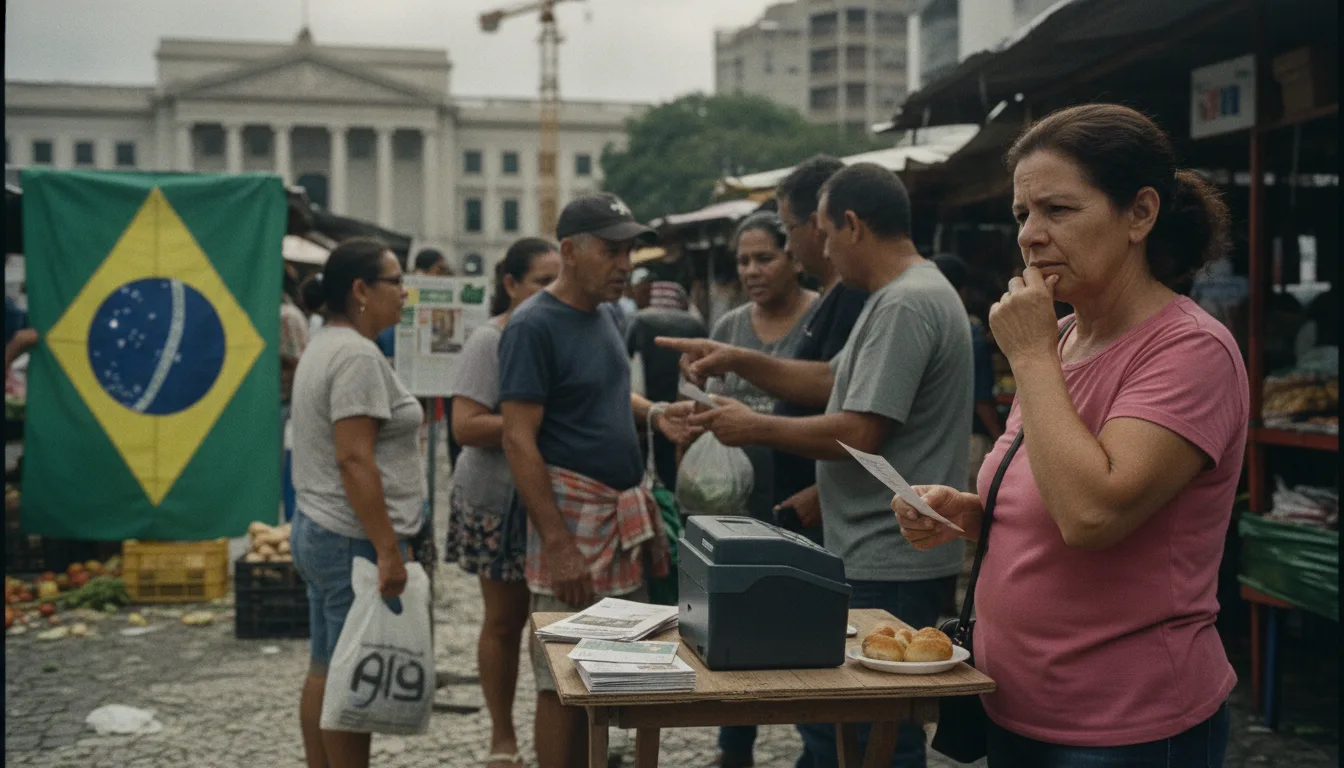
Argentina’s poverty rate was 32.3% in the first half of 2026, up 4.1 percentage points from 28.2% in the second half of 2025, according to INDEC. The measure is income-based and covers urban agglomerations: it compares total household income against the cost of a basic basket of goods and services, so a household falls below the line when its income cannot cover that basket.
| Indicator | H2 2025 | H1 2026 | Change |
|---|---|---|---|
| Poverty rate (% of population) | 28.2% | 32.3% | +4.1 pts |
| Extreme poverty / indigence (%) | 6.3% | 7.5% | +1.2 pts |
| Child poverty, age 14 and under (%) | Not stated | 44.5% | Not stated |
| Unemployment rate (%, Q2 reference) | Not stated | 7.9% | Highest since 2021 |
| Per-capita household income growth (%) | Not stated | +11.5% | — |
| Basic basket cost increase (%) | Not stated | ~20% | — |
The arithmetic behind the reversal is straightforward. Per-capita household income rose 11.5% across the first six months of 2026, while the basic basket used to draw the poverty line rose close to 20%, as reported by the Associated Press. Consequently the line moved faster than earnings and pulled households that had crossed above it in 2025 back underneath — the measured deterioration is driven by relative prices rather than by a collapse in nominal income.
The damage is concentrated by age. INDEC recorded 44.5% of children aged 14 and under living in poverty, because larger households with more dependants face higher basket costs per earner, and lower-income households hold a greater share of their spending in food, the component that rose fastest. Readers following this story through INQ Daily world affairs coverage should treat the child figure as the sharpest indicator of distributional strain.
Why the Numbers Reversed: Wages, Prices and the Labour Market
Poverty rose because incomes grew roughly 11.5% while the basket that defines the poverty line rose close to 20%, and because employment deteriorated at the same time. Annual inflation has fallen to around 30% from near 300%, therefore the disinflation achievement remains intact on its own terms. But food and regulated-service prices inside the basket rose faster than negotiated wage settlements, resulting in lost purchasing power for exactly the households sitting closest to the line.
The second driver is the labour market. Unemployment reached 7.9% in the second quarter of 2026, the highest level since 2021, with job losses concentrated in manufacturing and retail. The causal chain is identifiable: deregulation and reduced import barriers exposed domestic producers to cheaper imported goods, which compressed margins and then headcount in the sectors that employ a large share of lower-income workers. The effect of that adjustment is to remove earners from households at the same moment the basket is repricing upward.
A third element compounds the measured figure. Falling real wages pushed households toward consumer credit to cover routine basket costs, which means the income statistic understates financial stress — a household that maintains consumption through debt registers as better off than its balance sheet suggests.
Jésica Pla, a researcher at CLACSO, argues that the 2025 drop to 28.2% concealed structural impoverishment, because monetary poverty measures capture income at a single point in time and miss accumulated deterioration in housing quality, access to services and household indebtedness. The government’s counter-position is that disinflation is the precondition for durable income recovery, and that the 2026 figures reflect transition costs rather than a failure of the model. Both readings draw on the same INDEC series; they differ on what that series can and cannot show.
The Falklands Escalation: Sea Lion, Sanctions and the ITLOS Filing
Argentina escalated its Falklands claim in 2026 by targeting one specific commercial project. Sea Lion is a deep-water oil development roughly 220 km north of the islands, operated by Britain’s Rockhopper Exploration alongside Israel’s Navitas Petroleum, with first production targeted for 2028. Because that target date fixes the investment timetable, it also fixes the window in which Argentine legal pressure can realistically bite.
- September 2026 — Milei announces a measures package, including sanctions proceedings against more than 60 companies and individuals tied to the offshore drilling.
- September 2026 — At the UN General Assembly, Milei calls the oil development an “unlawful act” causing “irreversible and irreparable” harm to Argentine sovereign rights.
- September 2026 — Extra funding is announced for a new naval base in Tierra del Fuego, the Argentine province closest to the archipelago.
- Late September 2026 — Argentina issues a two-week ultimatum demanding the UK halt the Sea Lion project.
- October 2026 — After the deadline expires, Foreign Minister Pablo Quirno confirms Argentina is seeking provisional measures at the International Tribunal for the Law of the Sea (ITLOS) in Hamburg.
- 2028 — Target date for first production at Sea Lion, the commercial deadline shaping both sides’ urgency.
The legal instrument matters more than the rhetoric. Provisional measures at ITLOS are an interim remedy, which means Argentina is asking the tribunal to pause drilling while the underlying dispute is heard, rather than to rule on sovereignty. As reported by MercoPress, Quirno confirmed the request after the ultimatum lapsed. Jurisdiction itself is contested, therefore a procedural decision on whether the tribunal can hear the case precedes any substantive order.
The domestic function of the package is harder to separate from its legal content. Funding a naval base in Tierra del Fuego delivers visible state activity in a province defined by the claim, and the UN General Assembly speech placed the dispute in front of a global audience. Analysts reading the sequence argue that nationalist mobilisation serves a rallying purpose when economic messaging weakens; the Argentine government rejects that framing and presents the claim as a continuous legal position.
How London and Washington Responded
London rejected Argentina’s demands outright. The UK position is that the islanders hold the right to develop their own natural resources, therefore London treats Argentine sanctions as an extraterritorial measure to be blocked rather than negotiated. Parliamentary Under-Secretary of State for Overseas Territories Uma Kumaran called Argentina’s actions “unacceptable,” according to Guardian reporting on the dispute.
| Party | Stated position | Concrete action taken |
|---|---|---|
| Argentina (Milei government) | Drilling is an “unlawful act” in sovereign waters | Sanctions proceedings vs 60+ entities; ITLOS filing |
| United Kingdom | Islanders hold resource development rights | Rejected demands; approved measures shielding UK firms |
| Falklands / project operators | Not stated | Sea Lion production targeted for 2028 |
| United States | Historically neutral on sovereignty | $20bn currency swap line extended in 2025 |
The American variable requires precision. Milei has drawn on his relationship with President Donald Trump, whose administration extended a $20 billion currency swap line to Argentina in 2025, strengthening the bilateral financial relationship. Trump suggested in a GB News interview that Washington might review its long-standing neutrality on the islands’ sovereignty, and Milei seized on the remark domestically. That was a comment, not a policy change: no formal shift has been published, which means its practical effect so far is domestic narrative rather than diplomatic leverage.
Two Crises, One Government: How the Economy and the Falklands Fight Intersect
Argentina Under Pressure: Poverty Climbs to 32.3% as Milei Escalates the Falklands Fight is best read as a single political sequence, because the sovereignty escalation intensified in the same quarter the poverty reversal became public. The causal argument advanced by commentators is that nationalist mobilisation offers a government a consensus issue precisely when its core economic claim weakens. There is also a strategic rationale independent of politics: Sea Lion’s reserves sit in waters Argentina claims, therefore the energy and sovereignty interests align rather than compete.
The polling, reported by the Buenos Aires Times, indicates the substitution has not worked in voter rankings.
- 55.5% disapprove of the Milei administration overall (Zentrix, late October 2026)
- 48.2% cite economic uncertainty as a primary concern
- 46.2% cite falling wages
- 44.6% cite unemployment
- Annual inflation of roughly 30%, down from near 300%, has not displaced cost-of-living as the top issue
The electorate’s stated priorities are overwhelmingly domestic and economic, which means the Malvinas dispute has not displaced the cost of living in the concerns voters report. Three of the top four grievances are income-related.
A structural constraint closes the loop. Litigation at ITLOS runs over months and years, including a preliminary fight over jurisdiction, while the basic basket is repriced monthly and the next INDEC poverty release is a fixed date. Consequently the timelines of the two crises do not match: the sovereignty case cannot deliver a result inside the electoral cycle that the economic data can.
Limitations, Competing Readings and What This Report Cannot Settle
INDEC’s poverty figure is income-based and covers urban agglomerations, therefore it does not capture multidimensional deprivation such as housing quality or service access. The Catholic University of Argentina’s parallel estimates use different methodology and are not directly comparable to the official series.
Reporting lag matters. The 32.3% figure covers January to June 2026 and does not reflect conditions in the second half of the year.
Causation is contested. Attributing the reversal solely to the Chainsaw Plan overstates certainty, because import liberalisation, global commodity prices and inherited inflation all contribute; the government attributes the slowdown to the transition costs of disinflation.
Interpretation is likewise contested. The link between the economic data and the timing of the Falklands escalation is an analytical reading held by commentators, not an established fact. The Argentine government frames the sovereignty claim as a long-standing legal position independent of domestic politics.
Legally, ITLOS has not ruled on jurisdiction, therefore no outcome should be assumed.
Finally, a terminology note: the islands are called the Falkland Islands in the UK and Islas Malvinas in Argentina. This report uses both, and that usage is not a sovereignty judgement.
What to Watch Before the End of 2026
Three dated institutional outputs will settle the direction of both stories, each tied to a named body rather than to sentiment.
- INDEC’s next poverty release covering the second half of 2026, and whether the basket–income gap narrows
- The ITLOS ruling on provisional measures, including whether the tribunal accepts jurisdiction at all
- UCA’s year-end social debt estimate, which projects poverty reaching 35% if current trends hold
- Any formal change to the US position on sovereignty, as distinct from informal remarks
- Drilling and investment decisions at Sea Lion ahead of the 2028 production target
One measurement caveat applies to the forecast. The UCA Observatory of Argentine Social Debt estimate and INDEC’s official series use different methods, therefore they will not converge exactly; compare direction rather than levels.
Frequently Asked Questions
What is Argentina’s current poverty rate?
Argentina’s poverty rate reached 32.3% in the first half of 2026, according to INDEC, up 4.1 percentage points from 28.2% in the second half of 2025. Extreme poverty rose from 6.3% to 7.5%. The figure is income-based: it compares household income against the cost of a basic basket of goods, which rose close to 20% while incomes rose 11.5%.
Why did poverty rise again under Milei?
Because incomes grew more slowly than the prices that define the poverty line. Per-capita household income rose 11.5% in the first half of 2026, while the basic basket rose nearly 20%. Unemployment also increased to 7.9% in Q2 2026, with losses concentrated in manufacturing and retail, consequently reducing household earnings even as annual inflation fell to roughly 30%.
Did Milei’s Chainsaw Plan reduce poverty at all?
Measured poverty fell sharply before reversing. It peaked at 52.9% in early 2024 and fell to 28.2% by the second half of 2025, driven by disinflation. CLACSO researcher Jésica Pla argues that decline overstated real improvement, because monetary measures miss structural impoverishment and household debt. The 2026 rise to 32.3% leaves the net change positive but the trend negative.
What is the Sea Lion oil project?
Sea Lion is a deep-water oil development roughly 220 km north of the Falkland Islands, operated by Britain’s Rockhopper Exploration with Israel’s Navitas Petroleum and targeted for first production in 2028. Argentina claims the waters as sovereign territory, therefore it treats the drilling as unlawful and has made the project the focus of sanctions and international legal action.
What legal action has Argentina taken over the Falklands?
Argentina is seeking provisional measures at the International Tribunal for the Law of the Sea in Hamburg. Foreign Minister Pablo Quirno confirmed the filing in October 2026 after a two-week ultimatum to halt Sea Lion expired. Provisional measures are an interim remedy to pause drilling, not a sovereignty ruling, and the tribunal must first decide whether it has jurisdiction.
How has the United Kingdom responded?
London rejected the demands outright. Parliamentary Under-Secretary of State for Overseas Territories Uma Kumaran called Argentina’s actions “unacceptable” and restated that the islanders hold the right to develop their natural resources. The UK has also approved measures shielding British companies from Argentine sanctions, which means the dispute is being contested through blocking legislation rather than negotiation.
Has the United States changed its position on Falklands sovereignty?
No formal change has been announced. President Donald Trump suggested in a GB News interview that Washington might review its historically neutral stance, and Milei used the remark domestically. Washington extended a $20 billion currency swap line to Argentina in 2025, which strengthens the bilateral relationship, but no published policy shift on sovereignty has followed the comment.
Is Milei likely to lose power over these figures?
Polling is negative, but no national vote is immediately scheduled. A late October 2026 Zentrix study put disapproval at 55.5%, with economic uncertainty, falling wages and unemployment the leading concerns. Electoral outcomes depend on variables not yet known, so the measurable test is INDEC’s next poverty release rather than current survey data.
Conclusion
Argentina Under Pressure: Poverty Climbs to 32.3% as Milei Escalates the Falklands Fight rests on a verified set of figures: poverty at 32.3% in the first half of 2026, extreme poverty at 7.5%, unemployment at 7.9%, sanctions proceedings against more than 60 entities linked to Sea Lion, and a provisional measures request lodged at ITLOS in Hamburg. The analytical conclusion follows from those numbers. The Chainsaw Plan’s disinflation held — annual inflation of roughly 30% against near 300% is a measurable result — while its distributional outcome stalled, which means the government’s claim to have reduced poverty is now contested on the data it publishes itself.
The binding constraint is time. Legal proceedings at ITLOS run far longer than the monthly repricing of the basic basket, so the sovereignty case cannot answer the cost-of-living question. Two checkpoints will test the direction: INDEC’s release covering the second half of 2026, and the tribunal’s jurisdiction decision. Both will be covered in daily briefings from INQ Daily.
References
- INDEC (Instituto Nacional de Estadística y Censos), Argentina — official poverty and indigence incidence, first half of 2026. https://www.indec.gob.ar/
- Associated Press — reporting on the poverty rate rising to 32.3% in H1 2026, income growth of 11.5% against basket inflation near 20%. https://apnews.com/
- CLACSO — Jésica Pla, researcher, analysis of monetary poverty indicators and structural impoverishment. https://www.clacso.org/
- Universidad Católica Argentina (UCA), Observatorio de la Deuda Social Argentina — estimate that poverty could reach 35% by end-2026. https://uca.edu.ar/es/observatorio-de-la-deuda-social-argentina
- MercoPress (South Atlantic News Agency) — sanctions proceedings, the two-week ultimatum and the ITLOS request confirmed by Foreign Minister Pablo Quirno. https://en.mercopress.com/
- The Guardian — UK rejection of Argentine measures and remarks by Uma Kumaran. https://www.theguardian.com/world/falkland-islands
- Rockhopper Exploration corporate disclosures and industry reporting — Sea Lion specifications and 2028 production target. https://www.rockhopperexploration.co.uk/
- Buenos Aires Times — Zentrix polling, late October 2026, on administration disapproval and voter concerns. https://www.batimes.com.ar/