

Table of Contents
- Key Numbers at a Glance
- What Typhoon Champi Cost Taiwan
- Crop losses by commodity
- Rainfall and infrastructure
- What Taiwan Is Actually Voting On November 28
- The Taipei mayoral race
- Candidate eligibility rulings
- How Beijing Is Targeting the Vote
- Cyberattacks on government networks
- AI-generated polls and fake reports
- Intimidation replacing endorsement
- Why a Storm Day Decides Mayoral Careers
- Relief Spending Collides With Election Security Spending
- Why November 28 Decides More Than Mayors
- Frequently Asked Questions
- Limitations of These Figures and What Could Change Them
- What to Watch Next
- References
- Related Reading
Key Takeaway
>
The Taiwan November elections are scheduled for Nov. 28, 2026, when voters fill more than 11,000 local offices in the island’s “nine-in-one” ballot. They vote while the government is still tallying Super Typhoon Champi’s damage: one death, 616 injuries, 9,027 damage reports, more than 340,000 households blacked out and NT$221.63 million (US$6.82 million) in farm losses as of Oct. 26. The National Security Bureau has intercepted more than 2.5 million pieces of Chinese disinformation in the first nine months of 2026, a 48% rise.
TAIPEI, Oct. 28, 2026 — The Taiwan November elections fall on Nov. 28, four weeks after Super Typhoon Champi raked the island’s northeastern coast and left ministries counting losses. Agricultural damage stood at NT$221.63 million (US$6.82 million) as of Oct. 26, while Taiwan’s National Security Bureau has intercepted more than 2.5 million pieces of disputed or false Chinese-origin information since January. Because this is the first national vote since President Lai Ching-te took office, the result will be read as the baseline for 2028.
Key Numbers at a Glance
The figures below are provisional tallies from Taiwan’s Central Emergency Operation Center and the Ministry of Agriculture, current as of Oct. 25–26, 2026, and they have been revised upward on successive daily updates.
| Measure | Figure | Source / as of |
|---|---|---|
| Deaths | 1 (Pingtung County) | CEOC, Oct. 25, 2026 |
| Injuries | 616 | CEOC, Oct. 25, 2026 |
| Damage reports filed | 9,027 | CEOC, Oct. 25, 2026 |
| Households without power at peak | 340,000+ | CEOC, Oct. 2026 |
| People evacuated | Nearly 5,000 | CEOC, Oct. 2026 |
| Agricultural losses | NT$221.63m (US$6.82m) | Ministry of Agriculture, Oct. 26, 2026 |
| Peak 48-hour rainfall | 650mm (Yilan); nearly 470mm (Taipei) | CEOC, Oct. 2026 |
Champi produced that damage without landfall, because the storm’s eye tracked within 1 kilometre of the northeastern coast while carrying winds of up to 185 mph.
What Typhoon Champi Cost Taiwan
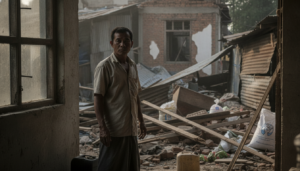
Champi caused 9,027 reported damage incidents and NT$221.63 million in farm losses without making landfall on Taiwan, because the eye passed within 1 kilometre of the northeastern coast at wind speeds reaching 185 mph. Losses concentrated in agriculture and the distribution grid rather than in housing stock, which means the headline cost is a harvest and electricity problem rather than a reconstruction one.
Crop losses by commodity
Agricultural losses reached NT$221.63 million (US$6.82 million) by Oct. 26, 2026, according to the Ministry of Agriculture, with garlic the heaviest single loss at NT$63.59 million. Yunlin County was the hardest-hit agricultural region, driven by its concentration of garlic, peanut and onion acreage standing in the fields during this harvest window — which means wind and rain damage in a single county translates almost directly into the national total. Verification is continuing, resulting in a figure that remains provisional.
| Crop | Reported loss (NT$) | Main affected area |
|---|---|---|
| Garlic | 63.59m | Yunlin County |
| Peanuts | Not stated | Yunlin County |
| Onions | Not stated | Not stated |
| Tangerines | Not stated | Not stated |
| All crops (total) | 221.63m | Nationwide; Yunlin hardest hit |
Rainfall and infrastructure
Yilan County recorded 650 millimetres of accumulated rainfall over 48 hours and Taipei recorded nearly 470 millimetres, per Central Emergency Operation Center data released in late October 2026 and corroborated by Taipei Times reporting. Fallen trees, downed power lines and dislodged advertising signage accounted for the bulk of the 9,027 damage reports, and the same falling debris severed distribution lines, resulting in more than 340,000 households losing electricity at the storm’s peak. The Central Emergency Operation Center has not published a consolidated restoration figure as of Oct. 28, 2026.
What Taiwan Is Actually Voting On November 28
The Taiwan November elections take place on Saturday, Nov. 28, 2026. The “nine-in-one” election consolidates nine categories of local office onto a single ballot, filling more than 11,000 executive and legislative seats, which means turnout and party swing are measured nationally in one count, according to the Central Election Commission. Because a single national vote share becomes the headline number both parties campaign on, every mayoral race carries national read-across.
| Office category | Level | Why it matters nationally |
|---|---|---|
| Special municipality mayors | Municipal executive | Largest electorates; presidential launchpads |
| Special municipality councillors | Municipal legislative | Sets party strength in the biggest cities |
| County commissioners and city mayors | County executive | Controls local budgets and disaster response |
| County and city councillors | County legislative | Builds party benches for future national races |
| Township mayors and councillors | Township | Organisational base for turnout mobilisation |
| Village and borough chiefs | Neighbourhood | Thousands of seats; grassroots network |
| Indigenous district representatives | District | Indigenous district governance |
The Taipei mayoral race
Taipei is the single most-watched contest because past mayors have converted the office into national candidacies, therefore the capital’s result is read as a shortlist for 2028. The candidate field is still being confirmed through Central Election Commission registration, and INQ Daily will update the field as registrations are confirmed rather than naming contenders ahead of that record. Champi has already pulled municipal performance into the campaign: the capital recorded nearly 470 millimetres of rain, consequently how City Hall handled drainage, outages and the typhoon-day call is now an active campaign issue.
Candidate eligibility rulings
The eligibility of some China-born candidates has been contested and routed through administrative appeal. As of Oct. 28, 2026, INQ Daily has not confirmed final rulings in those cases from the Central Election Commission or the reviewing authorities, and this article does not fill that gap with an estimate. The consequence is administrative: unresolved eligibility decisions close to polling day compress the window for ballot printing and litigation, which means any late reversal carries direct cost and risks disputed ballots.
How Beijing Is Targeting the Vote
Ahead of the Taiwan November elections, Beijing’s campaign runs on cyber intrusion, AI-generated disinformation and direct intimidation of candidates and their supporters, according to Taiwan’s National Security Bureau and Mainland Affairs Council. The NSB intercepted more than 2.5 million pieces of disputed or false information originating in China in the first nine months of 2026, a 48% increase on the comparable period.
Four documented interference tactics, ranked by scale of reported activity
- Mass cyberattack on government networks — 185.6 million attacks on the Government Service Network in July 2026 alone, averaging 2.58 million a day (National Security Bureau).
- Disinformation at volume — more than 2.5 million disputed or false items intercepted in January–September 2026, up 48% (National Security Bureau).
- AI-generated fake polls and fabricated local election reports, distributed alongside malware (National Security Bureau).
- Targeted hacking of academic institutions, telecommunications operators and defence industry supply chains, reaching toward policymaking and sensitive technology.
- Punishment and intimidation of candidates and their supporters, replacing open endorsement of favoured candidates (MAC Deputy Minister Shen Yu-chung, Oct. 22, 2026).
Cyberattacks on government networks
July 2026’s 185.6 million recorded attacks on the Government Service Network exceeded the combined total of the first three months of the year, which means the tempo escalated sharply rather than simply continuing. The NSB names academic institutions, telecommunications networks and defence industry supply chains as targets of suspected Chinese hackers. The stated objective is to undermine defence policymaking and extract sensitive technologies, therefore the intrusions serve intelligence collection and political coercion at the same time.
AI-generated polls and fake reports
Beijing is using artificial intelligence in these operations, according to the National Security Bureau, specifically to fabricate opinion polls, generate misleading local election reports and distribute malware. Fabricated polling is the most consequential of the three because voters use poll numbers to judge which candidates are viable, consequently false numbers distort tactical voting and depress turnout for candidates shown as losing. INQ Daily cannot independently verify the NSB’s attribution of individual items to Chinese state actors, and the figures published are interception counts rather than measured effects on voter behaviour.
Intimidation replacing endorsement
Mainland Affairs Council Deputy Minister Shen Yu-chung said on Oct. 22, 2026 that the Chinese Communist Party has shifted tactics from supporting favoured candidates to “punishment and intimidation” directed at political opponents.
“create a chilling effect in Taiwan, making voters afraid to openly support particular candidates or parties”
— Shen Yu-chung, Deputy Minister, Mainland Affairs Council, Oct. 22, 2026
On the enforcement side, Interior Minister Liu Shyh-fang announced on Oct. 27 that the National Police Agency is stepping up nationwide efforts to prevent election meddling by China, local gangs and domestic collaborators, per the Ministry of the Interior. The shift matters because punishment is cheaper to run and harder to attribute than endorsement, therefore it raises the cost of open political participation without leaving a campaign-finance trail for investigators to follow.
Why a Storm Day Decides Mayoral Careers
Local mayors and county commissioners personally decide whether to declare a typhoon day off, therefore the call is attributed to an individual officeholder rather than to a national agency and functions as a direct performance verdict. Calling a day off when the storm underperforms draws accusations of economic waste; refusing one when it overperforms draws accusations of endangering commuters. Both outcomes are measured publicly within 24 hours, which means the decision is a recurring, high-salience competence test that voters remember.
Champi’s near-miss track forced those calls across Taipei, Yilan, Yunlin and Pingtung four to five weeks before the Taiwan November elections, consequently storm-response performance enters this campaign as fresh evidence rather than abstract argument. The limit of the effect is worth stating plainly: typhoon-day decisions move individual mayoral races, but they do not determine national vote share, which is driven by party identification and cross-strait positioning.
Relief Spending Collides With Election Security Spending
The Lai administration is fast-tracking agricultural subsidies and low-interest disaster loans while simultaneously funding counter-espionage and network defence, which means the same ministries are running two emergency workstreams inside the final four weeks before polling. Delivery speed carries direct political consequence for the Taiwan November elections, because relief that arrives late in Yunlin and Pingtung — the counties carrying the largest crop losses and the storm’s single fatality — becomes a campaign liability in precisely the races where damage is most visible.
Relief measures announced after Champi
- Cash agricultural disaster subsidies for verified crop losses, administered by the Ministry of Agriculture
- Low-interest disaster recovery loans extended to nine designated municipalities
- Fast-tracked damage verification in the hardest-hit counties, led by Yunlin
- Power restoration prioritisation for the more than 340,000 households affected at peak
- Expanded National Police Agency election-security operations announced Oct. 27, 2026, funded from the same administrative cycle
No consolidated relief budget figure had been published as of Oct. 28, 2026, so the scale of the trade-off is described here qualitatively rather than estimated.
Why November 28 Decides More Than Mayors
The nine-in-one result is the first national vote since Lai Ching-te took office, therefore it functions as the baseline both major parties will use to construct their 2028 campaigns.
If the Democratic Progressive Party takes key mayoral seats, Lai’s position inside his own party strengthens and his reelection campaign accelerates. That outcome carries a counter-effect, according to analysis from the Institute for the Study of War and the American Enterprise Institute: Beijing’s influence operations are designed to deepen polarisation, erode public trust in the DPP government and suppress turnout, and those analysts assess that a strong DPP showing raises the probability Beijing escalates military and economic coercion, including a “soft blockade” or quarantine scenario around the island next year.
If the opposition gains, losses in major municipalities constrain Lai’s legislative room and raise the weight of cross-strait accommodation inside domestic debate, consequently Beijing’s cost of coercion falls because pressure can be applied through Taiwanese politics rather than around it.
Both branches share one variable. Turnout is what Beijing’s operations target directly, which means turnout is the figure to read first on Nov. 28.
Frequently Asked Questions
What damage did Typhoon Champi cause in Taiwan?
One death, 616 injuries, 9,027 damage reports, more than 340,000 households without power and nearly 5,000 people evacuated, per the Central Emergency Operation Center as of Oct. 25–26, 2026. Most reports involved fallen trees, downed power lines and dislodged signage, because winds reached up to 185 mph as the eye passed within 1 kilometre of the northeastern coast.
How much did Taiwan lose in agricultural damage from Typhoon Champi?
NT$221.63 million (US$6.82 million) as of Oct. 26, 2026, according to the Ministry of Agriculture. Garlic was the heaviest single loss at NT$63.59 million, followed by peanuts, onions and tangerines. Yunlin County was the hardest-hit agricultural region. The figure is provisional and has been revised upward as loss verification continues.
When are Taiwan’s November 2026 elections?
Saturday, Nov. 28, 2026. The Taiwan November elections use the nine-in-one ballot, which fills more than 11,000 local executive and legislative offices in a single day, according to the Central Election Commission. Because every category is counted together, national vote share is measured in one count.
What are Taiwan’s nine-in-one elections?
A consolidated local election that fills nine categories of office on one ballot — from special municipality mayors and councillors down to township officials, village and borough chiefs and indigenous district representatives. Held every four years, it covers more than 11,000 seats, therefore it is treated as a national referendum on the governing party’s performance.
How is China interfering in Taiwan’s local elections?
Through cyberattacks, mass disinformation and intimidation, according to Taiwan’s National Security Bureau and Mainland Affairs Council. The NSB intercepted more than 2.5 million disputed or false items of Chinese origin in January–September 2026, a 48% rise, and recorded 185.6 million attacks on the Government Service Network in July 2026 alone.
Is Beijing using AI to influence Taiwan’s elections?
Yes, according to the National Security Bureau, which reports AI being used to fabricate opinion polls, generate misleading local election reports and distribute malware. Fabricated polling distorts tactical voting because voters use poll numbers to judge which candidates are viable. INQ Daily has not independently verified attribution of individual items.
Why do typhoons affect Taiwanese election outcomes?
Because mayors and county commissioners personally declare typhoon days off, making the call an individually attributed competence test. A day off during a weak storm draws accusations of economic waste; no day off during a severe one draws accusations of endangering commuters. Champi forced those calls four to five weeks before polling.
What has Taiwan’s government done to stop election meddling?
Interior Minister Liu Shyh-fang announced on Oct. 27, 2026 that the National Police Agency is expanding nationwide efforts against election interference by China, local gangs and domestic collaborators. The National Security Bureau publishes interception and attack data, and the Mainland Affairs Council has issued public warnings about intimidation tactics directed at candidates and voters.
How do Taiwan’s local elections affect the 2028 presidential race?
They set the baseline both parties campaign on. Key DPP wins strengthen President Lai Ching-te’s reelection position; losses in major municipalities constrain his legislative room. ISW and AEI analysis holds that a strong DPP showing raises the probability Beijing escalates coercion, including a soft blockade or economic quarantine scenario.
Did Typhoon Champi hit China after Taiwan?
Champi did not make landfall on Taiwan, passing within 1 kilometre of the northeastern coast. INQ Daily has not confirmed a post-Taiwan landfall track from an official meteorological source as of Oct. 28, 2026, and this article does not describe one. The record will be updated when an official track is published.
Limitations of These Figures and What Could Change Them
The numbers on this page come from government releases issued during an active response, which means several of them will move. The interference data is drawn from Taiwanese security assessments and should be read as such.
- Damage and loss figures are provisional Central Emergency Operation Center and Ministry of Agriculture tallies that have risen on successive daily revisions; final agricultural losses will exceed NT$221.63 million if verification continues to add claims
- Interference figures are Taiwanese government assessments, and attribution of individual disinformation items to Chinese state actors is not independently verified by INQ Daily
- Cyberattack counts measure detected attempts against the Government Service Network, not successful intrusions, therefore they indicate tempo rather than damage
- The eligibility status of contested China-born candidates was unresolved as of Oct. 28, 2026
- No consolidated relief budget figure has been published, so the relief-versus-security trade-off is described qualitatively rather than quantified
- An alternative reading holds that local elections in Taiwan turn on municipal service delivery rather than cross-strait pressure, which would limit the national read-across from any Nov. 28 result
What to Watch Next
Four dated checkpoints will determine how much is actually known about the Taiwan November elections and the recovery running alongside them.
- Early November 2026 — final Ministry of Agriculture loss verification and the published relief disbursement schedule for the nine designated municipalities
- Mid-November 2026 — Central Election Commission confirmation of the final candidate field, including any outstanding eligibility rulings
- Nov. 28, 2026 — turnout figures by municipality, read before party vote share, because suppressing turnout is the stated objective of the interference campaign
- December 2026 onward — National Security Bureau post-election reporting on disinformation volume, and any shift in Chinese military activity around the island
Read turnout first. Everything else on election night is interpretation built on top of it.
More coverage: INQ Daily world affairs coverage.
References
- Taiwan Central Emergency Operation Center / National Fire Agency — casualty, evacuation, damage report and power outage tallies, as of Oct. 25, 2026
- Taiwan Ministry of Agriculture — agricultural loss figures and disaster subsidy programme, as of Oct. 26, 2026
- Taiwan National Security Bureau — cyberattack volumes, disinformation interception counts and AI-use assessments, 2026
- Mainland Affairs Council — Deputy Minister Shen Yu-chung remarks, Oct. 22, 2026
- Taiwan Ministry of the Interior — Minister Liu Shyh-fang on National Police Agency election-security measures, Oct. 27, 2026
- Institute for the Study of War — China-Taiwan Weekly Update analysis of influence operations
- American Enterprise Institute — assessment of escalation scenarios following the local elections
- Central Election Commission of Taiwan — election date, ballot composition and candidate registration
- Taipei Times — late October 2026 reporting on Champi damage tallies and government interference statements