
Table of Contents
- What Operation River Wall Is and How It Started
- The Operation Lone Star Precedent: 1,000 Feet, $1 Million and a Federal Lawsuit
- Operation River Wall: The Federal Expansion That Scaled a State Stunt to 536 Miles
- Timeline: From State Buoys to a 536-Mile Federal Operation
- The July 2026 Flood That Broke the Barrier Before It Was Finished
- Confirmed Impacts of the July 2026 Buoy Breakaway
- The Money: $7.5 Billion Back to Texas and More Than $1 Billion in Contracts
- The Case Against the Barrier: Environmental, Humanitarian and Local Economic Objections
- Where the 536-Mile Project Stands in November 2026
- Frequently Asked Questions
- Limitations of the Public Record and What Is Still Unverified
- The Bottom Line
- References
Key Takeaway
>
From Operation Lone Star to Operation River Wall: How the Rio Grande Buoy Barrier Became a 536-Mile Federal Project is the story of a $1 million, 1,000-foot state barrier installed near Eagle Pass in 2023 becoming a federally funded plan for more than 536 miles of one-ton aluminum buoys. DHS Secretary Kristi Noem waived more than 30 federal laws on July 3, 2025; the U.S. Coast Guard launched Operation River Wall in October 2025 across roughly 260 river miles; and in mid-July 2026 roughly 600 buoys broke loose during Rio Grande flooding, temporarily closing two international bridges at Eagle Pass. On September 18, 2026, Texas announced it had received $7.5 billion in federal reimbursement.
Eagle Pass, Texas — November 14, 2026. On September 18, 2026, Governor Greg Abbott announced that the Department of Homeland Security and FEMA had awarded Texas $7.5 billion to reimburse the state for Operation Lone Star spending. The payment closed the loop on a border barrier that the federal government had once gone to court to dismantle, and it did so three years after the first buoys hit the water.
From Operation Lone Star to Operation River Wall: How the Rio Grande Buoy Barrier Became a 536-Mile Federal Project is a case study in how a contested state experiment becomes national infrastructure. Because the original Texas barrier was never physically removed while litigation ground on, the administration that took office in 2025 inherited a deployed prototype rather than a proposal. Consequently, the concept scaled from 1,000 feet to a planned 536 miles in under two years.
This article establishes the sequence: the 2023 Texas precedent, the July 2025 waivers that cleared more than 30 federal statutes, federal contracts exceeding $1 billion, the engineering claims made for the system, the July 2026 flood that swept roughly 600 buoys downstream, and the money that followed anyway. The breakaway happened before most of the barrier was installed, which means the failure tested staging and mooring practice rather than a finished system.
About this report: Compiled by the INQ Daily world affairs desk from agency statements, contracting records and contemporaneous local reporting. Every figure is attributed to its source of record and linked in the References section.
Transparency note: INQ Daily takes no editorial position on border policy. Where federal agencies and local critics disagree on fact, both positions are presented with attribution. Figures that cannot be verified from published documents are explicitly labelled as unverified.
What Operation River Wall Is and How It Started
Operation River Wall is the U.S. Coast Guard–led federal operation, launched in October 2025, to install interconnected floating barriers in the Rio Grande. It inherited its design from Texas’s Operation Lone Star buoys and expanded the concept toward 536 miles of river, running from the Gulf of Mexico into South Texas.
The federal system uses 15-foot-long, one-ton cylindrical aluminum buoys, interconnected and moored to the riverbed, intended to deter crossings between official ports of entry. The design choice follows from the geography: the Rio Grande is a water boundary governed by treaty with Mexico, therefore conventional land-based fencing cannot be built inside the channel, which means a floating barrier is the only in-channel physical option available to DHS. The first federal phase targeted a 17-mile stretch south of Brownsville at roughly $90 million, and Texas Public Radio reported in 2025 that total awarded contracts for the buoy programme exceeded $1 billion.
As of November 2026, installation covers only a fraction of the planned distance. Contractor staging yards remain in operation at Eagle Pass, and DHS has not published a reconciled account of how many units lost in July 2026 have been recovered or replaced.
| Specification | Operation Lone Star (2023, Texas) | Operation River Wall (2025–2026, federal) |
|---|---|---|
| Barrier length deployed or planned | 1,000 feet deployed near Eagle Pass | More than 500 miles planned; 536 miles cited in contracting records |
| Buoy size | 4 feet tall, rotating | 15 feet long, cylindrical |
| Buoy weight | Not stated | Approximately one ton each |
| Material and features | Orange buoys, serrated metal plates, underwater mesh | Interconnected aluminum cylinders, moored to riverbed |
| Reported cost | Approximately $1 million in state funds | Contracts exceeding $1 billion; first 17-mile phase about $90 million |
| Operating authority | State of Texas | DHS and U.S. Coast Guard |
The Operation Lone Star Precedent: 1,000 Feet, $1 Million and a Federal Lawsuit
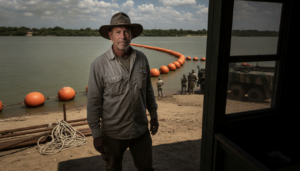
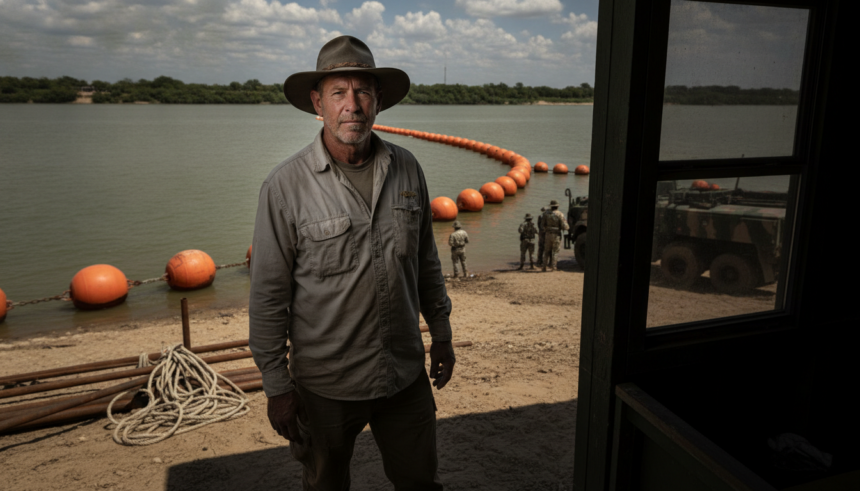
In 2023, Texas installed a 1,000-foot string of 4-foot-tall rotating orange buoys in the Rio Grande near Eagle Pass under Operation Lone Star, the state-funded border security crackdown directed by Governor Abbott’s office. The units were outfitted with serrated metal plates and underwater mesh to prevent swimming beneath them, a design feature that drew immediate criticism from humanitarian groups. The state spent approximately $1 million on the initial deployment — a figure that became politically significant later, because it established the barrier as cheap to start and expensive to litigate.
The legal response was swift. The Biden administration’s Justice Department sued to force removal of the barrier, arguing it obstructed a navigable waterway and implicated treaty obligations with Mexico. The litigation moved slowly through the courts and the buoys stayed in the water throughout. That outcome mattered more than the pleadings: because the barrier was never removed, it survived as a working prototype, therefore the administration that took office in January 2025 inherited a deployed system it could scale rather than a concept it had to prove.
The fiscal backdrop drove the next phase. The Texas Tribune has reported that Texas spent more than $11 billion on Operation Lone Star before federal adoption, which gave Abbott the central argument he later used to demand reimbursement: the state had funded a federal responsibility. Readers following the longer arc of this story can track it through INQ Daily world affairs coverage.
Operation River Wall: The Federal Expansion That Scaled a State Stunt to 536 Miles
From Operation Lone Star to Operation River Wall: How the Rio Grande Buoy Barrier Became a 536-Mile Federal Project turns on a single administrative instrument — the waiver. Federal waiver authority removed environmental and procedural review from the critical path, therefore construction timelines compressed from years to months.
Timeline: From State Buoys to a 536-Mile Federal Operation
- 2023 — Texas installs 1,000 feet of orange buoys near Eagle Pass under Operation Lone Star; the Justice Department sues to remove them.
- July 3, 2025 — DHS Secretary Kristi Noem signs a waiver bypassing more than 30 federal laws for waterborne barrier construction.
- July 2025 — The One Big Beautiful Bill Act is signed, allocating $13.5 billion in state and local border security grants.
- October 2025 — The U.S. Coast Guard launches Operation River Wall, covering roughly 260 river miles.
- Early 2026 — DHS confirms a plan for more than 500 miles of interconnected 15-foot, one-ton aluminum buoys; contracting figures cite 536 miles.
- June 2026 — Contractors stage more than 600 federal buoys at Shelby Park, Eagle Pass.
- Mid-July 2026 — Rio Grande flooding sweeps roughly 600 buoys downstream; two Eagle Pass international bridges close temporarily.
- September 18, 2026 — Abbott announces $7.5 billion in federal reimbursement to Texas for Operation Lone Star costs.
Documentation compiled by the Immigration Policy Tracking Project records that the July 3, 2025 waiver bypassed more than 30 statutes, including environmental protection rules, historic and cultural preservation requirements, and Administrative Procedure Act procedures. Those are precisely the laws that normally force environmental review, hydrological study and public comment before in-channel construction begins. As a result, the project proceeded without a published flood model — the omission critics cited directly when the buoys broke loose a year later. The waiver authority itself derives from Section 102 of the 1996 Illegal Immigration Reform and Immigrant Responsibility Act as amended, which means the legal basis is long-standing rather than improvised; what changed in 2025 was the scope of its application to a waterway.
The money and personnel followed the waiver. Federal contracts awarded to private firms exceeded $1 billion, the 17-mile first phase near Brownsville was priced at roughly $90 million, and The War Horse reported that the Coast Guard committed personnel and assets across roughly 260 river miles from October 2025 — an unprecedented inland deployment for the service.
The July 2026 Flood That Broke the Barrier Before It Was Finished
In mid-July 2026, a slow-moving rainfall system over South and Central Texas flooded the Rio Grande and tore hundreds of staged and partially installed federal buoys from their moorings at Shelby Park in Eagle Pass. Tricia Cortez, Executive Director of the Rio Grande International Study Center, estimated that roughly 600 buoys were swept away.
DHS and Customs and Border Protection had publicly stated the system was engineered to withstand a 100-year flood. The outcome fell well short of that claim, but the gap requires precision rather than rhetoric: most of the lost units were staged on land or only partially moored, therefore the failure tested the construction and staging sequence rather than a completed, interconnected barrier. That distinction cuts both ways. It means the episode is evidence about project management and contractor sequencing as much as about hydrology — and it also means the completed system’s flood performance remains untested, because DHS has not published the modelling behind the 100-year figure.
The downstream consequences were immediate. One-ton aluminum cylinders moving in floodwater become strike hazards for bridge piers, which is why emergency managers treated them as infrastructure threats rather than lost property. Texas Public Radio’s July 2026 reporting and statements from the Texas Division of Emergency Management, alongside Eagle Pass Police Chief Amy Gonzalez, confirmed that two international bridges closed temporarily, interrupting cross-border commercial and pedestrian traffic. Laredo activated its emergency operations center and deployed drones to track the buoys because four international bridges there sat downstream. Some buoys beached on the Mexican bank, where residents reportedly salvaged them for scrap metal — a detail that matters because it means an unknown share of federal assets was never recovered. Judged against its own timeline, From Operation Lone Star to Operation River Wall: How the Rio Grande Buoy Barrier Became a 536-Mile Federal Project ran construction ahead of engineering validation, and the July flood is the clearest documented consequence of that sequencing.
Confirmed Impacts of the July 2026 Buoy Breakaway
- Roughly 600 one-ton buoys swept downstream from Eagle Pass staging areas (Rio Grande International Study Center estimate).
- Two international bridges in Eagle Pass temporarily closed on debris-strike risk (TDEM; Eagle Pass Police Chief Amy Gonzalez).
- Laredo activated its emergency operations center and deployed drones to track buoys approaching four international bridges.
- Buoys beached on the Mexican side of the river, with reports of residents salvaging them for scrap metal.
- No reconciled federal inventory of lost, recovered or replaced buoys published as of November 2026.
“A human rights violation in the water and a public hazard on land.”
— Amérika García Grewal, Co-Director, Frontera Federation
The Money: $7.5 Billion Back to Texas and More Than $1 Billion in Contracts
On September 18, 2026, Governor Abbott announced that DHS and FEMA had awarded Texas $7.5 billion to reimburse Operation Lone Star spending. The payment was authorised by the One Big Beautiful Bill Act, signed in July 2025, which allocated $13.5 billion in grants for state and local border security efforts.
| Figure | Amount | Date / Source of record |
|---|---|---|
| Initial Texas buoy deployment cost | Approximately $1 million | 2023; state expenditure, Operation Lone Star |
| Total Texas Operation Lone Star spending | More than $11 billion | Texas Tribune reporting; Abbott’s office |
| Federal reimbursement to Texas | $7.5 billion | September 18, 2026; Abbott announcement (DHS/FEMA) |
| One Big Beautiful Bill Act border grant pool | $13.5 billion | Signed July 2025 |
| Federal buoy contracts awarded to private firms | More than $1 billion | 2025; Texas Public Radio reporting |
| Cost of first 17-mile federal phase near Brownsville | Approximately $90 million | 2025; DHS phase estimate |
The fiscal reversal is the sharpest fact in the record. Texas spent more than $11 billion on Operation Lone Star while the federal government was actively suing to dismantle part of it; the change of administration converted that liability into a reimbursable claim, resulting in what stands as the largest single border-security transfer to a state on record. Abbott called the award a “victory for taxpayers,” citing the years in which Texas, as he framed it, held the line alone. The counter-fact belongs in the same paragraph: $7.5 billion covers roughly two-thirds of what Texas reports spending, therefore the state absorbed the balance, and the reimbursement does not cover the federal cost of replacing buoys lost in July 2026.
DHS has not published a per-mile cost for the full 536-mile plan. Consequently, total programme cost cannot be verified from public documents, and any figure circulating for the completed barrier is an extrapolation from the $90 million first phase rather than a disclosed estimate.
The Case Against the Barrier: Environmental, Humanitarian and Local Economic Objections
The procedural objection came first and has proved the most durable. Frontera Federation Co-Director Amérika García Grewal argued that the buoys were installed without proper flood modelling or environmental review — a direct consequence of the July 3, 2025 waiver, which removed exactly those requirements. The organisation’s public statements described the barrier as both a humanitarian and a physical hazard. The July 2026 breakaway gave that argument evidentiary weight, because the failure mode critics had predicted — unsecured heavy units mobilised by high water — is the one that occurred.
The independent risk assessment carries disproportionate importance for the same reason. Tricia Cortez of the Rio Grande International Study Center called the flood incident a “fiasco” and said her organisation had commissioned an assessment predicting that type of failure. Because federal environmental and hydrological review was waived, that commissioned assessment became effectively the only published analysis of the staging plan’s flood exposure, which means a non-governmental organisation supplied the risk documentation the statutory process would normally have produced.
Local economic and humanitarian objections run alongside. As documented in San Antonio Current reporting, Aaron Millan, owner of Brownsville Kayaks, described the project as an “ecological disaster” and a “tremendous waste of time and money,” while artist Bekah Hinojosa called the structures “murder buoys.” The federal position differs on its own terms: DHS and CBP maintain that in-channel barriers deter crossings between ports of entry, and neither agency has conceded a design fault arising from the July 2026 losses.
Where the 536-Mile Project Stands in November 2026
As of November 14, 2026, the 536-mile plan remains federal policy. The July 2025 waivers are still in force, awarded contracts remain active, and installation covers only a fraction of the planned distance, concentrated in the Brownsville-area phase and the Coast Guard’s roughly 260-mile operating zone. The September reimbursement strengthened the programme’s political position because it demonstrated federal willingness to fund state-originated border infrastructure at scale — and because it rewarded, rather than penalised, a state whose barrier had been the subject of federal litigation two years earlier.
Three concrete variables determine the next phase. First, whether DHS publishes flood modelling and revises mooring and staging standards after July 2026: publication would allow independent review of the 100-year claim, while continued silence keeps the engineering case unverifiable. Second, whether litigation or treaty objections raised through the International Boundary and Water Commission constrain in-channel work, which would force redesign in the channel’s shared sections. Third, whether the remaining share of the $13.5 billion grant pool is obligated, because that obligation sets the funding ceiling for further state-federal cost-sharing.
Frequently Asked Questions
What is Operation River Wall?
Operation River Wall is the U.S. Coast Guard and DHS operation, launched in October 2025, to install interconnected floating barriers in the Rio Grande. It uses 15-foot-long, one-ton cylindrical aluminum buoys moored in the channel to deter crossings between ports of entry. DHS has confirmed a plan covering more than 500 miles; contracting records and reporting cite 536 miles along the Texas–Mexico border.
How is Operation River Wall different from Operation Lone Star?
Operation Lone Star was a Texas state programme; Operation River Wall is federal. Texas installed roughly 1,000 feet of 4-foot orange buoys near Eagle Pass in 2023 for about $1 million. The federal operation adopted the concept in 2025 and scaled it to 536 miles using far larger one-ton aluminum buoys, backed by more than $1 billion in contracts and federal waiver authority Texas never had.
How long is the Rio Grande buoy barrier supposed to be?
The plan calls for 536 miles of interconnected buoys, running from the Gulf of Mexico into South Texas. DHS statements describe it as “more than 500 miles,” while contracting documents and reporting cite the 536-mile figure. The first federal phase covered a 17-mile stretch south of Brownsville at a reported cost of about $90 million.
What happened to the buoys in the July 2026 flood?
Roughly 600 staged and partially installed federal buoys broke free during mid-July 2026 Rio Grande flooding. Extraordinary rainfall across South and Central Texas pushed the river over its banks at Shelby Park in Eagle Pass, where contractors had staged the units in June. The one-ton cylinders floated downstream, forcing the temporary closure of two international bridges in Eagle Pass and prompting Laredo to activate its emergency operations center.
Which federal laws were waived to build the barrier?
DHS Secretary Kristi Noem signed a waiver on July 3, 2025 bypassing more than 30 federal laws. The waived statutes included environmental protection rules, historic and cultural site preservation requirements, and Administrative Procedure Act procedures. Because those laws normally require environmental review and public comment before in-channel construction, the waiver removed the flood-modelling and review stages critics later cited after the July 2026 breakaway.
How much has the buoy barrier cost and who is paying?
Federal contracts for the buoy project exceed $1 billion, and Texas received $7.5 billion in federal reimbursement on September 18, 2026. That payment, announced by Governor Greg Abbott, came from the $13.5 billion state and local border security grant pool created by the One Big Beautiful Bill Act in July 2025. Texas reports spending more than $11 billion on Operation Lone Star, so the reimbursement covered roughly two-thirds of state outlays.
Was the barrier designed to survive flooding?
DHS and Customs and Border Protection stated the system was engineered to withstand a 100-year flood. The July 2026 failure involved buoys that were staged or only partially moored rather than a completed, interconnected barrier, which means the episode tested the construction sequence more than the finished design. DHS has not published the flood modelling behind the 100-year claim, so the completed system’s performance is unverified.
Is the 536-mile project still going ahead?
Yes. As of November 14, 2026, the 536-mile plan remains federal policy. The July 2025 waivers are still in force, contracts are active, and the September 2026 reimbursement to Texas signalled continued federal funding commitment. Installation covers only a fraction of the planned distance, and DHS has not published a reconciled inventory of buoys lost or replaced after July 2026.
Limitations of the Public Record and What Is Still Unverified
Several load-bearing figures in this account cannot be confirmed from federal documents. The 536-mile total appears in contracting records and reporting, while DHS itself describes the plan as “more than 500 miles,” therefore the authoritative length is not settled. The roughly 600-buoy loss estimate originates with the Rio Grande International Study Center rather than a federal count, and no agency inventory has been published to corroborate or correct it. DHS has released neither the flood modelling supporting its 100-year claim nor a per-mile cost for the full programme, which means every total-cost projection in public circulation is inferred from the $90 million first phase rather than documented.
Competing interpretations deserve their strongest form. Supporters argue that in-channel barriers are the only physical deterrent available on a water boundary where treaty obligations bar conventional fencing, and that deterrence effects cannot be measured by crossing counts alone. Critics argue the same money applied to ports of entry, personnel, surveillance and processing capacity produces measurable throughput gains without flood or navigation risk. From Operation Lone Star to Operation River Wall: How the Rio Grande Buoy Barrier Became a 536-Mile Federal Project is contested on cost-effectiveness, not only on ethics. INQ Daily takes no position on border policy.
The Bottom Line
A $1 million state barrier survived federal litigation, therefore it became available as a template the next administration could adopt without rebuilding the case for it. Waiver authority signed on July 3, 2025 removed environmental review, historic preservation and Administrative Procedure Act requirements, consequently construction outran engineering validation. The mid-July 2026 flood exposed that sequence when roughly 600 one-ton buoys broke loose and closed two international bridges at Eagle Pass. The September 18, 2026 award of $7.5 billion to Texas funded the programme anyway.
From Operation Lone Star to Operation River Wall: How the Rio Grande Buoy Barrier Became a 536-Mile Federal Project now hinges on a single measurable test: whether DHS publishes revised mooring and staging standards and a reconciled buoy inventory before the next high-water season on the Rio Grande. Publication would make the engineering case reviewable. Continued silence leaves the 100-year flood claim resting on an assertion that July 2026 did not support.
References
- Texas Public Radio — Federal plan to install 536 miles of floating barriers in the Rio Grande, including the 17-mile Brownsville-area phase and contracts exceeding $1 billion
- Texas Public Radio — July 2026 flooding, the breakaway of staged buoys from Shelby Park and resulting bridge closures in Eagle Pass
- Immigration Policy Tracking Project — Documentation of the July 3, 2025 DHS waiver signed by Secretary Kristi Noem bypassing more than 30 federal statutes
- Frontera Federation — Statements from Co-Director Amérika García Grewal on flood modelling, environmental review and public hazard
- The Texas Tribune — Operation Lone Star expenditures exceeding $11 billion and the September 18, 2026 announcement of $7.5 billion in federal reimbursement
- The War Horse — U.S. Coast Guard personnel and asset deployment under Operation River Wall across roughly 260 river miles from October 2025
- San Antonio Current — Local reaction, including Tricia Cortez of the Rio Grande International Study Center, Aaron Millan of Brownsville Kayaks and artist Bekah Hinojosa
- MyParisTexas / Texas Division of Emergency Management — Confirmation of the temporary closure of two Eagle Pass international bridges and Laredo’s emergency operations activation