
Table of Contents
- Inflation Reduction Act 2026: the status in one table
- Energy credits gutted: what the 2025 law removed
- The 45X manufacturing credit restrictions
- Wind eligibility ends December 31, 2027
- Foreign-entity rules and the 65% domestic-content test
- Critical minerals, and why metallurgical coal now qualifies
- Drug caps standing: negotiated prices land in 2026
- What seniors actually pay: the $2,100 cap, insulin and vaccines
- The fiscal backlash: a $650 billion Part D revision
- Launch prices keep climbing despite negotiation
- Consumer credits: solar, home energy and EVs in 2026
- Frequently asked questions
- Limitations of this assessment and what could change
- The bottom line
- References
- Related Reading
The Inflation Reduction Act 2026 is a split law: its healthcare provisions are live and expanding, while its clean-energy subsidies are being dismantled. Medicare’s first 10 negotiated drug prices took effect January 1, 2026, with reductions of 38% to 79%, and the Part D out-of-pocket cap sits at $2,100. The One Big Beautiful Bill Act, signed July 4, 2025, restricted the 45X manufacturing credit and ends wind eligibility after December 31, 2027.
Two things happened to the same statute at once. On January 1, 2026, Medicare’s first negotiated drug prices took effect, cutting list prices by 38% to 79% on ten Part D medicines, while the annual out-of-pocket cap for enrollees rose to $2,100. Meanwhile, the advanced-manufacturing and wind credits written into the 2022 law are winding down under the One Big Beautiful Bill Act, signed July 4, 2025, which ends wind component eligibility after December 31, 2027.
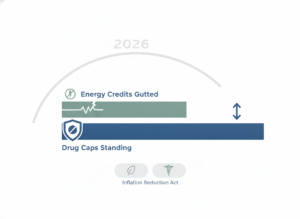
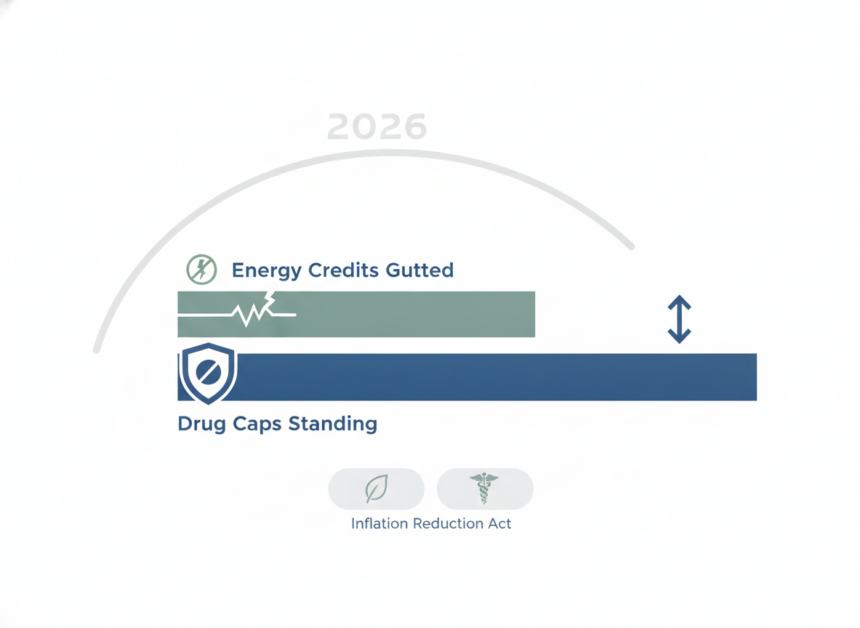
What survives of the inflation reduction act 2026 is the healthcare title: Medicare price negotiation, the indexed Part D spending cap, the $35 monthly insulin limit and zero-cost adult vaccines. What has been unwound is the energy title: the Section 45X manufacturing credit now carries foreign-entity and domestic-content screens, wind eligibility expires after 2027, and critical-mineral credits phase out between 2031 and 2034.
The split happened because the two halves score and poll in opposite directions. Drug negotiation reduces federal outlays and commands broad support among older voters; the energy credits were recast by their opponents as market-distorting spending and became the available offset in the July 2025 package. As a result, this piece sets out the provision-by-provision status, what enrollees and households actually pay, and the fiscal fallout now landing on the federal budget.
About this analysis: Reported and compiled by the policy desk at INQ Daily, an international news desk covering economics, energy policy and public health. Status statements are dated and sourced to primary government and legislative documents wherever those exist.
Transparency note: This is a policy explainer, not tax, legal or medical advice. Eligibility for any specific credit or benefit depends on Treasury, IRS and CMS guidance that continues to be issued. Readers should verify their own position with the relevant agency before filing or enrolling.
Inflation Reduction Act 2026: the status in one table
The healthcare title of the inflation reduction act 2026 stands intact and is expanding, while the energy title is being narrowed toward expiry. Two statutes drive that verdict: the original 2022 law, which created both regimes, and the One Big Beautiful Bill Act enacted July 4, 2025, which amended and restricted the clean-energy subsidies without touching the Medicare provisions. Because the 2025 law amended only the energy title, every drug-pricing deadline in the table below still runs on its original schedule.
The statuses below are not interchangeable. “Restricted” means the credit survives but now turns on new eligibility conditions. “Phasing out” means a fixed statutory end date applies. That distinction matters because each carries a different deadline and a different compliance burden, as documented in the legislative text of the One Big Beautiful Bill Act.
| Provision | Original 2022 terms | Status in 2026 | Key date |
|---|---|---|---|
| Medicare negotiation (first 10 Part D drugs) | Phased negotiation authority | In effect; 38%-79% cuts | Jan 1, 2026 |
| Part D out-of-pocket cap | $2,000, indexed to inflation | In effect at $2,100 | 2026 plan year |
| $35 insulin cap and $0 adult vaccines | Capped cost-sharing | In effect, unchanged | Since 2023 |
| Section 45X manufacturing credit | Broad component eligibility | Restricted by sourcing tests | July 4, 2025 |
| Wind component eligibility | Long-dated credit | Ends after cutoff | Dec 31, 2027 |
| Critical minerals credit | No scheduled phase-out | Phasing out; coal added | 2031-2034 |
Energy credits gutted: what the 2025 law removed
The energy provisions of the inflation reduction act 2026 were not repealed outright; they were narrowed until much of their value expires on a clock. The One Big Beautiful Bill Act layered two mechanisms onto the 2022 credits: new eligibility conditions that must be documented before a claim is filed, and hard end dates for specific technologies. The effect of combining the two is that a credit can remain on the books while being unusable in practice, because the sourcing test fails or the window has closed.
Timeline: how the energy credits were narrowed
- August 16, 2022 — the IRA is enacted with uncapped 45X manufacturing credits and long-dated clean electricity incentives.
- July 4, 2025 — the One Big Beautiful Bill Act is signed, amending and restricting the IRA’s clean energy subsidies.
- Post-2025 — four new foreign-entity restrictions apply to supply-chain ties with China, Russia, Iran and North Korea.
- Post-2025 — a 65% domestic-material-cost test applies to certain secondary components.
- December 31, 2027 — wind energy component eligibility ends.
- 2031-2034 — critical-mineral credits phase out, with metallurgical coal added as a qualifying mineral.
The 45X manufacturing credit restrictions
The Section 45X advanced manufacturing production credit remains law but applies on much tighter terms to makers of solar, battery, inverter and wind components. Because eligibility now turns on supply-chain sourcing tests rather than production volume alone, manufacturers must re-document the origin of their inputs before claiming the 45X advanced manufacturing production credit. Consequently, compliance costs rise and claims are delayed, which reduces the credit’s present value even for facilities that ultimately qualify.
Wind eligibility ends December 31, 2027
Wind energy components lose eligibility after December 31, 2027 under the July 2025 law. A fixed cutoff changes developer behaviour immediately rather than at the deadline: because the credit cannot be captured after the date, investment decisions get pulled forward into 2026 and 2027, resulting in a compressed build-out window and a cliff on the other side of it. The commercial question for turbine and component suppliers is therefore no longer whether to expand capacity but whether orders can be placed in service in time.
Foreign-entity rules and the 65% domestic-content test
Two screens now sit in front of the credit. The first is a set of four foreign-entity restrictions targeting supply-chain ties to China, Russia, Iran and North Korea. The second is a 65% domestic-material-cost requirement applied to certain secondary components. Because that test measures material cost rather than assembly location, a component built in a US plant from imported inputs can still fail, which means final-assembly reshoring alone does not secure the credit.
Critical minerals, and why metallurgical coal now qualifies
Critical-mineral credits are scheduled to phase out between 2031 and 2034, and the 2025 law added metallurgical coal as a qualifying critical mineral. Critics of the rollback cite that reclassification more often than any other single change as evidence that the energy title’s original purpose was inverted. That is an argued position, attributed here to its proponents rather than asserted.
Drug caps standing: negotiated prices land in 2026
Negotiated Maximum Fair Prices for the first 10 Part D drugs took effect January 1, 2026. A Maximum Fair Price is the ceiling CMS sets through direct negotiation with a manufacturer, replacing the list price for Medicare purposes. According to the Centers for Medicare & Medicaid Services, the negotiated prices land between 38% and 79% below the drugs’ list prices, and the agency projects roughly $1.5 billion in annual beneficiary out-of-pocket savings alongside about $6 billion in annual savings to the Medicare program.
Manufacturers negotiated because refusing was the more expensive option. A July 2026 sector analysis from CPHI described the enforcement mechanism as an excise tax starting at 65% and escalating to 95% of a non-participating manufacturer’s US sales of the selected drug. Therefore the arithmetic favoured the table, and the industry analysis frames the result as the most significant pricing-policy transformation the sector has faced in decades, with the sharpest effect on the risk-return calculus for chronic-condition drugs aimed at older patients.
Key figures: the first negotiation cycle
- 38% to 79% — range of price reductions against list prices for the 10 selected drugs (CMS)
- $1.5 billion — projected annual beneficiary out-of-pocket savings
- $6 billion — projected annual savings to the Medicare program
- 65% rising to 95% — excise tax on manufacturers that refuse to negotiate
- January 1, 2026 — date the negotiated prices took effect
The programme is also widening. Medicare Part B drugs became eligible for negotiation in the current cycle, which extends the mechanism beyond retail pharmacy spending into clinician-administered products billed under Part B.
What seniors actually pay: the $2,100 cap, insulin and vaccines
The Medicare Part D out-of-pocket cap for 2026 is $2,100. The cap launched at $2,000 for the 2025 plan year and is indexed for inflation, therefore it rose to $2,100 for 2026, according to KFF’s tracking of the Medicare drug provisions. Once an enrollee’s covered Part D spending reaches that figure, cost-sharing on covered drugs stops for the remainder of the calendar year — a structural change from the pre-2025 benefit, which had no annual ceiling at all.
The two most-used cost limits sit below the cap. Covered insulin products carry a $35 monthly cost-sharing limit, and recommended adult vaccines, including shingles and RSV immunisations, carry $0 cost-sharing. Neither provision was altered by the 2025 energy rollback, because that law amended the energy title only. Enrollees facing large bills early in the year can also spread covered costs across the plan year through the Medicare Prescription Payment Plan, as the Medicare Rights Center sets out in its beneficiary guidance.
The cap is narrower than it sounds. It applies to Part D covered drugs, which means monthly premiums do not count toward it, drugs excluded from a plan’s formulary do not count toward it, and spending on clinician-administered products billed under Part B falls outside it entirely. An enrollee whose medication is off-formulary can therefore spend well past $2,100 without triggering the protection.
| Benefit | 2026 amount | Applies to |
|---|---|---|
| Part D annual out-of-pocket cap | $2,100 | Covered Part D drugs only |
| Insulin monthly cost-sharing | $35 | Covered insulin products |
| Recommended adult vaccines | $0 | Includes shingles and RSV |
| Medicare Prescription Payment Plan | Monthly instalments | Covered Part D costs |
The fiscal backlash: a $650 billion Part D revision
The Congressional Budget Office recently revised its Medicare Part D cost projections upward by roughly $650 billion through 2035, and the IRA’s benefit redesign is a primary driver of the increase. That revision, published in the CBO’s health care projections, is the clearest fiscal verdict yet on the inflation reduction act 2026 drug provisions: the law reduced what enrollees pay without reducing what the drugs cost, so the difference had to land somewhere.
The causal chain runs in four steps. First, the redesign capped the annual growth of the base beneficiary premium. Second, plan costs kept rising, driven by general drug-price inflation and by explosive volume growth in GLP-1 prescriptions. Third, because the premium growth limit blocks plans from passing those increases fully to enrollees, the federal share absorbs them. Fourth, as the Committee for a Responsible Federal Budget has argued in its analysis of the redesign, the result is a cost shift onto the deficit rather than a cost reduction in the system.
The subsidy that softened the transition is also ending. To stop insurers from repricing sharply when the caps took effect, the Premium Stabilization Demonstration Project paid down part of the increase for 2025 and 2026. CMS announced in late July 2026 that it would halt the programme at the end of 2026, with termination effective January 1, 2027. The consequence is straightforward: plan bids for 2027 must absorb costs the demonstration had been covering, which puts upward pressure on enrollee premiums. No specific premium figure is forecast here, because the 2027 landscape has not been filed.
Launch prices keep climbing despite negotiation
Negotiation has not slowed the price at which new medicines arrive. A late-October 2026 report from the Institute for Clinical and Economic Review and West Health found the median annual net launch price for new drugs reached $257,000 in 2025, a 35% increase from 2022, with roughly one in four new 2025 drugs priced above $500,000 a year. The negotiation programme reaches established, high-spend products years after approval; it does not touch the opening price.
Launch pricing in the negotiation era
- $257,000 — median annual net launch price for new drugs in 2025 (ICER/West Health, October 2026)
- 35% — increase in median net launch price since 2022
- About 1 in 4 — new 2025 drugs with annual net prices above $500,000
Analysts reading the data offer a structural explanation rather than an accusation of intent. Because a selected drug’s negotiated price is eventually set against its established list price, and because the eligibility clock for negotiation starts from approval, a higher launch price preserves more revenue across the protected years before negotiation can apply. That is the analysts’ reading of manufacturer incentives, consistent with the CPHI assessment that the programme has altered investment calculus rather than compressed it. The policy implication is that the cost fight has migrated upstream, to the point of launch.
Consumer credits: solar, home energy and EVs in 2026
The household credit landscape narrowed sharply after the July 2025 law, while state-administered rebate programmes continue in places where funds were already obligated. The distinction matters because the two run on different machinery: federal tax credits are claimed on a return under IRS rules and end when the statute says they end, whereas Home Energy Rebates are disbursed by state energy offices from allocated IRA funding and therefore follow each state’s own programme timetable and remaining balance.
Before filing or buying, verify your own position against current IRS guidance for the credit in question and, for rebates, your state energy office’s open programme list. For a vehicle purchase, ask the dealer to confirm eligibility at the point of sale rather than assuming it from a model year.
| Incentive | Status in 2026 | Deadline or condition |
|---|---|---|
| Clean vehicle credit (new EVs) | Timetable changed by July 2025 law | Not stated; check IRS guidance |
| Used clean vehicle credit | Timetable changed by July 2025 law | Not stated; check IRS guidance |
| Residential clean energy credit | Not stated in current sources | Verify with IRS before filing |
| Energy efficient home improvement credit | Not stated in current sources | Verify with IRS before filing |
| State-administered Home Energy Rebates | Continuing where funds obligated | Varies by state programme |
Frequently asked questions
Is the Inflation Reduction Act still in effect in 2026?
Yes, partly. The inflation reduction act 2026 remains law, but it operates as two separate regimes. Its Medicare provisions are fully active: negotiated prices took effect January 1, 2026 and the Part D out-of-pocket cap stands at $2,100. Its clean-energy credits were restricted by the One Big Beautiful Bill Act signed July 4, 2025.
What is the Medicare out-of-pocket drug cap for 2026?
$2,100 for the year. The cap launched at $2,000 in 2025 and is indexed for inflation, therefore it rose to $2,100 in 2026. Once an enrollee reaches it, Part D cost-sharing for covered drugs stops for the remainder of the calendar year. Premiums and non-formulary drugs sit outside the cap.
Which Inflation Reduction Act energy tax credits were eliminated?
Wind components and much of 45X. The July 4, 2025 law ends wind component eligibility after December 31, 2027, restricts the Section 45X advanced manufacturing production credit through four foreign-entity rules and a 65% domestic-material-cost test, and schedules critical-mineral credits to phase out between 2031 and 2034.
How much did Medicare’s negotiated drug prices fall in 2026?
Between 38% and 79% off list prices. CMS negotiated Maximum Fair Prices for the first 10 Part D drugs, effective January 1, 2026. The agency projects about $1.5 billion in annual beneficiary out-of-pocket savings and roughly $6 billion in annual savings to the Medicare program itself.
Is the $35 insulin cap still available in 2026?
Yes. The $35 monthly cost-sharing limit on covered insulin products remains in force for Medicare enrollees in 2026, alongside $0 cost-sharing for recommended adult vaccines such as shingles and RSV. Neither provision was altered by the 2025 energy rollback, because that law amended the energy title only.
Can I still claim the EV tax credit in 2026?
Check IRS guidance before you buy. The 2025 law changed the timetable for consumer vehicle credits, and the current sources behind this analysis do not state a single nationwide amount or cutoff date for 2026 purchases. Confirm eligibility against live IRS guidance and get written confirmation from the dealer at the point of sale.
Why are Medicare Part D costs rising if the Inflation Reduction Act capped prices?
Because the cap shifted cost rather than removing it. The benefit redesign limited beneficiary premium growth, therefore rising plan costs fall largely on the federal budget. Combined with drug-price inflation and surging GLP-1 prescription volume, this drove CBO to revise Part D projections upward by roughly $650 billion through 2035.
What happens when the Part D premium stabilization program ends?
The subsidy that suppressed premium increases disappears on January 1, 2027. CMS announced in late July 2026 that the demonstration project halts at the end of 2026. As a result, plan bids for 2027 must absorb costs the demonstration had been covering, which puts upward pressure on enrollee premiums.
Did the Inflation Reduction Act actually reduce inflation?
The evidence is contested. Independent scorers judged the headline inflation effect to be small in either direction. Supporters point to measurable price relief concentrated in Medicare drug costs for affected enrollees. Critics attribute higher electricity costs and larger deficits to the energy spending. Both positions are argued; neither is settled here.
Why did drug caps survive while energy credits were cut?
Because the two provisions score and poll in opposite directions. Drug negotiation reduces federal outlays and is broadly popular with older voters, therefore repealing it carries both a budgetary and an electoral cost. The energy credits are scored as spending, which made them the available offset in the July 2025 package.
Limitations of this assessment and what could change
Statutory status is documented here; outcomes are not. Treasury, the IRS and CMS continue to issue implementing guidance, therefore whether a particular factory, rooftop installation or vehicle purchase qualifies is not settled by the statute alone. The CBO’s $650 billion revision and the ICER/West Health launch-price figures are projections and point estimates carrying their own stated uncertainty, not realised results. Where current sources do not state a 2026 figure, this article says so rather than filling the gap.
Open variables as of October 22, 2026
- Pending Treasury and IRS guidance on the foreign-entity and 65% domestic-content tests
- The 2027 Part D plan landscape, filed after premium stabilization ends on January 1, 2027
- The next Medicare negotiation cycle, including newly eligible Part B drugs
- Further legislative attempts at full repeal of the remaining energy provisions
- Litigation brought by manufacturers over the negotiation programme
The critics’ case deserves stating in its own terms. An October 2026 op-ed in the Flathead Beacon argued that the IRA’s energy subsidies distorted wholesale electricity markets, pushed reliable baseload coal, nuclear and natural gas plants into premature retirement, and failed to lower retail electricity prices — a case for repealing what remains. The counter-position, held by the credits’ defenders, is that the subsidies lowered the cost of capital for new generation and therefore added supply that would not otherwise have been built. Both are argued positions, and the published data has not resolved between them.
The bottom line
The healthcare half of the law is intact and widening, with negotiated prices live since January 1, 2026, Part B drugs now entering the pipeline and the $2,100 cap holding. The energy half of the inflation reduction act 2026 is narrowing toward expiry under the statute signed July 4, 2025. Two dates deserve a place in any 2027 planning calendar: December 31, 2027, when wind component eligibility ends, and January 1, 2027, when premium stabilization terminates. The unresolved tension is fiscal rather than clinical — the law caps what seniors pay while federal Part D exposure grows, which means the cost fight has moved from the pharmacy counter to the budget. For continuing analysis, see more world affairs coverage from INQ Daily.
References
- Centers for Medicare & Medicaid Services — Inflation Reduction Act and Medicare: negotiated Maximum Fair Prices effective January 1, 2026; end of the Part D Premium Stabilization Demonstration announced late July 2026. https://www.cms.gov/inflation-reduction-act-and-medicare
- Congressional Budget Office — health care projections, including the upward revision of roughly $650 billion to Medicare Part D costs through 2035. https://www.cbo.gov/topics/health-care
- KFF — Medicare prescription drug provisions tracking: $2,000 cap in 2025 indexed to $2,100 for 2026; $35 insulin cap and $0 adult vaccine cost-sharing. https://www.kff.org/medicare/
- Institute for Clinical and Economic Review and West Health, October 2026 launch-price report — median annual net launch price of $257,000 in 2025, a 35% rise from 2022. https://icer.org/
- Medicare Rights Center — beneficiary guidance on the 2026 Part D benefit and the Medicare Prescription Payment Plan. https://www.medicarerights.org/
- Committee for a Responsible Federal Budget — analysis of capped beneficiary premium growth and federal cost exposure. https://www.crfb.org/
- One Big Beautiful Bill Act, enacted July 4, 2025 — legislative text and summary covering Section 45X restrictions, wind eligibility cutoff, foreign-entity rules, the 65% domestic-material-cost test and critical-mineral phase-out. https://www.congress.gov/
- CPHI industry analysis, July 2026 — excise tax of 65% escalating to 95% for refusal to negotiate, and its effect on pharmaceutical investment calculus. https://www.cphi.com/