
Table of Contents
- The 2026 Numbers: Arrivals Down Sharply, Deaths Up
- Why Deaths Rose While Crossings Fell: Frontex's Shifting Mediterranean Rescue Map
- What happens after a boat is spotted from the air
- Interceptions and Returns: 17,067 Sent Back to Libya
- Deadlier Boats, Deadlier Weather: The Conditions Behind the Death Rate
- Three documented drivers of the 2026 death rate
- What Frontex and the IOM Say
- The EU Pact on Migration and Asylum: First Full Season
- Frequently Asked Questions
- Limitations of the Data and Competing Explanations
- What this analysis cannot settle
- Conclusion
- References
Key Takeaway
>
“Crossings Fall, Deaths Don’t: Inside Frontex’s Shifting Mediterranean Rescue Map” describes a measurable 2026 divergence rather than a rhetorical one. 70,598 people reached Europe by sea between 1 January and 12 October 2026, down from 110,817 in the same window of 2025, according to the International Organization for Migration. Over roughly the same period the IOM’s Missing Migrants Project recorded 2,437 dead or missing, up about 9% from 2,237. The Central Mediterranean shows the pattern most sharply: arrivals down 55%, deaths up from 921 to 1,006. The mechanism is operational — rescue-capable vessels moved away from the deadliest water while departures continued on less seaworthy boats.
BRUSSELS, November 4, 2026 — Fewer boats are reaching Europe this year than last, and more people are dying on the way. IOM figures covering 1 January to 12 October 2026 put sea arrivals at 70,598 against 110,817 a year earlier, a fall of roughly 36%, while recorded deaths and disappearances rose about 9% to 2,437 by mid-October. That contradiction is the story this piece examines: Crossings Fall, Deaths Don’t: Inside Frontex’s Shifting Mediterranean Rescue Map.
The divergence is not an accident of weather alone. It is the predictable effect of a surveillance-first enforcement model, because aerial assets detect distress but cannot lift anyone out of the water. What follows covers the route-by-route data, the shift from ships to drones, the 17,067 people intercepted and returned to Libya, the vessel and weather conditions driving mortality, what Frontex and the IOM each say about the same numbers, and the first full crossing season under the EU Pact on Migration and Asylum — part of INQ Daily world affairs coverage of the migration file.
About this analysis
>
This is a news analysis prepared by the INQ Daily world affairs desk. Every figure is attributed in-sentence to the publishing institution — IOM, the Missing Migrants Project, or Frontex — together with the period it covers, because the two agencies publish on different cut-off dates. No figure here originates with INQ Daily.
Transparency note
>
Arrival totals run to 12 October 2026, all-route death totals to mid-October 2026, and route-level breakdowns to mid-September 2026. Mortality-per-crossing comparisons in this article are derived from two separate data series and are presented as directional, not as a measured rate.
The 2026 Numbers: Arrivals Down Sharply, Deaths Up
Irregular sea arrivals to Europe fell roughly 36% in the first nine months of 2026 while recorded deaths rose about 9%, according to IOM Missing Migrants Project data through mid-October 2026. The arrival series — 70,598 against 110,817 — covers 1 January to 12 October; the death series — 2,437 against 2,237 — runs to mid-October; route-level detail runs to mid-September. The windows differ because the two series are compiled separately, which means direct ratios require care.
| Route / measure | 2025 (same period) | 2026 | Change |
|---|---|---|---|
| All sea arrivals to Europe (1 Jan–12 Oct) | 110,817 | 70,598 | −36% |
| Recorded dead or missing, all routes (to mid-Oct) | 2,237 | 2,437 | +9% |
| Central Mediterranean arrivals (to mid-Sep) | 48,231 | 21,393 | −55% |
| Central Mediterranean deaths | 921 | 1,006 | +9% |
| Eastern Mediterranean (Greece) deaths | 295 | 521 | +47% |
| Migrants intercepted and returned to Libya (Jan–mid-Sep 2026) | Not stated | 17,067+ | Not stated |
The Central Mediterranean carried the steepest arrival collapse, from 48,231 to 21,393 by mid-September — a 55% fall reported by Frontex in its migratory route monitoring — yet its recorded death count rose from 921 to 1,006. Because the denominator halved while the numerator grew, mortality per crossing on that route roughly doubled. The Eastern Mediterranean route to Greece deteriorated faster still in proportional terms: deaths up 47%, from 295 to 521, against a 20% fall in arrivals. Consequently the route that lost the most traffic and the route that lost the most ground on safety are not the same route, and enforcement pressure alone does not explain both.
The ratio matters more than the raw totals. A falling denominator with a rising numerator is the clearest available signal that the character of the journey changed, not just its volume — if conditions had held constant, fewer crossings would have produced fewer deaths. One caveat stands throughout: the IOM counts only deaths it can verify through survivor testimony, recovered bodies or confirmed shipwrecks, as secondary reporting from the UN Regional Information Centre for Western Europe also notes. Unwitnessed shipwrecks are therefore absent, and any mortality rate built on these figures is a floor rather than a ceiling.
Why Deaths Rose While Crossings Fell: Frontex’s Shifting Mediterranean Rescue Map
Deaths rose because EU maritime assets capable of rescue were substituted by aerial assets that cannot rescue, and because Italian patrol areas contracted — the operational core of Crossings Fall, Deaths Don’t: Inside Frontex’s Shifting Mediterranean Rescue Map. Frontex and member states moved toward drones and crewed aircraft that spot boats and relay coordinates to national coast guards. The IOM’s Missing Migrants Project attributes the shift in dynamics directly to the “decreased maritime patrol area of Italian authorities and the shift of EU/Frontex assets,” a reallocation also tracked by Brussels policy coverage from Agence Europe.
| Capability | Patrol vessel | Drone / aircraft |
|---|---|---|
| Detects boats in distress | Yes, within visual/radar range | Yes, over a wide area |
| Takes people aboard | Yes | No |
| Provides medical aid at scene | Yes | No |
| Time from detection to rescue | Immediate if on scene | Depends on nearest vessel |
| Can trigger third-country interception | Yes | Yes, via shared coordinates |
| Cost and coverage area | Higher cost, narrower area | Lower cost, wider area |
The physical consequence is straightforward. A drone fixes a position and transmits it; it cannot take anyone aboard or treat a casualty. Therefore the interval between detection and physical rescue is set entirely by how far the nearest capable vessel is stationed, and because those vessels now sit further from the deadliest water off Libya and Tunisia, that interval widened. People in overloaded dinghies are consequently exposed to sea state, dehydration and fuel-mixture burns for longer stretches, and that exposure window is where the additional deaths accumulate.
What happens after a boat is spotted from the air
- A Frontex drone or aircraft detects a vessel and fixes its position.
- Coordinates are passed to the relevant rescue coordination centre.
- The centre notifies the nearest capable authority, which is sometimes the Libyan or Tunisian coast guard rather than an EU vessel.
- Whichever asset is closest responds — interception and return, or rescue and disembarkation in Europe.
- If no capable vessel is within range, the boat continues unaided until one arrives or it fails.
The analytical position is explicit: surveillance has improved the EU’s knowledge of where boats are without improving the odds of the people on them, which means better data has not produced better outcomes. A second-order effect follows. NGO rescue ships, already constrained by distant port assignments and administrative detentions, are absorbing a share of the gap that state assets vacated — and they operate with fewer hulls and shorter endurance than the navies they are standing in for.
Interceptions and Returns: 17,067 Sent Back to Libya
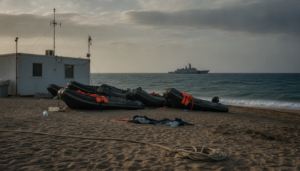
More than 17,067 people were intercepted at sea and returned to Libya by the Libyan Coast Guard between January and mid-September 2026, frequently using coordinates supplied by European aerial monitoring. Detection by EU assets, in other words, resolves into interception as readily as into rescue, because the notified authority nearest the boat is often Libyan rather than European.
Set that figure against the 21,393 who reached Italy by mid-September: close to one person returned for every person who landed. This is the arithmetic that the shifting Mediterranean rescue map produces. Detection increasingly ends in return rather than arrival, which lowers the arrival statistic without lowering the number of attempts — and attempts, not arrivals, are what generate exposure to drowning.
The legality is contested, and both positions deserve stating. Human rights organisations and UN bodies, including UNHCR’s reporting on the Libya situation, argue that facilitating returns to Libya sits uneasily with non-refoulement obligations because conditions in Libyan detention are documented as abusive. The EU and Frontex maintain that passing distress coordinates to the competent coast guard is an obligation under maritime law. The dispute turns on which duty governs when the competent authority is also the one people are fleeing.
Deadlier Boats, Deadlier Weather: The Conditions Behind the Death Rate
Vessel quality, departure timing and weather account for a substantial share of 2026 deaths according to Frontex and IOM assessments. Frontex reports heavier reliance on fragile, overcrowded rubber dinghies and poorly built iron boats through the first half of 2026, and notes that smugglers push boats out regardless of severe weather to protect margins. The IOM attributes a significant portion of the continuing loss of life to dangerous Mediterranean weather patterns that capsize those substandard hulls.
Three documented drivers of the 2026 death rate
- Vessel quality: overcrowded rubber dinghies and improvised iron boats that fail in moderate sea states (Frontex).
- Departure timing: smugglers pushing boats out regardless of forecast weather to protect margins (Frontex).
- Weather: storm systems and sea state that capsize substandard hulls (IOM).
- Response distance: longer intervals between detection and physical rescue after the contraction of patrol areas (IOM Missing Migrants Project).
The economics connect directly to the mortality figures. Smuggling networks absorb enforcement pressure by cutting the cost of the asset they expect to lose, which means cheaper hulls, less fuel, more passengers per boat and departures in weather a seaworthy vessel would wait out. As a result, enforcement that raises the cost of smuggling without reducing the demand for crossing produces a lower-volume, higher-risk market. That is precisely the pattern the 2026 route data shows: traffic down by more than a third, deaths up by nearly a tenth.
What Frontex and the IOM Say
The IOM’s reading is that the two series must be read together. Director General Amy Pope, addressing the late-2026 data in an IOM statement, put it this way:
“These figures tell two stories at once. Fewer people are arriving by sea in Europe than at this point last year. But people are still dying and going missing in alarming numbers trying to reach safety… Deaths rising even as arrivals fall shows migrants are taking increasingly dangerous journeys.”
— Amy Pope, Director General, International Organization for Migration
The organisation’s operational ask follows from that diagnosis: stronger coordination among states, NGOs and international partners to fill the gaps in search-and-rescue capacity left by the withdrawal of state-led maritime assets.
Frontex reads the same data from the enforcement side. Executive Director Hans Leijtens attributes the fall in arrivals to “sustained cooperation with our partners in the region” and to preventive measures in key departure states, a position set out in Frontex news releases. He has not disputed the death toll: “But behind every number is a person, and people are still dying at sea. Our officers remain on the ground at the external borders, supporting member states and helping to save lives.” The disagreement is therefore narrow and specific. Both institutions accept the figures. They differ on whether the asset shift is a cause of the rising death rate or a parallel development that coincided with worse boats and worse weather.
The EU Pact on Migration and Asylum: First Full Season
Summer 2026 was the first full crossing season under the implemented EU Pact on Migration and Asylum, which introduced a single standardised screening process at the EU’s external borders. The reform expanded Frontex’s role on arrival: officers assist national authorities in establishing nationalities, collecting biometric data and verifying documents before an applicant enters a formal procedure.
The limit of the reform is where it bites. The Pact governs what happens after landfall, which means it reshapes processing, transfer and return pathways but adds no vessels, no patrol hours and no rescue obligation at sea. Therefore the mortality trend sits outside the Pact’s reach entirely — a standardised screening file does nothing for a dinghy 90 nautical miles from Lampedusa. Frontex itself flags the forward risk: conflict and economic fallout across the Middle East and the Sahel have not yet produced a surge at EU borders, but they are driving displacement capable of redirecting pressure between routes into 2027.
Frequently Asked Questions
Why are Mediterranean deaths rising while crossings are falling?
Deaths rose because rescue capacity moved away from the deadliest water while departures continued on less seaworthy boats. The IOM recorded 2,437 dead or missing by mid-October 2026, up about 9% year on year, against a roughly 36% fall in arrivals. The Missing Migrants Project attributes the shift to reduced Italian patrol areas and the relocation of EU and Frontex assets — the mechanism behind “crossings fall, deaths don’t.”
How many migrants reached Europe by sea in 2026?
70,598 people reached Europe via Mediterranean and Atlantic routes between 1 January and 12 October 2026, down from 110,817 in the same period of 2025, according to IOM and Frontex figures. The Central Mediterranean route to Italy fell furthest, from 48,231 to 21,393 by mid-September — a 55% decline.
Does Frontex carry out search and rescue in the Mediterranean?
Frontex supports rescue but no longer anchors it with ships in the central Mediterranean. The agency relies mainly on drones and crewed aircraft that detect boats and relay coordinates to rescue coordination centres, because aerial assets cannot take people aboard. Rescue therefore depends on whichever national vessel, commercial ship or NGO boat is in range. Executive Director Hans Leijtens says officers continue “helping to save lives” at the external borders.
How many people were intercepted and returned to Libya in 2026?
More than 17,067 people were intercepted at sea and returned to Libya by the Libyan Coast Guard between January and mid-September 2026, frequently using coordinates supplied by European aerial surveillance. That total approaches the 21,393 who reached Italy over the same period, which is why arrival figures fell faster than departure attempts.
Which Mediterranean route is the deadliest in 2026?
The Central Mediterranean remains the deadliest in absolute terms, with deaths rising from 921 to 1,006 even as arrivals fell 55%. The fastest deterioration was on the Eastern Mediterranean route to Greece, where deaths rose 47%, from 295 to 521, against a 20% fall in arrivals. Both figures come from the IOM Missing Migrants Project.
Does the EU Pact on Migration and Asylum change rescue at sea?
No. The Pact, in its first full season in 2026, standardises screening at the EU’s external borders — nationality assessment, biometric collection and document checks, with Frontex officers assisting. It governs processing after landfall, which means it adds no vessels, no patrol hours and no rescue obligation at sea, so it does not address the rising death rate.
Are the recorded death figures complete?
No — they are a floor. The IOM counts only deaths it can verify through survivor testimony, recovered bodies or confirmed shipwrecks, so vessels that disappear without witnesses are absent from the total. Consequently the real toll is higher than 2,437, and any mortality rate calculated from these figures understates the risk.
Limitations of the Data and Competing Explanations
What the evidence supports should be stated plainly, along with what it does not. The correlation between the asset shift and the rising death rate is documented by the IOM, which names the contraction of Italian patrol areas and the relocation of EU and Frontex assets as drivers. A controlled causal attribution is not available, because arrivals, vessel quality, weather and third-country enforcement all changed within the same period. Frontex’s shifting Mediterranean rescue map is therefore one driver among several, and this analysis treats it as the most clearly documented rather than the only one.
What this analysis cannot settle
- Death counts are verified minimums; unwitnessed shipwrecks are excluded.
- Arrival, death and route figures use different cut-off dates in September and October 2026.
- Mortality per crossing is derived from two separate series, not measured directly.
- Weather severity and vessel quality are reported qualitatively by Frontex and the IOM, not as indexed data.
- Alternative reading: fewer but more desperate departures on worse boats would raise mortality even with patrol levels unchanged.
Conclusion
Crossings Fall, Deaths Don’t: Inside Frontex’s Shifting Mediterranean Rescue Map describes an enforcement model that has succeeded on the metric it measures and failed on the one it does not. Arrivals are down roughly 36% on 2025. Recorded deaths are up about 9%. Interceptions and returns to Libya, at more than 17,067 between January and mid-September 2026, approach the volume of landings in Italy over the same window. All three figures move in the direction the policy intended except the one that counts bodies.
The implication is decisive. Because surveillance substitutes information for capability, the elevated death rate persists until rescue-capable vessels are stationed where distress calls originate. Two changes would move the trend: a restored maritime patrol presence in the central Mediterranean, and a disembarkation framework that does not depend on Libyan interception. Neither is in place. For now the IOM’s call stands — fill the search-and-rescue gap that state assets vacated. Route data is tracked month to month in the daily briefings from INQ Daily.
References
- International Organization for Migration — Missing Migrants Project, verified dead and missing on Mediterranean routes through mid-October 2026, including route-level breakdowns and the attribution to the “decreased maritime patrol area of Italian authorities and the shift of EU/Frontex assets.” https://missingmigrants.iom.int/
- IOM Newsroom — statement by Director General Amy Pope on the 2026 Mediterranean figures and the call for stronger state, NGO and international coordination. https://www.iom.int/news
- Frontex — monthly irregular border crossing data and risk analysis, January–October 2026, including reporting on unseaworthy dinghies, iron boats and departures in severe weather. https://www.frontex.europa.eu/what-we-do/monitoring-and-risk-analysis/migratory-map/
- Frontex Media Centre — statements by Executive Director Hans Leijtens on regional cooperation and deaths at sea. https://www.frontex.europa.eu/media-centre/news/
- European Commission — Pact on Migration and Asylum, standardised external-border screening in force for the 2026 season. https://home-affairs.ec.europa.eu/policies/migration-and-asylum/pact-migration-and-asylum_en
- UN Regional Information Centre for Western Europe (UNRIC) — secondary confirmation of the 70,598 vs 110,817 arrival comparison and the 2,437 vs 2,237 death comparison. https://unric.org/en/
- UNHCR — Libya situation and disembarkation reporting, context for interception and return figures and non-refoulement concerns. https://www.unhcr.org/countries/libya
- Agence Europe — EU border policy coverage, 2026, on the reallocation of Frontex maritime and aerial assets and member state patrol commitments. https://agenceurope.eu/