
Table of Contents
- How the Nations Championship 2026 Format Works
- The Two Pools
- The Home-and-Away Split
- July 2026 Recap: The Numbers Behind the First Half
- Attendance and Scoring
- Individual Leaders
- The Results That Shaped the Table
- Australia's Pressure Point Heading North
- What to Know Before the November Window
- Finals Weekend: November 27–29
- Why London Matters
- The Second Tier: World Rugby Nations Cup 2026
- The Promotion and Relegation Debate
- The Economics of the Reset
- Ticketing and Hospitality Demand
- Frequently Asked Questions
- When does the November window of the Nations Championship start?
- How are Finals Weekend matchups decided?
- Who are the leading players after July?
- Is there promotion or relegation in 2026?
- Which teams play in the World Rugby Nations Cup?
- Limitations of This Briefing
- Conclusion
- References
Key Takeaway: The Nations Championship 2026 resumes on Friday, November 6, with three Northern Hemisphere rounds that feed into a seeded Finals Weekend at Allianz Stadium, Twickenham, from November 27 to 29. Every one of the 12 teams will finish in a ranked finals match.
>
- Format: 12 nations in two hemisphere pools of six. Each team plays all six opponents from the other pool once.
- Halfway mark: 18 matches played in July, 641,550 spectators, and 161 tries.
- Stakes: Aggregate points from July and November decide the pairings, from 1st North vs. 1st South down to 6th vs. 6th.
- Second tier: The World Rugby Nations Cup runs alongside the main event. There is no promotion or relegation in 2026.
>
Results now carry consequences, so the November window will settle the competition rather than act as an end-of-year exhibition.
International rugby’s calendar has changed more in 2026 than at any point in a generation. World Rugby, Six Nations Rugby and SANZAAR created the Nations Championship as a biennial global tournament. It replaces the old system of standalone summer tours and autumn internationals with a single cross-hemisphere league. The old windows produced matches with little at stake, so the governing bodies tied July and November together into one points table with a title at the end.
The Nations Championship 2026 has now reached its halfway point. July’s Southern Hemisphere Series produced close results, high scoring and strong crowds. The Northern Hemisphere Series begins in less than two weeks. This briefing covers the format, the July numbers, the November schedule and the commercial reasons behind the change.
About the Author: This briefing was prepared by the INQ Daily news desk, which produces concise, attributed reporting on world affairs, business and major international events.
Transparency Note: This article relies on published tournament information, ticketing guides and sports coverage available as of October 26, 2026. INQ Daily has no commercial relationship with World Rugby, any national union or any ticket vendor mentioned. Figures reflect Rounds 1–3 only. Pool standings are not reported here because verified current tables were not available in our source material.
How the Nations Championship 2026 Format Works
The tournament splits 12 nations into two hemisphere pools of six, and each team plays every opponent from the other pool exactly once. This cross-pool design gives every test a place in a shared standings table, which ends the disconnected scheduling of previous years. According to the tournament overview on Wikipedia, the competition is planned on a biennial cycle starting in 2026.
The Two Pools
The Northern Pool is the Six Nations, and the Southern Pool is the Rugby Championship plus Fiji and Japan. The Northern Hemisphere Pool contains England, France, Ireland, Italy, Scotland and Wales. The Southern Hemisphere Pool contains Argentina, Australia, New Zealand and South Africa, with Fiji and Japan joining as invitational teams. Adding Fiji and Japan gave the Southern Pool six teams to match the north, which allowed a symmetrical six-round schedule.
The Home-and-Away Split
Rounds 1–3 took place in the Southern Hemisphere in July, and Rounds 4–6 move north in November. Each team therefore plays three matches in each window. Under the old model, a November defeat had no lasting effect. Now every result changes a team’s position in its pool, which in turn sets its Finals Weekend opponent. As a result, coaches cannot treat November as a development window without paying for it in the table.
July 2026 Recap: The Numbers Behind the First Half
The July window delivered close finishes, high try counts and solid attendance, which supports the argument for the new format. Results across the Southern Hemisphere Series coverage from Read Rugby Union showed that points on the line encouraged attacking rugby rather than conservative play.
Attendance and Scoring
Across 18 matches, 641,550 fans attended, an average of 35,642 per fixture. The largest crowd was 55,125 for Fiji vs. Scotland on July 18, 2026. That figure shows the format’s ability to bring major Northern Hemisphere opponents to Pacific nations, which rarely happened under the old touring model. On the field, teams scored 161 tries in three rounds, an average of 8.9 per match. Because losing bonus points and table position are at stake, teams kept attacking late in games instead of protecting narrow leads.
Individual Leaders
France’s Maxime Lucu leads the tournament with 37 points, and New Zealand’s Will Jordan tops the try chart with six. Lucu’s total reflects France’s dependence on accurate goal-kicking in tight matches. Jordan’s six tries in three rounds show how New Zealand’s finishing turned territory into points.
The Results That Shaped the Table
Three results defined July:
- New Zealand 34–32 France in Christchurch
- Ireland 33–31 Australia in Sydney
- South Africa 45–21 England in Johannesburg
The first two were each decided by two points. That margin matters more under aggregate-points seeding, because one score can move a team up or down a finals pairing. South Africa’s 24-point win over England was the window’s clearest statement and gave the Springboks a strong points return from the series.
Australia’s Pressure Point Heading North
Australia enters November under significant pressure because of its July results. According to Australian sports coverage from Sportstralia, the Wallabies lost a shootout to Ireland and then lost heavily to France, 42–26. They suffered both defeats at home, where they had the best chance of collecting points.
Under the old calendar, these results would have produced criticism and then been forgotten. The Nations Championship 2026 table does not reset, so Australia now has to win away from home in November to recover its finals seeding. This is the jeopardy the organisers designed for. World Rugby’s promotional messaging puts it plainly: “every point, result and match matters.”
What to Know Before the November Window
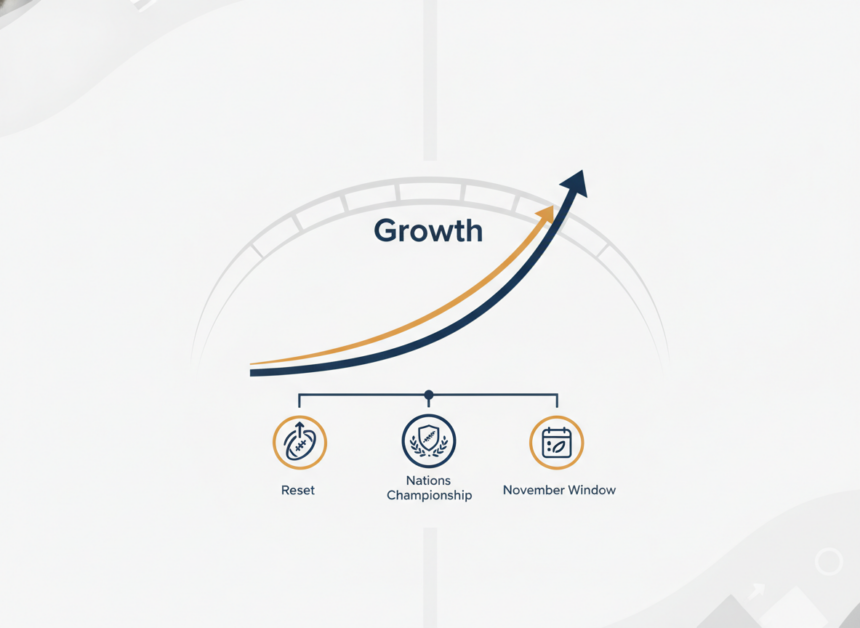
The Northern Hemisphere Series starts on Friday, November 6, 2026, when the six Southern Pool teams travel north for their last three pool matches. Because the July rounds were played in the south, the northern unions now hold home advantage for the decisive half of the pool stage. Consequently, Northern Pool teams that struggled on tour, including England after Johannesburg, have a realistic chance to recover in front of home crowds.
Finals Weekend: November 27–29
Finals Weekend packs six ranked matches into three days of double-headers at Allianz Stadium, Twickenham. Teams are ranked 1 to 6 within their pools by aggregate points from July and November, and then paired by position: 6th North vs. 6th South, 3rd North vs. 3rd South, and so on. The Grand Final between the top Northern team and the top Southern team takes place on Sunday, November 29, 2026.
This structure fixes the old problem of the autumn series ending without a conclusion. Every team plays a final-weekend match with ranking value. According to an October 2026 ticketing guide from Goal.com, tickets for all six final matches are being sold through priority windows.
Why London Matters
London hosts all six finals, which concentrates commercial demand on one venue over one weekend. Placing the Grand Final at Twickenham uses the largest dedicated rugby stadium in the Northern Hemisphere and London’s international travel links. As a result, travelling supporters from the Southern Pool nations can plan one trip that covers several matches.
The Second Tier: World Rugby Nations Cup 2026
The inaugural World Rugby Nations Cup is running at the same time as a 12-team competition for developing rugby nations. Participants include Canada, Chile, Samoa, Tonga, Uruguay and the USA, according to the competition’s Wikipedia entry. The Nations Cup also started in July, with early wins for Georgia, Samoa, Chile, Tonga and the USA.
The Promotion and Relegation Debate
There is no promotion or relegation between the two tiers in 2026, which has drawn criticism from Tier 2 advocates. World Rugby has said that movement between tiers will be introduced later, with 2030 as the expected timeline.
The reasoning is financial. A closed top tier gives the 12 participating unions predictable broadcast and commercial income while the format is being established. The drawback is that Georgia, which is among the strongest teams outside the top 12, has no route into the Nations Championship this cycle however well it performs. That gap between merit and access is the main structural criticism of the 2026 edition.
The Economics of the Reset
Selling the July and November windows as one product has produced a more valuable broadcast and commercial property than the old standalone tests. Broadcasters now buy a story with a defined ending instead of a set of unrelated friendlies, which strengthens the unions’ position in rights negotiations.
Ticketing and Hospitality Demand
Premium demand has risen because the matches now matter in the standings. Coverage from England Rugby and travel packages from Gullivers Travel show strong interest in the November pool games and the London Finals Weekend. The RFU and other northern unions have reported heavy early-access sales.
The effect of competitive stakes is direct. A supporter has more reason to pay hospitality prices for a match that decides a finals seeding than for an end-of-season friendly. Ticket guides such as Live Rugby Tickets and Autumn Internationals list November fixtures as the main draw of the international season.
Frequently Asked Questions
When does the November window of the Nations Championship start?
The Northern Hemisphere Series begins on Friday, November 6, 2026. The six Southern Pool teams (Argentina, Australia, New Zealand, South Africa, Fiji and Japan) travel north to play their last three pool matches against the Six Nations sides. The pool stage then leads into Finals Weekend at Allianz Stadium, Twickenham, from November 27 to 29.
How are Finals Weekend matchups decided?
Teams are ranked 1 to 6 within their pools by aggregate points from July and November, then paired by position. First North plays first South in the Grand Final on Sunday, November 29, and the remaining pairs line up the same way, down to 6th North vs. 6th South. Because every team plays on Finals Weekend, each match there affects final rankings.
Who are the leading players after July?
France’s Maxime Lucu leads the scoring with 37 points, and New Zealand’s Will Jordan leads the try count with six. Lucu’s total comes mainly from goal-kicking in tight contests. Jordan scored his six tries in three rounds. Both totals can change during the November window and Finals Weekend, so the individual awards are still open.
Is there promotion or relegation in 2026?
No. The 2026 edition has no promotion or relegation between the Nations Championship and the World Rugby Nations Cup. World Rugby has said a movement mechanism will come later, with 2030 as the expected timeline. Supporters of developing nations have criticised the closed structure, while the top 12 unions gain financial stability during the launch phase.
Which teams play in the World Rugby Nations Cup?
The Nations Cup is a 12-team second-tier competition that includes Canada, Chile, Samoa, Tonga, Uruguay and the USA. It began in July alongside the main tournament. Georgia, Samoa, Chile, Tonga and the USA recorded early wins. The competition is meant to give developing nations regular meaningful fixtures ahead of the planned introduction of promotion and relegation.
Limitations of This Briefing
Research limitations: This article covers data up to October 26, 2026, and reflects Rounds 1–3 only. Verified current pool standings and full November fixture details were not available in our source material, so we have not projected Finals Weekend pairings. Some sources are commercial ticketing and travel sites, which have an interest in promoting demand.
Alternative approaches: Readers who want live standings, bonus-point details or match-by-match breakdowns should use World Rugby’s official tournament channels and their national union’s site, which update after each round.
Professional consultation: Before buying Finals Weekend tickets or hospitality packages, check pricing, priority-window eligibility and resale terms directly with the official vendor or the RFU. Secondary-market prices and conditions differ widely.
Conclusion
The Nations Championship 2026 has changed international rugby by giving July and November tests a direct effect on a final outcome. The July window showed the result: 641,550 spectators, 161 tries, and two matches settled by two points. Because aggregate points decide the finals pairings, the November matches from November 6 onward will matter more than any autumn series in recent memory.
The open questions are structural. Australia has to win away from home to rebuild its campaign. England has home advantage after its loss in Johannesburg. Tier 2 nations will keep pressing for promotion and relegation before 2030. By the evening of Sunday, November 29, Twickenham will host the first unified champions of global rugby, and the result will shape how the 2028 edition is viewed.
Follow INQ Daily for concise coverage of the November window, Finals Weekend results and the wider business of international sport.
References
- Live Rugby Tickets. Nations Championship ticketing information (2026). liverugbytickets.co.uk
- Goal.com. How to get World Rugby Nations Championship 2026 tickets: Finals Weekend schedule, Twickenham ticket prices and more (October 2026). goal.com
- Read Rugby Union. Nations Championship coverage (2026). readrugbyunion.com
- Gullivers Travel. Rugby travel and hospitality packages (2026). gulliverstravel.co.uk
- Live Rugby Tickets. Finals Weekend ticket guide (2026). liverugbytickets.co.uk
- Wikipedia. Nations Championship (rugby union) (2026). wikipedia.org
- Sportstralia. Wallabies Nations Championship coverage (2026). sportstralia.com.au
- Autumn Internationals. November 2026 fixtures and tickets. autumn-internationals.co.uk
- England Rugby. Nations Championship ticketing updates (2026). englandrugby.com
- World Rugby. Nations Championship tournament information (2026). world.rugby
- Wikipedia. World Rugby Nations Cup (2026). wikipedia.org
- World Rugby. World Rugby Nations Cup and competition structure (2026). world.rugby