
Table of Contents
- The numbers in one place
- What UNHCR said, and why the warning came now
- Why registration decides access to food, health care and school
- How refugee registration works in eastern Chad
- What an unregistered household loses
- What is driving the twentyfold increase in arrivals
- From the Darfur offensive to the Chad border: the sequence
- The funding gap behind the registration backlog
- Conditions in eastern Chad
- What happens next
- How to help and where to follow the story
- Organisations operating in eastern Chad and the data portals that track them
- Frequently asked questions
- How reliable are these figures, and what the reporting cannot tell you
- Caveats on the figures in this article
- The bottom line
- References
- Related Reading
GENEVA / N’DJAMENA — 14 October 2026
Key takeaway
- UNHCR reported in October 2026 that roughly 319,000 refugees in Chad are waiting to be registered, most of them Sudanese.
- Monthly arrivals at the eastern border rose about twentyfold against the earlier monthly rate, driven by fighting in North Darfur.
- Without registration there is no documentation, which means no verified access to food rations, health care or school enrolment.
- The backlog is a funding problem as much as a conflict problem: UNHCR’s Chad appeal remains far short of requirements.
- Chad hosts more Sudanese refugees than any other country neighbouring Sudan, concentrated in four eastern provinces.
About 319,000 Sudanese refugees in Chad and other arrivals remain unregistered, the UN refugee agency said in its October 2026 warning on the Chad operation, published on UNHCR’s Chad country pages and reported by UN News. Monthly arrivals at the eastern border rose roughly twentyfold against the earlier rate this year. Because registration is the step that produces documentation, and documentation is what unlocks assistance, those households sit outside the systems that deliver food, clinical care and school places.
The warning landed now because two pressures converged: arrival volumes outran registration capacity at the same time as a severe funding shortfall constrained staffing and support programmes. Two threads run through what follows — figures as reported by the agencies, and this publication’s own analysis, which is signposted where it appears.
About this reporting. Compiled by the INQ Daily world affairs desk from UN agency briefings, operational data portals and NGO field updates, all linked in the References section. INQ Daily has not conducted on-the-ground reporting at the Chad–Sudan border for this article.
Transparency note. Figures in a live displacement emergency are revised continuously. Every number below carries an as-of date and a source. Where a figure is not published by a primary source, this article states that rather than estimating it.
The numbers in one place
The headline figures for Sudanese refugees in Chad, as reported by UNHCR and tracked by IOM and OCHA, sit in the table below. One distinction matters before reading it: the registration backlog is a subset of the refugee population already present in Chad, not an additional group on top of it. Several summaries of the October briefing have treated the 319,000 as new arrivals, which it is not.
| Indicator | Figure | As of | Source |
|---|---|---|---|
| Refugees in Chad awaiting registration | ~319,000 | October 2026 | UNHCR briefing |
| Share of the backlog that is Sudanese | Majority, per UNHCR framing | October 2026 | UNHCR briefing |
| Change in monthly arrivals, eastern border | ~20x the earlier monthly rate | 2026 | UNHCR briefing |
| Sudanese refugees hosted in Chad (total) | See live figure | Updated continuously | UNHCR Operational Data Portal |
| Chadian returnees and third-country nationals | See live figure | Updated continuously | IOM DTM Chad |
| UNHCR Chad appeal requirement, 2026 (US$) | Not stated in the October briefing | — | OCHA FTS |
| Funding received against the appeal (US$ and %) | Not stated in the October briefing | — | OCHA FTS |
| Provinces hosting the largest arrivals | Ouaddai, Wadi Fira, Sila, Ennedi Est | 2026 | UNHCR, IOM DTM |
Read together, the figures point to one conclusion: a backlog on this scale is not evidence that people are being turned away at the border, because they are already inside Chad and physically counted. The binding constraint is processing capacity. Totals are revised weekly as teams work through cases, therefore the live portals cited at the end carry more current values than any article can.
What UNHCR said, and why the warning came now
The UN refugee agency warned in October 2026 that more than 300,000 refugees in Chad risk losing access to basic services amid a funding crisis, citing delays in registration that leave people without the documentation needed for food, health care and education. The agency put the figure at 319,000 and said the shortfall also threatens protection work and self-reliance programming, according to UN News coverage of the briefing.
Analysis. The escalation was driven by money rather than by a single new arrival spike, because UNHCR had already absorbed earlier waves through 2025 and 2026 without a public warning of this kind. Once registration, protection and livelihoods were all exposed simultaneously, the agency had no operational lever left and went public. Consequently the October statement should be read as a budget signal to donors, not as a border alert.
Why registration decides access to food, health care and school
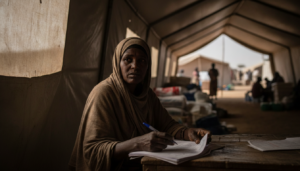
Registration is the process by which a host government and UNHCR record who a person is, where they came from and who travels with them, then issue documentation confirming that record. In Chad it is conducted jointly with the national refugee commission, CNARR, which is why the backlog is a shared government–agency bottleneck rather than a purely UN one. Biometric registration adds fingerprints and iris scans to that record; agencies use it because it prevents duplicate ration claims and allows a lost card to be replaced without re-profiling the whole household. For Sudanese refugees in Chad, that card is the practical difference between being inside and outside the assistance system.
How refugee registration works in eastern Chad
- Arrival and screening at a border or transit site such as Adre.
- Level 1 emergency recording: household headcount and a basic profile.
- Individual biometric enrolment of each household member.
- Issue of documentation and a ration or assistance card.
- Transfer and allocation to a camp or hosting site, with referrals to services.
Because food distributions, clinic referrals and school enrolment are all keyed to a verified individual record, an unregistered household is effectively invisible to those systems. As a result families either go without or draw on rations shared by registered relatives, which lowers per-person intake across an entire site even where the total tonnage delivered has not changed.
What an unregistered household loses
- General food distribution and cash transfers tied to a verified ration card.
- Primary health care referrals and nutrition programme enrolment for children.
- School registration, which requires documentation for a place and for exam entry.
- Legal protection documents that establish lawful stay.
- Family tracing and access to self-reliance or livelihood programmes.
What is driving the twentyfold increase in arrivals
The increase is driven by the escalation of fighting in North Darfur, centred on El Fasher and the settlements around it, which pushed civilians west because the routes toward Tine and Adre were the ones still passable. UNHCR has tied the surge in monthly arrivals directly to that fighting in its October 2026 statements on the Chad operation.
From the Darfur offensive to the Chad border: the sequence
- Fighting tightens around El Fasher, cutting supply routes into North Darfur’s largest remaining urban centre.
- Displacement camps around the city empty as residents move west and south.
- Reports of mass violence trigger a second, larger movement out of the area.
- Arrival volumes at Adre and Tine jump, overwhelming transit-site capacity.
- Onward transfer to camps slows, so arrivals accumulate at border sites awaiting registration.
Analysis. Arrivals concentrate at a small number of crossings, therefore registration capacity has to be concentrated at the same points — which means a staffing shortfall at one site translates immediately into a national backlog figure. Field updates from MSF in Chad and flow monitoring by IOM’s Displacement Tracking Matrix also describe a profile weighted toward women, children and the injured. That shift raises per-case processing time, because unaccompanied children, survivors of violence and medical cases each require referral steps that a healthy adult arrival does not.
The funding gap behind the registration backlog
UNHCR’s October 2026 warning rests on an arithmetic problem: the Chad operation’s requirements for the year exceed what donors have provided, and the agency has said the shortfall is what puts registration, protection and self-reliance work at risk. This article does not quote a percentage-funded figure, because the value changes with every pledge and with reporting lags; the current position for the Chad plan is published on OCHA’s Financial Tracking Service.
The consequences the agencies themselves name follow directly from that gap. Fewer registration teams and biometric kits reduce daily throughput, which lengthens the backlog. Reduced funding has squeezed self-reliance and livelihood programming, which pushes households back onto full dependence on distributions. And ration levels follow pledges: WFP’s Chad operation has reduced food baskets below full entitlement in previous funding cycles, and food insecurity classifications for eastern Chad published by the IPC show the host region has little slack to absorb the difference.
This publication’s assessment. Registration is cheap relative to the assistance it unlocks — it is clerical work with equipment costs, not a supply chain. Underfunding it while continuing to fund camps is therefore a false economy: donors are paying for aid while withholding the administrative step that makes that aid deliverable to the people counted in it.
Conditions in eastern Chad
The great majority of Sudanese refugees in Chad are concentrated in four eastern provinces, with Adre in Ouaddai the single largest entry point. Adre now functions as both a crossing and a de facto settlement, because onward transfer has slowed — which means transit infrastructure built for days of use is carrying populations that have stayed for months.
| Province | Main sites | Approximate refugee population | Primary pressure point |
|---|---|---|---|
| Ouaddai | Adre, Farchana area | See UNHCR portal (live) | Transit site used as settlement |
| Wadi Fira | Iriba, Tine corridor | See UNHCR portal (live) | Northern arrival route capacity |
| Sila | Goz Beida area | See UNHCR portal (live) | Camp absorption and services |
| Ennedi Est | Northern crossings | See UNHCR portal (live) | Remoteness and supply distance |
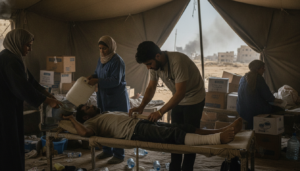
Populations by province are published and revised on the UNHCR Operational Data Portal. Beyond headcounts, the recurring field constraints reported by UN agencies and MSF are water supply per person, shelter still built from plastic sheeting, and acute malnutrition detected through screening of children under five. The host-community effect compounds all three: eastern Chad’s own population already faces food insecurity under IPC analysis, therefore arrivals compete for firewood, water points, grazing land and clinic hours, which drives localised tension in exactly the districts carrying the largest caseloads.
What happens next
If biometric teams and equipment are restored to earlier staffing levels, the backlog clears on a timescale measured in months, because registration throughput scales almost linearly with team numbers. If they are not, documentation gaps harden: a cohort of children misses enrolment and examination windows entirely, and that exclusion is not recoverable by a later funding increase.
Funding decisions set the second variable. Ration levels and programme coverage follow pledges with a lag of roughly one quarter, which means commitments made in the closing months of 2026 and in the 2027 appeal cycle largely determine what is distributed in the first half of 2027. The decision point is now, not when the shortfall becomes visible in the camps.
The third variable is the conflict itself. Large-scale voluntary return is not a near-term outcome while Darfur remains contested, and resettlement from Chad to third countries covers a fraction of a percent of the caseload. Therefore the realistic planning assumption is a protracted presence, which argues for including refugees in Chadian schools, clinics and labour markets rather than financing indefinite camp maintenance.
How to help and where to follow the story
Readers asking how to help Sudanese refugees in Chad have two practical routes — funding agencies already operational in the east, and following the live data rather than the headline figure. Unearmarked donations move faster because agencies can allocate them to registration, which is chronically underfunded relative to food and shelter.
Organisations operating in eastern Chad and the data portals that track them
- UNHCR — registration, documentation and protection; Chad operation and donation pages.
- WFP — general food distribution and cash transfers for refugees and host communities.
- MSF — clinical care at border and camp sites.
- IOM Displacement Tracking Matrix — arrival and flow figures.
- UNHCR Operational Data Portal — caseload by country and province.
- OCHA Financial Tracking Service — appeal requirements against funding received.
For continuing coverage of the Sudan emergency and its regional spillover, follow INQ Daily’s world affairs coverage.
Frequently asked questions
How many Sudanese refugees in Chad are unregistered?
About 319,000 refugees in Chad were awaiting registration as of UNHCR’s October 2026 warning. The agency says the majority are Sudanese arrivals displaced from Darfur. The figure is a subset of the refugees already present in the country, not an additional group, and it is revised as teams process cases.
What does it mean when UNHCR says arrivals surged twentyfold?
Monthly arrivals at Chad’s eastern border rose to roughly twenty times the earlier monthly rate. It is a rate comparison between two periods in 2026, not a cumulative total. The baseline matters: a low starting rate produces a dramatic multiple from a large but finite absolute increase in people crossing.
Why can’t UNHCR register refugees fast enough?
Because arrival volumes outran staffing and biometric equipment at the same time as funding fell. Three constraints bind: trained registration staff, biometric kits, and transfer capacity from border sites to camps. Registration is a per-person process, therefore daily throughput is fixed by team numbers rather than by willingness to register people.
What services do unregistered refugees lose access to?
Food distributions, health referrals, school enrolment, legal documentation and livelihood programmes. Each is keyed to a verified individual record, which means an unregistered household is invisible to the distribution system. Families typically survive by sharing rations with registered relatives, lowering per-person intake across the whole site.
Where in Chad are Sudanese refugees arriving?
Overwhelmingly through the eastern border, with Adre in Ouaddai province the largest entry point, alongside Tine in Wadi Fira. Sila and Ennedi Est host further caseloads. Adre has become a settlement as well as a crossing, because onward transfer to camps has slowed and arrivals accumulate there.
How much funding does UNHCR need for the Chad operation?
UNHCR has not published the 2026 requirement and funded percentage in the October briefing text itself; both sit on OCHA’s Financial Tracking Service and UNHCR’s funding pages. The agency states the unfunded portion covers registration teams, protection staffing and self-reliance programmes — the three areas it named as at risk.
Why are people still fleeing Darfur in 2026?
Because fighting in North Darfur intensified around El Fasher, displacing civilians from the city and the camps surrounding it. UNHCR links the arrival surge directly to that escalation. With routes north and east closed or dangerous, westward movement into Chad became the only available option for many households.
Is Chad the largest host of Sudanese refugees?
Chad hosts more Sudanese refugees than any other country neighbouring Sudan, according to UNHCR’s operational data. Egypt, South Sudan, Libya and Ethiopia host substantial caseloads as well, and the country ranking is published on UNHCR’s Sudan situation portal, where figures are updated continuously as registration proceeds.
What happens if the registration backlog is not cleared?
Exclusion becomes structural. Children miss enrolment windows and examination cycles; households remain outside food and cash systems; and protection risks rise, because undocumented people are more exposed to arrest, exploitation and forced movement. The outcome depends on registration staffing levels and on 2027 funding commitments made during this quarter.
How can readers help Sudanese refugees in Chad?
Donate to agencies already operational in the east — UNHCR, WFP and MSF — preferably without earmarking, because unearmarked funds can be directed to registration, the least-funded link in the chain. For verified updates rather than headline figures, use UNHCR’s Operational Data Portal and IOM’s Displacement Tracking Matrix.
How reliable are these figures, and what the reporting cannot tell you
Figures for displacement into Chad come from different methods with different error profiles. Biometric registration produces verified individual counts. Border monitoring produces flow estimates. Site assessments produce headcount approximations. As a result, totals published by UNHCR, IOM and government bodies on the same day will not match exactly, and a discrepancy between them is usually a methodological difference rather than an error.
The gaps are worth stating plainly. The unregistered population is, by definition, incompletely profiled. Circular cross-border movement is difficult to measure. Mortality and sexual-violence data from inside Darfur cannot be independently verified from Chad. This publication has not reported from Adre for this article and relies on agency briefings and portals, all linked.
Caveats on the figures in this article
- Backlog totals change weekly as teams process cases, so any figure is a snapshot with an as-of date.
- Arrival “surge” multiples depend on the baseline period chosen and are not cumulative totals.
- Funding percentages shift with each pledge and with reporting lags in OCHA FTS.
- Province-level populations include returnees and third-country nationals in some datasets but not others.
- Conditions reported from inside Darfur rest on survivor testimony and remote monitoring.
The bottom line
The constraint on assistance in eastern Chad is administrative, not logistical. Roughly 319,000 people are physically present, counted and reachable, but lack the record that unlocks food, health care and a school place. The registration backlog is therefore the single most consequential bottleneck in the operation.
Because registration costs a fraction of the assistance it enables, the funding shortfall produces a disproportionate loss of service delivery. Donor decisions over the next two quarters set ration levels and school enrolment for the first half of 2027, which means the window to change that outcome is open now.
Three indicators are worth watching: weekly backlog figures on UNHCR’s portal, funding percentages on OCHA FTS, and arrival volumes at Adre in IOM’s flow monitoring.
Last updated: 14 October 2026.
References
- UNHCR — Chad operation page and October 2026 briefing notes on registration delays and the funding shortfall: https://www.unhcr.org/countries/chad
- UNHCR Operational Data Portal — Sudan situation, live caseload by country and province: https://data.unhcr.org/en/situations/sudansituation
- UN News — coverage of the October 2026 UNHCR warning that over 300,000 refugees in Chad risk losing access to basic services: https://news.un.org/
- OCHA Financial Tracking Service — appeal requirements against funding received: https://fts.unocha.org/
- WFP — Chad country page and emergency updates on ration levels: https://www.wfp.org/countries/chad
- IOM Displacement Tracking Matrix, Chad — arrival flows and returnee counts: https://dtm.iom.int/chad
- IPC — food security and acute malnutrition analyses for Chad and Sudan: https://www.ipcinfo.org/
- MSF — field updates from eastern Chad: https://www.msf.org/chad